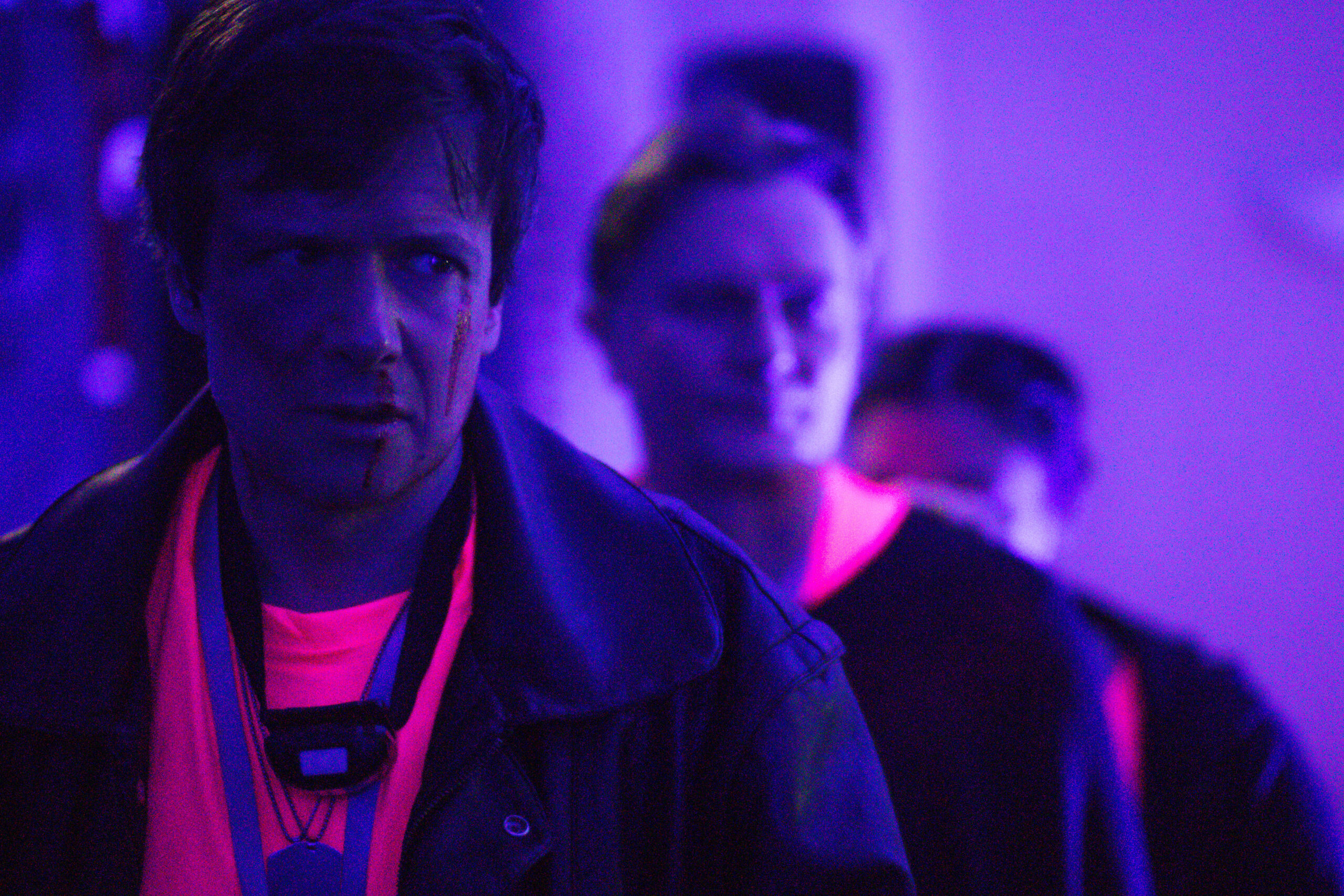
SOMA is a larp about intense human connection in a hopeless world, about people finding each other in the dark, even as they slowly lose themselves. This review covers the first international run of the LARP (following a beta test and a French run) in March 2026.
Setting
SOMA, which is according to the main organizer JC Larpin inspired by larps like Baphomet and Lotka-Volterra, is a post-apocalyptic dystopian larp set seven years after an alien species, the Xenos, conquered Earth. Humanity has largely been enslaved or wiped out. The survivors either endure a harsh, tightly controlled existence in underground complexes or struggle to survive in the wastelands, “The Zone”, above ground.

Photo by JC Larpin.
The resistance against the Xenos has managed to capture and repurpose some of the Xenos’ giant war machines: the so-called SOMAs (Symbiotic Organic & Mental Alignment). These four machines can only be operated by units of four pilots (so each pilot operates one of the SOMAs), and crucially, they function better the closer those pilots are to each other, emotionally as well as physically. This makes intimacy a central strategy of survival for the SOMA pilots.
But operating those giant extraterrestrial robots comes at a cost. The deeper you connect, both to your unit and to your SOMA, the more your sanity begins to erode. The participant guide of the larp is very clear about it: there is no happy ending possible. Your character will end up dead, insane, or somewhere in between. What SOMA explores is not how to avoid that fate, but what happens in the meantime, how people still reach for each other, love, argue, fight, get close, even when everything is falling apart.
Design & Structure
SOMA is a small larp with only sixteen participants, supported by an almost equal number of organizers. Each unit of four participants is accompanied by two dedicated organizers who are deeply embedded in the play. They take on multiple roles, like therapists, command staff, the SOMAs themselves and the so-called “shadows.” This creates a highly intense experience where you are constantly seen, constantly supported, and constantly engaged with on a very personal level.

Photo by JC Larpin
The larp follows a tightly structured loop of repeating sequences: X-Convergence (intimacy development) sessions, missions, psychological evaluations, and moments of rest, occasionally interspersed with special scenes like parties, guard duty, or alarm situations. At first glance, this schedule can feel restrictive, almost overwhelming in its density. But in practice, it creates a very effective rhythm, a pressure cooker that still allows space to breathe. The intensity comes in waves, not as an unbroken wall, and I never felt that the structure prevented meaningful character play. On the contrary, it enabled it.
Standout Design Elements
Creating Artificial Intimacy
At the heart of SOMA lies the concept of artificial intimacy. During X-Convergence, guided by in-character therapists, the unit undergoes structured exercises designed to build closeness quickly between people who have only just met. These exercises range from conversations about emotions or the former life of the characters to more physical or emotionally confrontational interactions, like letting oneself fall into the hands of the others or pointing out who is the biggest obstacle to a deep, intimate connection. While the exercises are framed as benevolent attempts to help the unit function better (the resistance system is not per se an oppressive one), they can also become deeply uncomfortable or challenging.

Photo by JC Larpin.
What surprised me most here was how well creating artificial intimacy worked. I went into the larp eager to play around that subject while being highly sceptical about the idea that creating artificial intimacy is possible – and still found myself genuinely experiencing it. At one point, I realized that I had been ready to play a character who would fail at this process, only to discover that, within the fiction, the intimacy had become real enough to matter for the character I played.
Shadow-play
If I had to choose one mechanic that stood out the most, however, it would be the shadows. Each participant is accompanied by shadow figures, played by the organizers, who embody intrusive thoughts, fragments of memory, the voice of the designated SOMA or people from the character’s past. They whisper in your ear, interact with you physically, dance with you during parties and constantly push you – sometimes gently, sometimes mercilessly – exactly where it hurts most.
These interactions often felt incredibly cinematic, like being inside a film where your inner voice drowns out everything else. Over time, the presence of the shadows becomes so constant and intimate that their absence after the larp is almost jarring. I found myself genuinely missing them.
Mission Design Featuring VR
The mission design is another highlight. Combat is represented through VR, but not in a way that turns the larp into a test of participant skill. Instead, the VR serves as an immersive layer on top of collaborative storytelling. What happens in the mission is decided by the participants and the unit dynamic, not by how good you are at gaming. The result is action that actually carries emotional and narrative weight, rather than distracting from it.

Photo by JC Larpin.
I experienced those mission sequences as both able to release some pressure, to have some action and fun as the character (and of course also as participant) as well as creating new conflicts, messing things up and developing interesting connections with the character of their own SOMA. It reminded me of the fighting sequences of The Ultimate Football League, another larp by JC, which had a similar approach and purpose, even if not done via VR but through slow-motion fighting. In my experience, those sequences provide a great framework for action-loaded play while staying deeply in the narrative of the larp and enhancing it.
Audio and Lighting Design
Insanity and hallucinations are woven into the experience through audio design and visual cues, marked by red light. These moments blur the boundaries between individuals, intensify emotional states and sometimes push scenes into in-character deeply uncomfortable territory – of course in a way that is out-of-character intentional, controlled and consented to. They can be destructive, overwhelming and strangely liberating at the same time.
E.g. at one point, one of my character’s psych evaluation sessions turned into a nightmare hallucination, with her therapist telling her all her fears and doubts were true, she was not worth being a pilot, while her SOMA (through shadow-play of an organizer) got aggressive and almost strangled her to death. The red lightning and audio cues made it completely clear that this was a scene out of the ordinary reality of the character and allowed easily to play on it as an overwhelming hallucination.
Co-Creation
Finally, the larp relies heavily on co-creation. Characters are not fully predefined but developed collaboratively beforehand. Participants are invited to answer questions, shape relationships and contribute material that the organizers later integrate into the experience, for example through personalized audio. This does require some preparation, but the expectations are flexible and even minimal input is enough to engage with the larp.
Practicalities
From a practical perspective, SOMA is very clear about what it offers – and what it does not offer. The location is remote, several hours south of Paris, and the accommodation is simple: shared dorms, limited facilities, no luxury. Food during the larp is intentionally minimal and immersive, consisting of rice waffles and instant noodles, and participants are strongly encouraged to bring additional supplies.
At the same time, the event is remarkably affordable. At 150 euros, it is the cheapest international larp I have ever attended. The trade-off between comfort and cost is very transparent, and in my view, quite fair.
The larp runs for roughly one and a half days, from Friday afternoon to Saturday evening, followed by cleanup on Sunday, which is a required part of participation. The rather short runtime and the tight schedule makes it a quick paced larp where you won’t ease slowly into the setting or spend time in everyday scenes (like in a slice-of-life larp). It is structured, intense and focused from beginning to end.
Safety
Given the themes of intimacy and psychological intensity, safety is handled thoughtfully. There are clear boundaries communicated in advance, including the exclusion of certain topics, as well as established safety mechanics like traffic light system, check-in and look-down plus short calibration breaks before the missions. These tools are actively encouraged to use by the organizers.
Through the encouraged pre-larp online talks and the workshops it was possible to create a safe and brave space; I felt it was especially easy through the small number of participants and the transparent communication from the organizers both in the online participant guide before the larp as well as during the whole larp.
My Play Experience
For me, SOMA was an extremely intense, deeply emotional and ultimately cathartic experience. I played a character who was already mentally unstable when she entered the base: a former Xeno slave, fragile and dangerous at the same time, carrying the fear that she might already be compromised by the enemy.

Photo by JC Larpin.
Over the course of the larp, I found myself in a position where my character was repeatedly blamed for failures within the unit, even as she tried to make things work. That dynamic – being treated as the problem while genuinely trying – became one of the most powerful emotional threads for me. It created moments of rejection, betrayal and isolation that felt very real, but at the same time entirely safe, because the unit was always forced back together in-character, the out-of-character environment was clearly supportive and there were also always close connections outside the unit to fall back to – in addition the shadow play made real isolation impossible. I consider it rather remarkable that heavy topics like rejection and isolation, that a lot of larpers generally avoid for a good reason, were playable in an enjoyable and play-enhancing way at this larp.
There were many moments that stayed with me: going on a solo rampage with my character’s SOMA whispering encouragement and chaos into her ear, having all of her unit plus some more people lying on her to hold her down and quiet during a panic attack in an alarm situation or facing moral dilemmas that forced my character into choices that broke her emotionally.
By the end, I felt deeply connected to my unit, the shadows and the experience as a whole.
Who Is This Larp For?
SOMA is a larp for participants who actively seek intensity. It works best for those who enjoy emotionally charged play, close interpersonal dynamics and a certain level of structure and direction. It is particularly well suited for participants who are interested in exploring intimacy, conflict and psychological pressure within a safe framework.
At the same time, it is probably not the right fit for participants who prefer slow pacing, long stretches of introspection or more open, sandbox-style environments. The larp does not offer much downtime and while there is some space to breathe, it is rather scarce and always within a larger, tightly guided structure.
Final Verdict
SOMA is an intense, tragic and beautifully crafted larp about connection in the face of inevitable collapse. It is not comfortable, not slow and not gentle – but it is deeply rewarding for those who are looking for intensity, emotions and close play with others.
If you are interested in exploring intimacy, breakdown and the fragile ways in which people hold on to each other when everything else is lost, this is a larp I can wholeheartedly recommend.
Larp Name: SOMA
Designer(s)/Studio: JC Larpin
Dates: 12–15 March 2026
Location: Gîte du Plou, France
Organizers: JC Larpin & team
Price: EUR 100/150/200
Website: https://soma-larp.mystrikingly.com/
Cover image: Photo of SOMA larp, by JC Larpin
