Author: Evan Torner

  • Pandemic Larp Improvisation

    Published on

    in

    Pandemic Larp Improvisation

    By

    Evan Torner

    Larp organizers have learned a thing or two about organizing scenarios. How have we applied those skills during the COVID-19 pandemic?

    If nothing else, larping means engagement. Players invest themselves in bringing made-up characters to life, mapping a fictional world onto our real world. During the ongoing COVID-19 pandemic of the past several years, engagement became a scarce commodity.

    Every organization, be it schools or businesses or governments, wanted to re-engage with its constituency who, through pandemic isolation and general neoliberal precarity, had understandably become detached from society and lacked the necessary motivation to do most activities of institutional benefit. You know: all of us.

    Ironically, just as we ourselves as larpers could no longer gather – since our events are natural super-spreaders of any number of diseases, including COVID-19 – my own larp expertise began to be called upon as an asset and skillset. I started getting messages from Fortune 500 companies and major news outlets about this thing called “larp,” which could then be leveraged to win back – you guessed it – engagement from their customers, students, and volunteers.

    My tales of pandemic-era collaborations in non-larp and larp-adjacent contexts highlight both the very special medium (of larp) with which we work, as well as the limitations of such collaborations.

    Image of players in costume in an online video conference
    Screenshot of the crucial Zoom call in which University of Cincinnati students role-played cardinals electing a pope.

    Temptemus Papam

    The 1492 Papal Election was an absolute shitshow, and I ran it as an online larp for a history class at my university.

    The conversation began in fall 2020 when Dr. Susan Longfield-Karr in the History department at the University of Cincinnati reached out to me as Director of the UC Game Lab about running a “papal election larp” called Temptemus Papam that famous SF author and historian Ada Palmer ran at University of Chicago in 2018. I took one look at the materials as a larpwright and was overwhelmed: over 50 character sheets 6-12 pages in length, with many different overlapping subsystems for combat, intrigue, religious favors, economics, and inheritance. Hundreds upon hundreds of pages lay before me, all during a time when my own patience for this much reading was stretched to its natural limits. I agreed to do the project on one condition: I would need to substantively pare down the material and scope of the game, in addition to adapting it to a remote experience rather than an in-person one. Dr. Longfield-Karr agreed. The UC Papal Election Game was born.

    We transformed Temptemus Papam into a correspondence game, like the old play-by-mail Diplomacy runs. Over the course of 8 weeks, player-characters would exchange virtual letters with each other while sending “orders” for any character action to me. Every week, a video would be posted online with updates and the results of the previous week’s orders, giving the players a sense of agency and impact. All of these videos and the letters would be stored in a shared online folder, from which the passive players taking on the roles of historians could assemble the history of this particular election based on player-generated “primary documents.”

    Dr. Longfield-Karr and I tapped into 2 different funds available to us and hired ourselves a larp team: history student Matthew Photides made hundreds upon hundreds of shared folders to deposit letter correspondence, Erich Pfingstag made the videos, and Felicity Moran assisted with student communication. We had intrigue, kidnapping attempts, and even a few cat-and-mouse murders as letters flew.

    Several faculty playing NPCs got very involved in their characters, leading me to believe that participant safety is equally important for non-players. Two Zoom meetings let us first conduct the papal election, and then inaugurate the new pope, who turned out to be Rodrigo Borgia, the very person actually elected pope in 1492.

    Image of a computer directory with character names
    One of the many shared online folders containing letter correspondence in the UC Papal Election Game.

    D&D Speed Dating

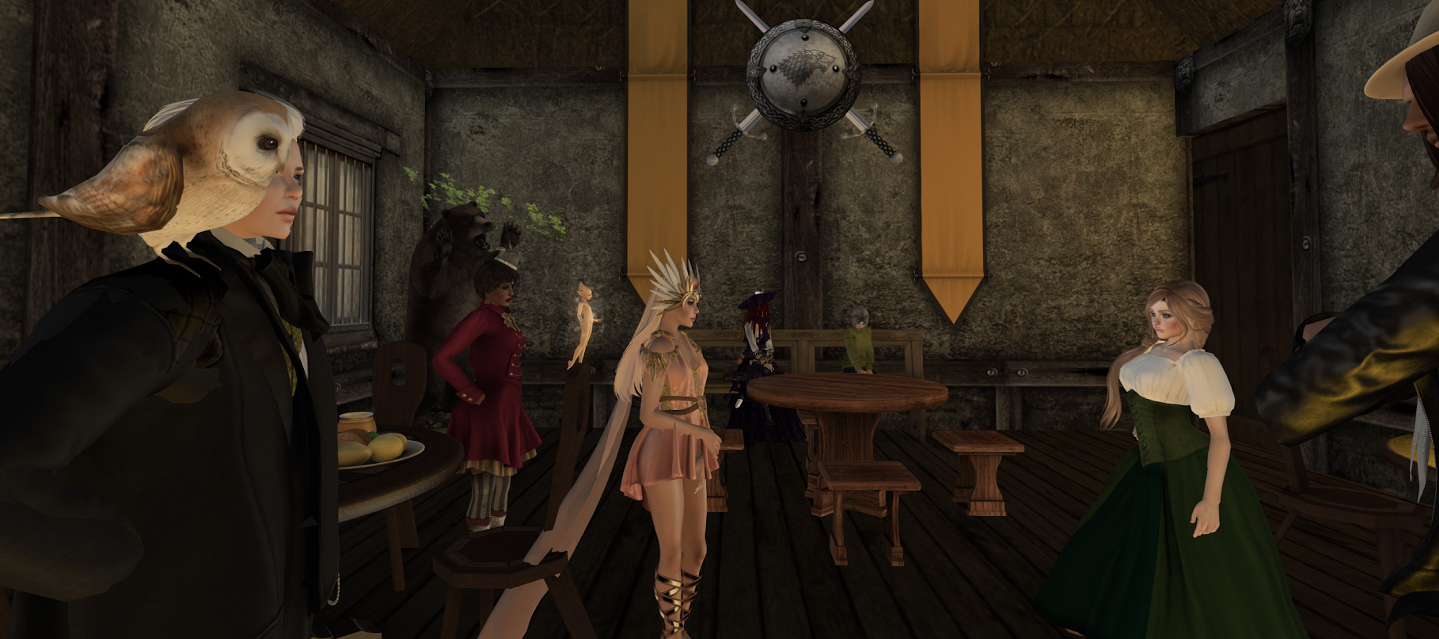
    Shared-folder correspondence was only one form of online larping I organized. Another was in the long-standing virtual community Second Life, as part of the event SLarpFest organized by Celia Pearce and Jenn Frank in 2021 at the IndieCade island. The game I ran was Marc Majcher’s First Impressions, a Dungeons & Dragons-style speed-dating larp from his book Twenty-Four Game Poems.

    The premise of the game is simple: a group of fantasy adventurers go on a series of “dates” to determine whom they’d like to include in their questing party. Players get to embody fairly basic fantasy stereotypes while also deepening their own relationships with each other –– often role-players whom they’ve just met. In-person at conventions, I can run the game for 8 people in about an hour. The reason why I run it at conventions is also the reason why it worked well in Second Life: it’s short and it helps people navigate an awkward social situation. Most of our players knew either Second Life or larp, but almost no one knew both well. They’d switch partners maybe 3 or 4 times, with me calling them back to the tavern each time.

    Players felt safe enough to experiment with their avatars and their roleplay without too much worry about the stakes or consequences. First Impressions in fact served as a “warm-up” larp for other, more intimate and serious SLarpFest games: Angel Falls, a funeral larp inspired by Wim Wenders’ Wings of Desire (1987) by Pearce, Frank, and Annika Waern, Athena Peters’ Regency matchmaking game Romancing Jan, and The Sleepover by Julia B. Ellingboe and Kat Jones from the Honey and Hot Wax anthology, which deals with teen queerness and sexuality.

    All of us at SLarpFest were veteran larp organizers, and thus understood the relationship of comfort, safety, and community-building even in an online space: seemingly “silly” games like First Impressions build the trust necessary to take further role-play risks. Many of us have been running games on Discord, Zoom, and now Second Life for several pandemic rules, and our previous in-person larp experience directly applies to building necessary trust and competence in online spheres.

    Ongoing and Upwards

    Organizing continues! Jones and I have joined the writing team for JEWEL, a 2-day interactive experience for Jewish teens in Cincinnati. We’re using the larp design toolbox to help plan an event in which the participants experience Moses’ teachings and then mourn at his funeral. JEWEL is intended to reconnect Jewish youth with the social-justice meanings and embodied nature of their beliefs. But it is also an opportunity. JEWEL lets us take part in an exciting new world of event planning, in which larp activities can be integrated into broader community events with large constituencies and deeper pockets.

    “Larping exists in various other activities besides larps,” wrote J. Tuomas Harviainen in his 2011 article “The Larping that is Not Larp.” This persistent fact is solace during a time in which we’ve all become radically separated from one another and larps themselves are endangered by logistical and pandemic-level uncertainties. Our own generation of larpwrights are now, voluntarily or not, performing what Rudi Dutschke called “the long march through the institutions”: the incorporation of larping into whatever organizations we serve, with whomever will take a chance on our vibrant and evolving form.

    These organizations have, at last, discovered that engagement isn’t to be taken for granted. We as larpwrights can now choose to engage, too.

    References

    Harviainen, J. Tuomas. 2011. ”The Larping that is Not Larp.” In Think Larp: Academic Writings from KP2011, edited by Thomas D. Henriksen, Christian Bierlich, Kasper Friis Hansen, and Valdemar Kølle. Copenhagen, Denmark: Rollespilsakademiet.


    Cover photo: SLarpFest attendees hang out in the tavern on the IndieCade island in Second Life. Photo by Celia Pearce. Image has been cropped.

    This article is published in the Knutpunkt 2022 magazine Distance of Touch and is published here with permission. Please cite this text as:

    Torner, Evan. 2022. “Pandemic Larp Improvisation.” In Distance of Touch: The Knutpunkt 2022 Magazine, edited by Juhana Pettersson, 78-82. Knutpunkt 2022 and Pohjoismaisen roolipelaamisen seura.


  • Labor and Play

    Published on

    in

    Labor and Play

    By

    Evan Torner

    Have you gone to a larp that somehow required more work than your day job? Have you done work in a larp and been compensated with fictional resources in the larp rather than money or in-kind, real resources such as shelter and food? Have you had video of your larp experience used in a commercial setting outside of the play context? While larp is in no need of a Marxian revolution, the community is in need of a reckoning with regards to players’ play being also valuable as labor.

    Let me explain.

    Modern societies operate based on a division between human activity considered “productive” — i.e., that delivers value to someone — and “non-productive,” that seems to deliver value to no one. Value is a central part of labor, and also part of play. Despite recent public discourse on the topic (Bogost 2019), few players care about the distinction between play and labor. We all understand that the line between work and play is murky in late capitalism, as evidenced by so-called “modding” culture, streaming, eSports and other “playbour” movements (Kücklich 2005). But, as Aleena Chia (2019) asserts, players do care about who is gaining what benefit at the expense of others, and whether or not they are burning themselves out in the process:

    Vocational passion energizes social, cultural, and organizational practices that create economic value for companies, yet drains workers and aspirants through class-based expectations to compromise employment security in ‘doing what you love.’

    Few play more intensely and passionately than larpers.

    This chapter continues research begun four years ago with our piece Playing At Work: Labor, Identity and Emotion in Larp (Jones, Koulu, Torner 2016), where we asserted that core larp activities — playing roles as supporting characters, pretending to dig ditches, putting up with off-putting players — involve labor during the game’s runtime. Larpers’ passion for play means a lot of work before, during, and after the game. We also introduced a three-fold taxonomy of labor during a larp: first-order labor (that which keeps players alive, beyond any system of value), second-order labor (non-survival-critical work that would otherwise be financially compensated in other contexts), and third-order labor (entirely fictional work performed with entirely fictional rewards.)

    Such research continues to accompany discussions as they evolve around a wide range of labor-related topics: the art of larp volunteering (Mutsaers 2018), in-game larp counseling and post-game debrief (Atwater 2016) as well as the range of skills that larp requires as an assemblage of practices (Kamm 2019). Our work focused on in-game labor, as pre-game and post-game labor has a different set of issues associated with them.

    It appears that structured live-action role-play with preparation, rules, and unspoken play cultures is indistinguishable from labor. When players enter the “magic circle” of play, supposedly they have entered a space in which different rules apply from social reality. Yet from the start of the game, players perform intensive work to keep the game itself afloat as well as support their own play experience. Moreover, such “playbour” may create surplus value for the players themselves or, more frequently, others. This work is inseparable from the bodies and emotions of the participants, just as play is (Keogh 2018). Using the conceptual framework of the human body, a model used in a notable film theory textbook (Elsaesser and Hagener 2010), I discuss below the varied ways in which play and work intermingle, and how players actively evolve skills not only to do this labor well, but also to effortlessly elide it from their consciousness as “play.” Relying on several examples from Nordic larp and freeform, I explore the complex relationship between play, work, the body, mind and, above all, capital.

    Hands and Feet

    Let’s begin with the hands and feet as metaphors for physical labor play, the most obvious form of playbour. Building, crafting, cleaning, cooking — there is so much to be done in a larp, and much of it can be done in-character. Olle Nyman’s post-apocalyptic larp Skymningsland (Dusk Land 2010), for example, incorporated chopping wood, making coal, pumping water and other labor-intensive jobs into the design, so as to let the refugee and marginalised characters in the game feel their lower stations in life in their very bodies. Tor Kjetil Edland and Hanne Grasmo’s five-day larp experience Just a Little Lovin’ (2011-) has a whole kitchen staff, the cooks of Pepper’s Diner, that is also in-character; they spend most of the game preparing food for the other characters, but are also able to get involved with fictional plotlines and take part in the party. The Czech game Legion: Siberian Story (2016) involves long, physical treks on foot through January snow in order to move from one location to another.

    This form of in-game, physical labor has wildly variable value, since its value as play may not be as high as its first-order contribution to the basic survival of the larpers (i.e., food preparation, custodial work, transport), but such physical activity can certainly contribute to the deepening of one’s investment into one’s character and the core themes of the larp itself (i.e., survival, hardship, labor inequality, etc.)

    It is interesting to note that psychologist Mihaly Csikszentmihalyi developed his concept of flow (1975), or the pleasurable mental states produced by a steady, voluntarily chosen set of achievable tasks and competence at those tasks, against the backdrop of Italian fascism. His family was in Italy during the chaos of war, and he was able to nevertheless maintain a stable mental state by playing chess. How do certain physical and mental activities secure our minds against fear and despair? How could both play and work be actually two sides of the same coin? Csikszentmihalyi’s schema Flow is created through concentration and effort, a revolving state of being mildly challenged and rising to meet the challenge.

    Losing track of time in the “playbour” state of larp can be a positive thing: it means the player is thoroughly engaged in activity, whatever it may be. In the larp context, Sarah Lynne Bowman (2018) calls this “immersion into activity,” or when the physical and cognitive tasks of a game become rewarding in themselves and, in turn, a player’s activity as a character becomes spatial-motor and tactile. Neither play nor labor induces flow by necessity, however. There can be play that is not remotely fun (Stenros 2015, Sharp and Thomas 2019), and there is plenty of work that serves no purpose in society other than to subjugate us with mind-numbing tedium (Graeber 2018). Players must voluntarily enter into the activities of a larp, but they’re better when conscientiously designed and implemented.

    Larp as a medium often exhibits its best side when these structured physical tasks are introduced by way of conscious design. Rather than simply standing around as if at an awkward party, players have something concrete to do that may require additional in-character problem-solving, player physical effort, and time. Larp designs that revolve around professionals performing small talk while taking care of volumes of tasks, either fictional or not, preoccupy the players with various stakes in their characters’ stories as well as brute reality. If dinner at the historical larp Fairweather Manor (2015- 2018) isn’t served by in-character servants, for example, then players do not get to eat.

    As we have argued earlier (Jones, Koulu, Torner 2016), first-order and second-order labor in larp can also cause jarring context collapse: the vital tasks that would ordinarily be compensated with money are both (A) variably or not remunerated outside the larp and (B) now mixed in with ingame drama that may interfere with the tasks themselves, forcing players to make a choice between dropping character and doing the task well or doing the task poorly (or not at all) and risking both ingame and out-of-game consequences.

    Larp play can itself produce objects of value and transaction in the open market. For example, Martin Tegelj’s game Polka Pillow Production (2018) simulates a Slovenian workers’ co-op that stuffs pillows, all while interrupting work on occasion for music and dance. The four stages of production — spinning yarn, looming the cloth, embroidering the cloth, and constructing and stuffing pillows — can be play-acted, but there is at least one group who has played the game and constructed actual pillows. Who owns these pillows? These are clearly artifacts of play, having emerged from a fictional context, and one with starkly different regimes of value (i.e., Slovenia under communist rule) at that.

    Larps that produce actual goods, even those just meant as keepsakes for their participants, have added “commodity creation” as one of the design outcomes, meaning that the play that produced them now has monetary value, scant as it may be.

    Obvious physical labor in larp thus straddles a wide range of value to the players and organizers. Ingame cooking, cleaning, and security may be vital to the larp, or entirely marginal. Tasks that players must perform in-character may create flow states, allowing the player to lose themselves and induce a positive mental state in the player or they may be distractions and liabilities that sideline play away from the larp’s core focus.

    In turn, larps may create objects with exchange value or services with use value, in which case an organizer team has an ethical obligation to their players in being transparent about who profits from those goods or services. Larps have the power to engage their participants in vigorous, meaningful physical activity, but design and play must mediate against distraction, drudgery, and economic exploitation.

    Eyes, Mouth, Ears, and Brain

    Turning next to the eyes, mouth, ears, and brain in our metaphor, we conceive of our ideal larper as someone actively investing their cognitive energy and sensory capacities in making the larp work: they are noticing details, making sense of them, and communicating about them in a certain way. Players work and create value in the larp as a whole when they pay attention to others, in particular to in-play cues. They then perform additional labor by sorting the cues and acting upon them with their full cognitive and emotional capacities.

    Almost any play advice worth mentioning will encourage players to, at bare minimum, listen to each other. Players in larps are typically not “lost” in character, but rather are constantly shifting their attention between various in-character goals, extant player needs, and just “being” in the game. This requires active awareness, or the devotion of one’s full attention to the comprehension of one’s environment and fellow players. For example, in blockbuster games such as the magic school larp College of Wizardry (2014-), whether or not someone is aware of a group of students headed off to follow a serpent spirit or is in an area cordoned off for an impromptu magic ritual can make or break multiple players’ larp experiences.

    The core skill being exercised in many games is reflective listening, or the basic repetition of material one has perceived to ensure one understands. Players do this every time they noticeably state a fellow player’s character name aloud instead of their real name: “Hi Miguel!” They are confirming “I understand you are playing a fictional entity by the name of Miguel and acknowledge you as this entity.” Reflective listening in larps also manifests with respect to all the meme-like nuggets of plot information normally circulated: “The king has a traitor in his court!” “Susanne has an illegitimate child.” “I am not actually a horse.” Larps are usually robust enough to deal with the social realities of tacit misinformation — think of how a message transforms over time during a child’s game of “telephone” — but accurately passing on the message “Stefan is not actually a horse” can have profound effects on subsequent play, due to the host of fictional triggers and social opportunities at hand in a larp.

    It turns out that paying attention and good communication are some of the most basic and valuable work skills there are. German rationalist philosopher Christian Wolff already outlined in Psychologia empirica (1732) and Psychologia rationalis (1734) the formal bases of our perception, apperception, and attention, with the goal of controlling one’s own conscious thought for as long as possible. Centuries of inquiry have been devoted to how to increase one’s self-control over one’s attention, and it is an overt commodity in the digital age (Dean 2012). 21st Century capitalist societies both require extensive intellectual work in programming, engineering, teaching, and management to survive, and also relentlessly exhaust those capacities through advertising, email, and the daily distractions of digital life. John Tierney (2001) argues that this relentless struggle over our attentive decision-making capacities is more taxing than one would think:

    No matter how rational and high-minded you try to be, you can’t make decision after decision without paying a biological price. It’s different from ordinary physical fatigue — you’re not consciously aware of being tired-but you’re low on mental energy. The more choices you make throughout the day, the harder each one becomes for your brain, and eventually it looks for shortcuts…

    Tierney, quoted in The Communist Horizon, Dean 2012

    When we larp well, we are not just good players. We are also good co-workers and employees of the larp (Saitta 2012) — we not only submit to its rules system and genre expectations, but we also watch out for fellow players and listen to the various subtleties in their expression and demeanor. Taking it all in and making in-character decisions is both the object of most games and also, as described above, substantively exhausting.

    Listening empathically to both player and character, performing emotional labor where needed (see Koulu 2020, also in this volume) — a responsibility that often falls to the already marginalized — can be part of play for certain, but also constitutes labor in the informal sense. Participatory art is thorny in this way. Cognitive and emotional load take center stage in larp design (Li and Morningstar 2016), and players self-manage their labor on this front, regardless of whether organizers do.

    One scenario I have witnessed on occasion is the labor performed by close social acquaintances of high-maintenance players. If said player regularly does not have a good time at games without playing with their acquaintances, they will likely steer their play toward these acquaintances, who suddenly have the labor of providing a decent larp experience for this player. I mention this after encountering multiple players weighing their in-game emotional labor before a large event: “If Janaki is in the larp, then that will mean they will eventually wind up playing with me, and I do not know if I can handle it this time when they suffer their typical emotional breakdown after Act II.”

    Another scenario includes players actively steering away from portions of the larp that make them uncomfortable, especially when they know someone in power might nevertheless choose not to keep them safe (Algayres 2019). Much of this labor goes unseen, but is absolutely vital for maintaining seemingly “effortless” play.

    Skin

    We turn to the metaphor of skin specifically to validate costume and beauty work as an immense portion of both pre-game and in-game player efforts, as well as the physical preparations to embody a character. Such efforts are often feminized and de-valued, something I consider every time I watch a woman apply make-up on a man’s face when he exhibits no capacity to put it on himself.

    For events that last hours, one wants a topnotch look that acceptably portrays one’s character for the evening. For events that last days, one wants a durable set of costumes that can be easily donned or taken off at the end of a larp day. And in our current era, we also need to look good for the cameras: larp photographers dart amidst us, taking hundreds of photos for perusal afterward. Sharing good photos shores up self esteem and confers social capital.

    Preparing one’s body for the portrayal of a character can prove intensive. Characterization changes one’s posture, voice, facial expressions, hand gestures, and dozens of other details that, often, only the player knows about. Characters that require cultural sensitivity to play also mean that players must balance between their own desires for the character and what is respectful and acceptable in a cosmopolitan, multicultural society; embodying the character without using harmful accents or mocking bodily movements. Costuming and make-up simply add another layer of labor on top of this. Larp costuming and make-up straddle four primary focal areas: character portrayal, comfort, durability, and overall polish, and few of these come without a financial or labor cost.To portray a character, it can take anywhere from 5 minutes to upwards of an hour to get ready for a game prior to a larp’s start time. This is not to mention all of the planning, measuring, shopping, sewing, experimentation, and touch ups required before one even sets foot on the larp site. Some larps such as the period game De la Bête (2016-) provide costumes themselves in order to achieve desired “looks” for the game; others such as Inside Hamlet (2015-) rely on players to supply their own costumes, but one needs to fit the 1930s style for an “epic party and heartbreaking tragedy.” Players scour online photo boards, consider historical fashion textbooks, and do video make-up tutorials in order to get the proper look.

    The comfort of costumes or make-up cannot be underrated as part of a player’s labor. Discomfort impacts all aspects of play, including the sheer amount of energy required to simply “be” that character. One makes oneself comfortable through a variety of means: padding, extra zippers, breathable fabrics, and lightweight materials. A heavy make-up mask that looks stunning for staged larp photos can be substituted for a lighter make-up mask for actual play. Those who have theatrical or dress-up skills that allow for such shortcuts are able to help the players who have chosen onerous costume and make-up arrangements. The same goes for costume and make-up durability: regardless of one’s monetary investment in a particular look, a player must be mindful of wearing out the elements of that look before the end of the larp. That level of care and attention to one’s materials is also labor.

    A player with an appearance that nails the character and period, looks sharp for others and the camera, and is easy to take on and take off is what Karl Marx would call “congealed labor,” in which the commodity’s effortless appearance belies how much labor went into its creation, and that it is not correspondingly valued either. And yet we also deny social capital to those nerds who just throw on a cape over street clothes and show up for a larp: they have not shown proper deference to the play of the larp through their labor, and will pay a subsequent social cost. This can vary, from exclusion from recognition in the larp itself — and thus, play — to visual absence in the post-game documentation.

    Smartphone

    Finally, I have included the smartphone as a body part, as it represents an object that is both an extension of our being and also something fully external to us. Modern smartphones represent outside forces endlessly pushing in on our lives, as well as our externalized memory and communication with the world. In our metaphorical universe of larp labor, the smartphone represents the permeability of the magic circle and the pressures of non-larp forces on our larp play. Larp as a medium demands much of its participants but generates little to no profit, as one can see from the collapse of many for-profit larp companies over the years and the struggle of even Disney’s 2019 Star Wars: Galaxy’s Edge immersive entertainment resort. Nevertheless, there are many stakeholders lurking at the edge of our play. Larp-adjacent activities such as military or search & rescue simulations are designed to teach real, testable skills and responses. Political messages can be advocated in a larp (Rantanen 2016), and larps funded through government grants may be obligated to take a particular position on a topic or on the outcome of the larp itself. Larp organizers and players are not necessarily the owners of the overall larp business which pays for the event itself, and thus labor on behalf of for-profit entities.

    It is odd to think the actual play of a larp could be financially exploited, but the 21st Century has seen to it that neoliberal financialization will creep into every activity we do. In particular, content creators on social media and video-sharing platforms, many of whom seek clicks and advertisers for revenue, now use larp as a rich trove of imagery and stories with which to provide content for a wider audience.

    Gone are the earlier days of stilted larp documentary (Torner 2011), replaced by “influencers” and media professionals making high-quality webisodes for Larp House or The Nerdist. Influencers can increase the Internet attention paid to a particular larp, and there are occasions in which their publicity labor is exchanged for perquisites such as free admission, lodging, and more. Yet the players’ playbour becomes contested terrain once the influencers’ cameras start rolling. Players are suddenly “performing” for an unknown, broadly conceived global Internet audience, and their playbour is likely to go uncompensated, despite the congealed result of their physical, mental, emotional, and cosmetic efforts. Even if organizers clearly state in the photography and video policy that their images will be circulated in such a fashion, the value being derived from the players’ play is highly suspect. Players are in theory exchanging money for not only the larp but also high-quality imagery of them in-costume and in-character, and yet in practice are providing surplus value to be extracted by others in the digital economy.

    Organizers must be mindful of the external stakeholders in the images generated by a larp, and streamers must be particularly mindful of the wishes of the players for the circulation of their larp character images online. It is hegemonic to simply ask players to be happy that they are getting high-quality images taken of them. Moreover, the labor of creating quality streaming material means, in practice, that the influencers become a separate larp within the larp with different stakes and stipulations. Players are forced to take on more labor to collaborate with or avoid such entities.

    The Whole Body

    It is not of much intellectual or social benefit to distinguish between play and work — the modern age has produced a surreal sliding scale of play that also makes its participants millions of dollars and worthless work that serves only to occupy the time of those who do it. It is, however, of great importance to recognize the value of one’s playbour as a player. Physical and/or remuneration-worthy work in a larp can be of great surplus value to the players and organizers, or not. Players who pay active attention to each other, communicate, and respond in consensual, socially acceptable ways are absolutely crucial for most larps, and are thus producing value internal to the whole operation. When we travel long distances or do uncompensated emotional counseling of fellow players, we are putting work into making the play experience better. But when we make ourselves beautiful, presentable for the camera and the outside world — beyond our own gratification and the game itself — the value of our playbour becomes increasingly clear.

    When our larp play becomes consumed vicariously — through photos, videos, or a live, ticketpaying audience — then our playbour is producing surplus value for outside stakeholders. When we actively employ it to teach a lesson or transmit a political message for some institution, our playbour now has investors seeking a particular outcome or effect, possibly resulting in the conferral or denial of future resources.

    Good play and good make-up/costuming among the players does indeed increase the larp’s value to others. Our communities can be financialized and, in doing so, our playbour alienated. One begins to think of Ilya Khrzhanovsky’s long-rolling DAU project: players staying in costume and on a set for 24 hours a day, but still being filmed for some future moving-image project.

    Above all, our players should attend to these principles:

    Your play is also labor.

    Your play has value.

    Keep track of what others do with the products and recordings of play.

    Do not subjugate yourselves.

    Bibliography

    Muriel Algayres (2019) The Impact of Social Capital on Larp Safety. Nordiclarp.org

    Brodie Atwater (2016) We Need to Talk: A Literature Review of Debrief. International Journal of Role-Playing, Vol. 6, 7-11.

    Ian Bogost (2019) Don’t Play the Goose Game
    . The Atlantic.

    Sarah Lynne Bowman (2018): Immersion and Shared Imagination in Role-Playing Games. In José P. Zagal and Sebastian Deterding (eds.), Role-Playing Game Studies: Transmedia Foundations. New York: Routledge, 379-394.

    Aleena Chia (2019): The Moral Calculus of Vocational Passion in Digital Gaming. Television & New Media, Vol. 20(8), 767-777.

    Mihaly Csikszentmihalyi (1975): Beyond Boredom and Anxiety: Experiencing Flow in Work and Play. San Francisco: Jossey-Bass.

    Jodi Dean (2012): The Communist Horizon. London: Verso.

    Thomas Elsaesser and Malte Hagener (2010): Film Theory: An Introduction Through The Senses. New York: Routledge.

    David Graeber (2018): Bullshit Jobs. New York: Simon & Schuster.

    Katherine Castiello Jones, Sanna Koulu, and Evan Torner (2016): Playing at Work: Labor, Identity and Emotion in Larp.In Kaisa Kangas, Mika Loponen, and Jukka Särkijärvi (eds.), Larp Politics – Systems, Theory, and Gender in Action. Helsinki: Solmukohta. 122-132.

    Björn-Ole Kamm (2019): Adapting Live-Action Role-Play in Japan: How “German” Roots Do Not Destine “Japanese” Routes. Re-Playing Japan 1, 64-78.

    Brendan Keogh (2018): A Play of Bodies: How We Perceive Video Games. Cambridge, MA: MIT Press.

    Julian Kücklich (2005): Precarious Playbour: Modders and the Digital Games Industry. The Fibreculture Journal 5

    J Li and Jason Morningstar (2016): Pattern Language for Larp Design

    Suus Mutsaers (2018): Designing the Volunteer Experience. Nordiclarp.org

    Teemu Rantanen (2016): Larp as a Form of Political Action: Some Insights from the Theories of Political Science Political Larps: Two Audiences. In Kaisa Kangas, Mika Loponen, and Jukka Särkijärvi (eds.), Larp Politics – Systems, Theory, and Gender in Action. Helsinki: Ropecon ry, 111-118.

    Eleanor Saitta (2012): It’s About Time. In Juhana Pettersson (ed.), States of Play: Nordic Larp Around the World. Helsinki: Pohjoismaisen roolipelaamisen seura, 124-128.

    John Sharp and David Thomas (2019): Fun, Taste, & Games: An Aesthetics of the Idle, Unproductive, and Otherwise Playful. Cambridge, MA: MIT Press.

    Jaakko Stenros (2015): Playfulness, Play, and Games: A Constructionist Ludology Approach. Dissertation. Tampere: Tampere University.

    John Tierney (2001): Do You Suffer from Decision Fatigue? New York Times Magazine.

    Evan Torner (2011): The Theory and Practice of Larp in Non-Fiction Film. In Thomas Duus Henriksen, et al. (eds.), Think Larp. Denmark: Bymose Hegn, 104-123.

  • Tensions between Transmedia Fandom and Live-Action Role-Play

    Published on

    in

    Tensions between Transmedia Fandom and Live-Action Role-Play

    By

    Evan Torner

    Larp is a medium that helps us co-create intricate shared fictions through subjective understandings of the story world around us. Meanwhile, large story franchises – the Marvel Universe, the Potterverse, the Star Wars Expanded Universe, etc. – both steadily add content to their story universes and also canonize (and copyright) this content. Larping in a franchise or adjacent to a franchise means that players can rapidly build competence and familiarity with the material. Yet franchises encourage fans to establish canons and traditions that occasionally contradict the flexibility of the larp medium. This essay addresses tensions related to larps that aspire to create larger story universes and/or draw on the fandom related to larger franchises. I argue that larp organizers and designers must attend to how their events interact with fandom behaviors, especially the impulse to 1) canonize specific practices, characters, and events, and 2) manufacture second-order knowledge and products related to the game. Both fan practices, while in many cases beneficial to the larp, have the potential to unintentionally supplant designer principles and goals. It will be helpful for us to figure out how to wield this double-edged sword of mass culture for larps in the future.

    Transmedia and Franchises

    In our current socio-historical moment, immersive story worlds connected to billion-dollar global franchises such as the Potterverse let us live and breathe the fiction thanks to those dollars purchasing ubiquity and high-quality design. By “ubiquity,” I mean that it becomes hard to avoid knowing at least something about a particular franchise, given that the material is everywhere and being discussed by a critical mass of people. By “high-quality design,” I mean that the money involved has given the universe an undeniable “look” that becomes part and parcel to its brand and affordances. Design has re-asserted its authority in the corporate world (Rhodes, 2015), as franchises abide by the truism that Harry Potter isn’t the same without robes and wands or Star Wars isn’t the same without lightsabers and Death Stars. Merchandising then ensures such objects can be purchased on the open market. These franchises engage us precisely because they catch our attention, provide an easily accessible basis of the premise (i.e., Harry Potter is about wizards trying to get through school while also investigating Voldemort’s potential return), and can be found everywhere. The last point would deem them “transmedia.”

    cover of a book with an iPod on it
    Cover of Convergence Culture by Henry Jenkins (2008).

    Transmedia, or the instantiation and narration of events in a story world across multiple media platforms, pervade today’s globalized society. Coined by Henry Jenkins in his widely cited book Convergence Culture (2006), “transmedia” describes a climate of media production in which franchises seed fan participation: “The circulation of media content––across different media systems, competing media economies, and national borders––depends heavily on consumers’ active participation” (Jenkins 3). These consumers, or “fans,” are prompted to seek more information about and connect the dots between the content of a G.I. Joe movie, a G.I. Joe comic book, and a G.I. Joe action figure. The business model is simple: get a niche audience to emotionally invest in your content on at least one platform, and then support these devoted fans as they promote this fictional universe and consume related products. Much as we would like to dismiss transmedia as purely cynical, however, the fan practices of promotion and consumption cultivated by the business model (and transmedia’s ease of accessibility) affect our storytelling practices in fundamental ways.

    Arran Gare (2016) has argued recently that most of our societal rewards now stem from a “dematerialized economy,” and that our habitus, our whole way of life, encourages us to divorce ourselves from reality as much as possible. Fans spend huge portions of their lives laboring on behalf of immersive story worlds, largely uncompensated for their efforts (De Kosnik, 2013). Fans write fan fiction (“fanfic”) about their favorite characters, much of which is readable for free on http://archiveofourown.org or Tumblr. They crowdsource and maintain Wikis and “story bibles” that are then referenced by the producers of the content, who are in turn pressured to keep continuity with previous “facts” in the story worlds. Pierre Lévy observes that this “circuit” formed between authors, readers, spectators, producers, creators and interpreters blurs the distinction between them all, as they each work to support the others (Lévy, quoted in Jenkins, 2006, 95). In the end, genre fiction and transmedia story worlds guide us to a pleasurable divorce from reality: they give us clear characters to follow, a language to communicate, and a pre-established set of expectations about the world that give us easy entry into a complex fictional world. When transmedia spreads to larp as a platform, however, the complexity of that world, its corresponding fandom, and the practices that fandom engenders all strain against the possibilities that larp affords.

    Larp is above all an ephemeral medium, heavily reliant on the narrative and social emergence that happens when you get actual humans together in a space (Montola, 2012). The first-person audience (Sandberg, 2004) of the form ensures that each player experience within a larp is radically subjective, may not correspond with agreed-upon “facts” about the world, and is not readily reproducible. Yet we also have within us the impulse to make larp a canonical medium, i.e. one that builds worlds with their own intricate history and weight. Although the 360° illusion so popular in larp theory is but a myth – “a complete environment alone does not generate better role-playing” (Koljonen, 2007) – the guiding principle that one should larp in a well-conceived, deeply structured aesthetic world is endemic to most larp cultures.

    photo of a man in vintage military coat and hat
    Photo of the author in his Inside Hamlet Stormguard costume as Colonel Perdue.

    We have a couple of practices that we regularly use to establish “world facts” in our ephemeral medium. We articulate them in large PDFs and books, writing dozens or even hundreds of pages of text normally not readily available during role-play that we hope some people have committed to memory. We create visual media, physical artifacts, fictional maps, acoustic environments – anything to give players a foothold on what the fictional world would look, feel, and sound like. We also form small groups on social media and strategize. In Inside Hamlet (Ericsson, Pedersen and Koljonen, 2015), for example, I was given the character of Colonel Perdue, commander of the Stormguard. Given that we wanted to make them “seem real,” we had a four-person Facebook group in which we co-created fictional aspects of the Stormguard that were to come up during play, including our own insignia patches and musical anthem. These aspects formed part of what Moyra Turkington calls our “socket” (Turkington, 2006), or the “place where people plug themselves into a game and give and take their focus and energy to and from.” We invested, and received returns on that investment. We gladly invented this ephemera to secure our character immersion and help others with theirs, but we also did not expect for this material to survive the run: it was for the Stormguard’s use in Run 1, and we let the Stormguard in Run 2 come up with its own material. We assumed that none of our own world building should impose any further on other runs as a matter of etiquette, that our fictional “facts” would remain an artifact of our play, rather than as aspects of the game that future players must attend to.

    The act of “attending to” anything in a larp is not neutral. As J Li and Jason Morningstar (2016) recently argue it costs player energy and cognitive load to keep the fiction in focus. “Players need their working memory to fictionalize,” they write. “Structure plot so that each person only has 4-5 things to keep track of” (19). The same could be said of a story world. If I need to know off the top of my head that engineers are categorically unable to revive the ship’s computer, or even the name of that one CoW House with the unspeakable drinks (Sendivogius), then I am often committing working memory to internalize that information. If a fact about a game is recorded on some Facebook thread or some fan Wiki and I cannot readily access it in character, there is a question as to whether or not that ephemera will even exist in the duration of the larp. Transmedia from major franchises actually help us secure more fiction in our brains, as we have engaged with that story universe before and have more of its nuances stored in our long-term memory. Yet much of that readily-available fiction vanishes when creating even a re-skinned version of a franchise: new words must be remembered, new fictional events attended to, and new casts of characters with their own personalities met and judged. If a larper has to keep a “story bible” in their head as they try to navigate to find food in a place unfamiliar to the player while also navigating their complex relationship with a half-hydra, chances are that the story universe information will be forgotten.

    The Case of the Wizardry-verse and the Magimundi

    In 2014, the wildly successful Polish-Danish blockbuster larp College of Wizardry (CoW, Nielsen, Dembinski and Raasted et al. 2014) took the larp community by storm with its high concept and low bar for entry: players get to play wizards in a Harry Potter-esque school for several days in Czocha Castle, co-creating immersive fiction as they compete for the coveted House Cup. The “-esque” suffix in “Harry Potter-esque” is important. The organizers had to attend to Warner Brothers’ request to separate their story universe from that of the famous wizard school series due to copyright following the first 3 runs (CoW1-3). The transition from the Potterverse to the College of Wizardry-verse for CoW4 and on (or, for that matter, the Magimundi for the American adaptation New World Magischola (NWM, Brown and Morrow, 2016) proved a model lesson in filing the serial numbers off of a well-known franchise. “Muggles” became “mundanes,” Hogwarts was wiped off the map, and suddenly necromancy took on an increasingly central role as a story device.

    On the one hand, a player from CoW1 in the fan-expanded Potterverse reported that having all the names, creatures, places, and events already established in the world as canon “[made] it possible to play almost without preparation and without having to remember background text, if only you knew your HP.” On the other hand, players of the post-Potterverse CoW and NWM runs remarked how much space had been established for them. Peter Svensson writes that “the emphasis on diversity and acceptance is something where NWM [and CoW] shone. I’m a gay man. The Harry Potter books could only hint at the existence of people like me. But NWM firmly established that this is a world where I exist. Where people like me are and have been part of the historical record.” The framing of our fictional lives matters. Content and expectations around the immersive story world let players know what is and isn’t possible to see happen during play.

    Nevertheless, fan culture also sets expectations, with CoW and NWM taking center stage as larps adapted from the propositions of the larger Potterverse. One fandom expectation example is the concept of the OTP (One True Pairing), a term from fanfic meaning one’s emotional commitment to two franchise characters being destined to be together. In Harry Potter, for example, popular OTPs include Sirius Black and Prof. Snape, Harry and Hermione, and so forth. This is fine in fanfic, but becomes an issue when one as a player wishes to have an OTP-type experience in a larp. At the end of CoW and NWM, there is a dance that involves characters showing up in pairs or groups. Players who privately reported expecting something resembling a OTP experience were often sorely disappointed that the relationship did not go the way they (as a player) had imagined it, and were unable to fateplay1 or “play to lose”2 as a means of controlling the situation. Larps promise living out one’s fantasies, but the expectations that come with those fantasies must be managed around the natural emergence within the game. Fandom does not necessarily prepare us for this.

    a wizard in a rob, flying hat, and sunglasses
    DJ Dizzywands at New World Magischola 1. Photo by Sarah Lynne Bowman for Learn Larp, LLC.

    Another example from CoW and NWM involved canonization. During a pre-game video call with NPCs from a previous run who would participate in my run of NWM, I mentioned in passing that I might be able to step in and do some music at the dance, in keeping with organizer expectations for us to use the affordances of the playspace. One former NPC was shocked: “But… but… DJ Dizzywands!” they stammered, thinking it inconceivable that anyone but the designated NPC whom they enjoyed from a previous run could possibly help run the dance. Although DJ Dizzywands –– played by Austin Shepard in a smashing wizard’s cloak –– did not exist in any of the game materials, he had become canonized as part of the NWM experience.

    Finally, both CoW and NWM are exploring the marketing of merchandise, as one does with a franchise: control of one’s product across platforms creates multiple financial outlets for fans to show their support. The problem arises when the making and marketing of merchandise confuses relevant information about the game with fandom. A NWM player lamented to me about the constant upselling of the game through products such as T-shirts, wands, and supplemental world materials, such that one of their friends dropped out of the game “when the ‘game’ became no longer apparent amidst a marketing machine.” Second-order products, such as fan art or homemade merchandise, suddenly fall into the gray area of having to be “endorsed” or not by the larp, and can help further canonization of specific aspects of the game that may or may not remotely resemble someone else’s first-person audience experience. While larp is a means of expression and a catalyst for other forms of expression, expressing oneself through material means about a larp also has transmedia fan assumptions underlying it.

    Responses to Transmedia

    Larp communities have been responding to franchises for decades, and in various ways inventing interesting strategies to the dilemmas around fandom. To escape the tyrannical ubiquity of J.R.R. Tolkien-esque fantasy worlds, for example, Mike Pohjola created what he calls “folk fantasy” to re-localize and re-nationalize globalized transmedia products. “Could we retell our own myths and say something relevant to our time?” he asks (Pohjola 51). Täällä Kirjokannen alla (2011) was a larp derived from specifically Finnish folk legends, which ultimately served as a means of reinvigorating a local storytelling culture. In this capacity, neither overt, garish nationalism nor fandom serves as a proper response to the material: larpers had to negotiate their own national myths and the fact that deep, immersive story universes ultimately came from somewhere, while also being cautious against the exclusionary idea that these folk legends are “superior” to others. The larp embraced specificity over ubiquity, and emergent qualities of these narratives rather than relying on fandom and franchise familiarity to drive play. Eliot Wieslander’s Mellan himmel och hav (2002) and the Danish team behind Totem (Schønnemann Andreasen and thurøe et al., 2007) both heavily relied on workshops and co-present co-creation3 to formulate ways to make science-fiction stories and stories of indigenous societies respectively neither cliché nor too abstract for the players to grasp.

    One can also turn to rules and regulation as part of the design. The common practice of using social media groups to structure in-game relations can also prompt player-characters to start play via post and even prompt the organizers to moderate or intervene such play. Having a clear policy about pre-game play and the in-game larp consequences allows organizers to not have to attend to every piece of fanfic or “what-if” scenario created by the players. Establishing that no single player has rights over a specific character in the fiction is also important: these characters are roles, not canonical figures, unless designed that way. Merchandise should above all serve play or memories of play, and memes and merchandise that point to specific moments in-game should generally have the run title (NWM2, CoW4, Inside Hamlet Run 2, etc.) somehow associated with it, so as not to create the impression that this is an eternal moment of the “classic” version of the game. Better still, organizers can connect multiple images of the same character or comparable situation across multiple runs, so as to engage with the dynamic of cosplay, in which one celebrates the labor of performance across multiple different representations of emergence (Scott, 2015). Such strategies assist prospective players in imagining themselves into their roles, rather than championing and canonizing the ephemeral acts of the past players.

    Conclusion

    Although franchise story worlds function through ubiquity and high-quality design, most larps do not. Our internal fictions, however cool, largely dissipate beyond war stories and actual-play reports. Few know our larp worlds, and fewer still keep track of all their details. This is fine, for it removes the pressure to establish anything we’ve done beyond the ephemerality of play. However, as we lay down track in our story worlds, we should be mindful of our impulses to canonize the configuration and results of our play across multiple runs of a game not designated a campaign. Canonization creates more laws, facts, and general overhead for other players to deal with later on, and it serves to cheapen future experiences by according social capital only to those who played the “classic” earlier runs. Especially in a climate in which Kickstarters and global simultaneous ticket release dates determine who gets into which larps, the players who had the benefit of a fast Internet connection should not get to pre-determine storyworld aspects of the game for other runs beyond what the organizers and designers have already established. Each larp run in a non-campaign larp benefits from its “reset” switch. Furthermore, fan-created ephemera about the game can comment on it and its world, but should not be confused with the material of the larp itself, which remains yet-to-be-determined.

    As larp moves into becoming a platform for well-worn fan properties – albeit re-invented without the burden of their original franchise – we must now figure out the contradictory balance between being a good fan and a good larper. A good fan knows the story world inside and out, perhaps contributing their own small portion of it in keeping with the general spirit of the fiction. A good larper knows that the rules, design, objects, and setting of a larp are but playthings for their imagination and the co-creative space of their fellow players. They understand the intent and spirit of a component, and use it for emergent play as it develops. A good fan, however, also speculates and chooses favorites from among the various fictional options available. A good larper, at least for the time being, leaves much up to chance encounters in play, leading sometimes to bittersweet results after months of preparation. Pre-playing as the good fan can sabotage the good larper; the vast storyworld overhead becoming instead a ballast as pre-game role-playing and the established canon of previous runs take on more importance than an individual run itself. Moreover, seeing certain players as the only ones able to inhabit the “classic” versions of characters inhibits the emergent properties of a larp’s design in favor of establishing a rarefied high court of “key” larpers and their social politics. Merchandising of franchise-related materials pulls in much-needed revenue, but also puts fetish objects at the center of organizer attention, the proverbial act of “selling the T-shirt” perhaps overtaking the event itself.

    Now: much of this argumentation could constitute my overly precious attempt to preserve some particular larp aesthetic in the face of imminent commercialization, such as through Disney’s impending licensed Star Wars larp attractions or expansions of the Wizarding World of Harry Potter at Universal Studios, but I find the corporation cooptation of the larp artform much less a threat than the colonization of our minds by fandom. Larp is a medium through which we can say anything we want, provided negotiation with the design, the organizers, and one’s co-players. We must therefore be agentic and proactive with respect to our designs, adopting Bjarke Pedersen’s (2016) ethos that not only is design everything, but that what we call “tradition” is its opposite. When we unintentionally encourage players to use fandom interests to patrol other players, then that is, indeed, the fandom tradition sneaking into our larp design. Whatever Jedi Knights or their analogues happen to do or be in our larps, they must follow the design of the larp first and the dictates of the franchise second. Whatever strict adaptation one wants to make of the Doctor Who universe, the larp should include the points of departure in its initial write-up, lest competing fandoms overtake the preparation and implementation of the game. Whatever character you thought you played well in one run of the larp, the next person will have an entirely different interpretation and that will be perfectly fine. As we calibrate our play with each other, let us know that our impulses to create fan Wikis, fanfic, speculation about what characters will and won’t do, fan-favorite actors and portrayals, and second-order merchandise have an overall effect on the larp in question and larp culture in general. Worldbuilding is an act we can undertake together, but let us recognize our fellow players first before the franchise.

    Bibliography

    De Kosnik, Abigail. “Fandom as Free Labor.” Digital Labor. Edited by Trebor Scholz. New York,US: Routledge, 2013. Pg 98-111.

    Gare, Arran. “Beyond Modernism and Postmodernism: The Grand Narrative of the Age of Re- Embodiments.” Edited by Ruth Thomas-Pellicer, Vito De Lucia, and Sian Sullivan. New York,US: Routledge, 2016. Pg 27-46.

    Jenkins, Henry. Convergence Culture: Where Old and New Media Collide. New York,US: New York University Press, 2006.

    Koljonen, Johanna. “Eye-Witness to the Illusion: An Essay on the Impossibility of 360° Role- Playing.” Lifelike. Edited by Jesper Donnis, Line Thorup, and Morten Gade. Copenhagen,DK: Projektgruppen KP07. 175-187.

    Montola, Markus. On the Edge of the Magic Circle. Ph.D. Dissertation. Tampere: University of Tampere, 2012.

    Morningstar, Jason and J Li. Pattern Language for Larp Design.  2016. http://www.larppatterns.org/

    Pedersen, Bjarke. “Game Design Tools for Intense Experiences.” Living Games Conference. May 19-22, 2016. https://www.youtube.com/watch?v=gYAZupokjEw

    Pohjola, Mike. “Folk Fantasy: Escaping Tolkien.” States of Play. Edited by Juhana Petersson. Helsinki: Pohjoismaisen roolipelaamisen seura, 2012. 48-53.

    Rhodes, Margaret. “Take It From An Expert: Design Is More Important Than Ever.” WIRED. 17/03-2015. https://www.wired.com/2015/03/take-expert-design-important-ever/

    Sandberg, Christopher. “Genesi. Larp Art, Basic Theories.” Beyond Role and Play: Tools, Toys and Theory for Harnessing the Imagination. Edited by Markus Montola and Jaakko Stenros. Helsinki: Ropecon, 2004. Pg 264-288.

    Scott, Suzanne. “‘Cosplay is Serious Business’: Gendering Material Fan Labor on Heroes of Cosplay.” Cinema Journal 54.3 (Spring 2015): 146-155.

    Turkington, Moyra. “Covering the Bases.” Sin Aesthetics. 13/11-2006. http://games.spaceanddeath.com/sin_aesthetics/34

    Ludography

    Björk, Katarina and Eliot Wieslander. Mellan himmel och hav. Denmark. 2003.

    Brown, Maury Elizabeth, and Benjamin A. Morrow. New World Magischola. US: Learn Larp. 2016.

    Ericsson, Martin, Bjarke Pedersen and Johanna Koljonen. Inside Hamlet. Copenhagen,DK: Odyssé. 2015.

    Nielsen, Charles Bo, Dracan Dembinski and Claus Raasted Herløvsen et al. College of Wizardry. Poland: Liveform(PL) and Rollespillsfabrikken(DK). 2014.

    Pohjola, Mike, et al. Täällä Kirjokannen alla. Helsinki. 2011.

    Schønnemann Andreasen, Peter, Kristoffer Thurøe, Mathias Kromann, Peter Munthe-Kaas and Rasmus Høgdall. Totem. Denmark. 2007.

    This article was initially published in Once Upon a Nordic Larp… Twenty Years of Playing Stories which was edited by Martine Svanevik, Linn Carin Andreassen, Simon Brind, Elin Nilsen, and Grethe Sofie Bulterud Strand and released as part of documentation for the Knutepunkt 2017 conference.

    Cover photo: The heads of New World Magischola, Nibelungen, and College of Wizardry speak before those assembled at The Challenge. Photos by Made by Iulian Dinu, Nicky Sochor and Brent Rombouts for Dziobak. Photo has been cropped.

    1. http://fate.laiv.org/fate/en_fate_ef.htm ↩︎
    2. https://nordiclarp.org/wiki/Playing_to_Lose ↩︎
    3. i.e., players actually in the space working through their characters, rather than on social media ↩︎

  • Literary and Performative Imaginaries – Where Characters Come From

    Published on

    in

    Literary and Performative Imaginaries – Where Characters Come From

    By

    Evan Torner

    Dungeon Crawl Classics: Where Characters Are Made to DIE. Photo by Evan Torner.
    Dungeon Crawl Classics: Where Characters Are Made to DIE. Photo by Evan Torner.

    Character creation and character sheets are a favorite topic of mine. Hang around me long enough and you’ll hear me utter the phrase “Character creation is 50% of the role-playing experience.” I mean this statement in several senses. We underestimate how much enjoyment we get out of the simple pleasure of assembling a thinking being whom we will then inhabit. Furthermore, we are actually already playing the (or at least a) game when we create a character. Finally, we often underestimate exactly how much actual time and energy we must invest in each character (unless you’re playing a horde larp or Dungeon Crawl Classics, with its infamous “funnel” of death). We are imbuing inanimate words with life itself; of course there are complications! They represent significant creative investments.

    Character sheet from 10 Bad Larps, by Alleged Entertainment. Photo by Evan Torner.
    Character sheet from 10 Bad Larps, by Alleged Entertainment. Photo by Evan Torner.
    Character sheet as promotional material for Knights of Badassdom (2013). Photo by Evan Torner.
    Character sheet as promotional material for Knights of Badassdom (2013). Photo by Evan Torner.

    Character sheets are the textual evidence of this investment and, if you think about it, constitute just as much of a role-playing game’s “text” as the session itself. In this respect, we can consider Eirik Fatland’s important observation that we use the same word “character” to describe both what’s on the sheet and its actual embodiment,1 as well as J. Tuomas Harviainen’s assertion that the act of role-playing generates numerous “texts” in the form of meaningful actions that players then subject to their own individual form of hermeneutic analysis.2

    Role-playing Games as a Medium

    But it turns out that this fluidity between written and performed character text is, in fact, specific to role-playing games as a medium. Here I’d like to discuss the media-specific propositional quality of pre-generated character sheets to show that so-called “new media” – which larp is, to some extent – are where old media such as literature go to live an undead afterlife. We are still subjects shaped by the written page.

    I argue that medium-specific assumptions about where “character” comes from underlie specific modes of character presentation which I have, for the sake of argument, subdivided into three different categories:

    • The Literary Mode
    • The Procedural-Performative Mode
    • The Explicitly Emergent Mode

    The Literary Mode consists of providing an extensive character backstory. The Procedural-Performative Mode involves explicit commands given to the player. The Explicitly Emergent Mode relies on the player to supply significant content to “fill in” the character as described. Each of these modes carries with it a corresponding imaginary, which I define as the set of values it promotes, and of propositions made that we accept as “given.” What we consider to be “character” is contingent on both design principles as well as the epistemologies – theories of how we know what we know – that shape them. The character sheet determines in part what we can or cannot know about a specific larp.

    A character from Lives, Births, Deaths by Martin Brodén & Tobias Wrigstad. Photo by Evan Torner.
    A character from Lives, Births, Deaths by Martin Brodén & Tobias Wrigstad. Photo by Evan Torner.

    “A ‘character’,” writes Markus Montola, “may indicate a group of quantitative attributes within the formal ruleset, a representation of the player in the game world or a fictitious person in the game world.”3 How we present this fluid construct necessarily represents what we might see as our own specific system of knowledge creation.

    My analysis here primarily focuses on what Katie Salen and Eric Zimmerman call the “formal level” of a game: “the game considered as a set of rules … not the experience of the game [itself],”4 which would be what they call the “phenomenological level.” It would be interesting to see correspondences with my model in actual play, but that’s for others to attempt.

    As a media scholar, I approach role-playing games as media, such that the games themselves mediate the cultural act of role-playing. What do I mean by this? Role-playing games frame our attention in specific ways, and construct subjectivities of “ideal” users much like newspapers or television. They have their own aesthetics, cultural authority, and political economy. They generate texts, and are texts themselves. Newspapers, for example, imply that the world’s events can be subdivided into digestible text morsels interspersed with glossy ads. The logics of television imply that content is irrelevant so long as it flows along. Role-playing games imply that a player is in a tense, co-dependent relationship with the rules of a given system, and only through the liberal interpretation of these rules can one appropriately explore alternative realities with one’s friends.

    RPGs are structured not around the willing suspension of disbelief but the “willing activation of pretense,” as Michael Saler put it.5 One creates – or is presented with – a character and then plays it within the diegetic world, bounded by certain rules which the players may have co-designed.

    A slide from Eirik Fatland's talk. Photo by Evan Torner.
    A slide from Eirik Fatland’s talk. Photo by Evan Torner.

    At a (particularly good) presentation at Solmukohta 2012, Eirik Fatland called larp design “predicting player behavior,” but also notes how openness to player interpretation is, in fact, a primary design feature of good larp characters.

    This poses us with a paradox familiar to most game designers: how do we predict and incentivize player behavior without sacrificing the very unpredictability of the larp experience, especially when the players are relying on the designer/organizers to provide a predictably unpredictable experience?

    To deal with this inherent struggle within the larp medium, we must conceive of high-quality larp as both well-defined, immersive and immanent as well as fluid and elusive. If we frame larps as what Christoph Bode calls “nodal situations,”6 then there is a predictable forking path of notable decision trees like in Interactive Fiction or a Choose Your Own Adventure novel that are predictable and actionable. In the world of larp, for example, Alleged Entertainment’s Garden of Forking Paths frames a series of nodal situations (see below).

    Alleged Entertainment’s Garden of Forking Paths. Photo by Evan Torner.
    Alleged Entertainment’s Garden of Forking Paths. Photo by Evan Torner.

    But if we frame larps as mere frameworks for social alibi with no central narratives, as Markus Montola and Jaakko Stenros have,7 then these “nodal” decision trees dissolve under the inherent complexity of human interaction within the medium. Larp is often too complex to be summarized in binary decision trees and other techniques.

    Character Sheets Shaping the Medium

    I conceive larp as a medium. As such, one can look at character sheets as an integral device in shaping its concept, much as the screenplay shapes a resultant film. Several recent perspectives on the character sheet have raised concerns about what exactly its role is in play. Daniel M. Perez sees the character sheet as a map,8 in that you can both use it as a reference to collect information about the game in one central place, and as a guide to what the game itself actually will prioritize during play. Reinforcing this point is Lars Konzack, whose article “Characterology in Tabletop Role-Playing Games” argues for the centrality of the character sheet in determining player experience (and here I quote him at length):

    It is the central document from which the player relates to role-playing a character as regards to rules, setting, situation, and performance. In this view, the character sheet transgresses the boundaries of role-playing textuality. The text becomes vital to the role-playing experience as a textual machine in working progress.9

    Konzack’s point is in direct response to David Jara’s argument that character sheets constitute paratexts, in the vein of Gérard Genette’s literary theory.10 Here I side with Konzack, in that I see Jara overemphasizing actual play as the real text, with all other texts being relegated to secondary and tertiary status. But Konzack’s analysis itself primarily focuses on semiotics – that is, how a character sheet signals a system’s priorities – and exclusively on tabletop games, which often have more thoughtfully laid-out character sheets. This is where I’d like to intervene as a larpwright and media scholar, so as to interrogate the medial significance of the larp character sheet.

    What Are Character Sheets?

    What are character sheets? Documents that make numerous propositions. In my mind, they are often non-diegetic texts that exist to preserve the diegesis by helping a player perform as a character within it. They do so by providing select information about the character and make deliberate emotional propositions to pull the player into the role.

    Character sheets are documents that seek instantiation and/or confirmation in the actual play. They often provide a combination of naming/binding the character, his/her approximate physical appearance, a short backstory – written in the 2nd or 3rd person – relationship to other characters in the larp, and mechanical leverage of certain abilities.

    The actual utility of a character sheet in a larp is to identify a character and telegraph how other characters should respond to him/her, provide character impetus for story engagement, abilities for advancing the story, and imply costumes. But these sheets presumably also offer the player a vision of character “interiority,” or a rich inner life with conflicted thoughts and emotions. This interiority proves somewhat crucial in one of the larp medium’s requirements: the act of becoming a “first-person audience,” as Christopher Sandberg describes it.11 Once the player is “activated” by the character sheet, they will then undergo the hermeneutic process of responding to events and characters in the larp through the lens of a complex persona construct.

    Our main theoretical and design question remains: how do we form this interiority with a piece of paper? The general solutions the larp medium has offered include: having the players read some literature about the character and interpret him/her based on literary analysis; just telling the players what they should be thinking or feeling; or doing away with the data on the sheet and creating a character through workshops, masks, or whatever else. The rest of my article will address these three modes.

    The Literary Mode

    The only substitute for an experience we ourselves have never lived through is art, literature.

    Alexander Solzhenitsyn, 1970 Nobel Prize speech

    The first is the literary mode, in which the larpwright often writes 2–10 pages of fiction resembling fanfic about the character which contains information the player is intended to internalize as their backstory. These are usually told in the second-person or third-person mode of address, depending on whether or not the larpwrights are signaling that the player immediately immerse themselves in their character. The point of such texts is for the larp organizers to start in media res with the player already knowing that which is known about the character within the diegesis.

    I call it “fanfic” because these texts are either generated by a larpwright passionate about this character set, or occasionally by the player him/herself in order to establish the character. (Based on past experience, having the player write the backstory is more effective, but usually produces characters less linked into social circles in the larp.) In addition, we as players are scarcely permitted to evaluate the text’s aesthetic values as fiction. (It’s sort of a bonus when larp fiction is good.) Now, seeing as these texts are, again, non-diegetic, the player is asked to do literary analysis to extract the necessary data. Kathleen Singles has noted that we take such analysis of the printed page as “natural and non-significant.”12 I wish to demonstrate, however, that we have many Freudian assumptions underpinning our character assimilation process.


    Madam Dragon. Character sheet provided by Sarah Lynne Bowman.
    Madam Dragon. Character sheet provided by Sarah Lynne Bowman.

    Here’s an example character sheet: Madam Dragon. We can see her abilities as in-game affordances at the top: Breath Weapon, Tough Skin, Claws… notably before any other data, such as what these figures even mean. Then we get to the part marked ‘Your Story’ which goes on for 4 pages. The narrative ostensibly is there to replicate Madam Dragon’s traumatic childhood, going into detail about numerous traumatic episodes, looking at the various nodal moments (of agency and choice) in her backstory that might suggest how the character might behave in the future. These also overload the player with pre-generated genre fiction that is then to be submerged in the player’s consciousness, only to manifest itself in later actions.

    Here, the character sheet is like a corked bottle of champagne, ready to burst forth through the player, who is meanwhile stuck with the task of memorizing a large pile of data, while also parsing it for actionable goals and character relationships. Such literary character sheets also operate on an act of faith that the fictions of each character sheet all align well with each other (so that play becomes “interactive literature”) and that the player is literate in the right way to retain the data so that their play can continue what the fiction started. Needless to say, this form of character sheet presumes genre fiction as the basis for all larp.

    The Performative-procedural Mode

    The second mode is the performative-procedural, in which the game organizers give a brief text about the character in question and explicit instructions to the players as to what they should do. Lizzie Stark and Alessandro Canossa have articulated many of the different ways this can be done. In this model, it is the responsibility of the players to follow the instructions given them by the gamemasters, with the key signifier being the “if-then” statement. It is particularly typical of so-called “horde” larps, with just a few PCs and many NPCs.

    Character descriptions from Babysteps by Tobias Wrigstad. Photo by Evan Torner.
    Character descriptions from Babysteps by Tobias Wrigstad. Photo by Evan Torner.

    Fatland has called this “fateplay,” in which players exchange agency over their characters’ every action for heightened dramatic stakes and what Greg Costikyan calls the “semiotic uncertainty” of the game.13 So rather than writing down an extensive backstory and providing characters with abilities to act on that backstory, designers working in the procedural mode break the “character” into tasks achievable during the larp and command the player to act on them. The player’s options are constrained, their larp experience boiled down to a series of “if-then” statements.

    A character sheet from All In by Chris Hall. Photo by Evan Torner.
    A character sheet from All In by Chris Hall. Photo by Evan Torner.
    Part of Akala’s objectives for Voyage to Venus, Planet of Death by Kat Jones & Evan Torner. Photo by Evan Torner.
    Part of Akala’s objectives for Voyage to Venus, Planet of Death by Kat Jones & Evan Torner. Photo by Evan Torner.

    Such play might be seen by some as disempowering, and also would in theory sacrifice the interiority created by the literary fiction of the first model.14 Whereas such fiction is somewhat Freudian – giving your character a past history of trauma and so forth – the procedural methodology is decidedly Brechtian. Bertolt Brecht commanded all his proletarian actors to enact certain social gestes, gestures that would signify the alienating class structures of society. Larp does this apolitically, removing the agency of a player so that they then have the alibi that the alienating “system” forced them to do whatever it is that they did in the larp. I theorize this using an alchemical blend of Brechtian theory and Ian Bogost’s concept of procedural rhetoric, which is probably familiar to most of you.

    Here’s a quote from Brecht collaborator Ernst Ottwalt: “It is not the duty of our literature to stabilize the reader’s consciousness but to alter it.”15 Again, the model presented indicates that the actor carrying out these commands will somehow experience an interior change, but Ottwalt is implying it to be at the level of the consumer/user. Ian Bogost says about procedural rhetoric: “It’s a theory or a design philosophy. It’s a way of making things. A way of thinking about the process of translating systems in the world into representations of those systems in the computer… It gives you a framework through which to ask questions about what a particular situation might demand.”16 Procedure can lead to character interiority, but such procedures also can directly enact specific ideologies through the characters too.

    The Explicitly Emergent Mode

    The third mode of character creation is to dispense with sheets entirely and just “workshop” a character, or perhaps build a character through a single sound uttered while wearing a trance mask. These techniques help build character interiority by relying primarily on the player’s own social and physical assets, which are then directly interfaced with a group. Importantly, these characters without character sheets would be dismissed by many larpers as part of a mere theater exercise. This mode has become popular within the blackbox movement, notably in games such as White Death.

    White Death at Blackbox CPH. Photo by Nina Runa Essendrop.
    White Death at Blackbox CPH. Photo by Nina Runa Essendrop.

    White Death has no character sheets, but rather a physical condition and a core prejudice your character has. Such abandonment of the character sheet makes for an RPG text divorced from the written page, seeking instead emergence of character, storyline, and the world through emergent player interaction. Other games such as Helene Willer Piironen and Maria Ljung’s Stereo Hearts create characters from music playlists. This mode is possibly the least well-understood mode of character presentation, and one that is rapidly evolving as our medium develops.

    But I stress the primacy of a medial understanding of larp here: role-playing games mediate the cultural act of role-playing. I don’t really want to get into the argument of then “what constitutes a game” here, but I would say that my cursory analysis also reinforces Emily Care Boss’ recent point that the “crunch/fluff” dichotomy in games – where we attempt to separate mechanical leverage in games (this is what my stats say I can do) from fictional positioning (this is what the situation dictates) – makes little sense.17 There is equally little substance in stats as there is in backstory as there is in arbitrary orders as there is in on-the-spot social fictions.

    In short: When you write a long backstory for a character, you are asking the player to perform literary analysis in order to understand the character. When you write out procedures and objectives for the character, the player has clear activities to engage in, but may be in some ways ensconced in ideological logics of power and control. When you provide no character sheet whatsoever, the design itself is likely relying on emergence to form the characters. There are so many ways for us to present characters to players; I encourage us to start reflecting on how we do so, and what are the hidden motives behind said designs.

    Works Cited

    • Bode, Christoph. Future Narratives: Theory, poetics, and media-historical moment. Berlin/Boston: Walter de Gruyter, 2013.
    • Bogost, Ian. “Procedural Rhetoric.” Media Systems 7. 23 September 2013. https://www.youtube.com/watch?v=VFaqguc_uNk
    • Boss, Emily Care. “Skin Deep.” WyrdCon Companion Book 2012: 50–54.
    • Carlson, Marvin. Theories of the Theatre. Ithaca: Cornell UP, 1984.
    • Costikyan, Greg. Uncertainty in Games. Cambridge, MA: MIT Press, 2013.
    • Fatland, Eirik. “What makes a character playable?” 2013.    http://www.youtube.com/watch?v=WqGVD0W5dhM
    • Harviainen, J. Tuomas. “A Hermeneutical Approach to Role-Playing Analysis.” International Journal of Role-Playing 1 (2009): 66–78.
    • Jara, David. “A Closer Look at the (Rule-) Books: Framings and Paratexts in Tabletop Role-playing Games.” International Journal of Role-Playing 4 (2013): 39–54.
    • Jenkins, Henry. Convergence Culture. New York: New York UP, 2006.
    • Konzack, Lars. “Characterology in Tabletop Role-Playing Games: A Textual Analysis of Character Sheets.” WyrdCon Companion Book 2013. Sarah Lynne Bowman and Aaron Vanek, eds. Orange, CA: Wyrd Con, 2013: 86-93.
    • Montola, Markus. “The Invisible Rules of Role-Playing. The Social Framework of Role Playing Process.” International Journal of Role-Playing 1 (2009): 22–36.
    • ––– and Jaakko Stenros. Nordic Larp. Stockholm: Fea Livia, 2010.
    • Ottwalt, Ernst. “‘Tatsachenroman’ und Formexperiment: Eine Entgegnung an Georg Lukács.” Die Linkskurve 4.10 (October 1932): 22.
    • Perez, Daniel M. “A Character Sheet Is a Map.” 5 April, 2011. http://dmperez.com/2011/04/05/a-character-sheet-is-a-map/
    • Sandberg, Christopher. “Genesi. Larp Art, Basic Theories.” Beyond Role and Play. Tools, Toys and Theory for Harnessing the Imagination. Markus Montola and Jaakko Stenros, eds. Helsinki: Ropecon ry, 2004.
    • Salen, Katie & Eric Zimmerman. The Rules of Play: Game Design Fundamentals. Cambridge, MA: MIT Press, 2004.
    • Singles, Kathleen. Alternate History: Playing with Contingency and Necessity. Berlin/Boston: Walter de Gruyter, 2013.

    Cover photo: White Death, at Blackbox CPH (photo by Nina Runa Essendrop).

    1. See Fatland, “What makes a character playable?” ↩︎
    2. Harviainen 66–67. ↩︎
    3. Montola 32. ↩︎
    4. Salen & Zimmerman 120. ↩︎
    5. Saler 28. ↩︎
    6. Bode 1. ↩︎
    7. Montola and Stenros 10. ↩︎
    8. See Perez. ↩︎
    9. Konzack 87. ↩︎
    10. See Jara. ↩︎
    11. Sandberg 274–279. ↩︎
    12. Singles 217. ↩︎
    13. Costikyan 102. ↩︎
    14. In practice, however, perhaps not. ↩︎
    15. Ottwalt 22. ↩︎
    16. See Bogost, “Procedural Rhetoric.” ↩︎
    17. Boss 50–54. ↩︎