Author: Simon Svensson

  • The Descriptor Model

    Published on

    in

    The Descriptor Model

    This article is related to a presentation that the authors gave at Solmukohta 2024. Here is a link to the slides. It is a companion piece to Defining Nordic Larp.

    We don’t think we are alone in sometimes having created larps where what our participants wanted from the larp was far different from what we had envisioned as organizers. Communication is of course key to get the right participants with the right expectations of a larp, but how do you successfully communicate this? We believe that we have put together a model that can be helpful in classifying and describing larps.

    What we wish to present is The Descriptor Model, a toolkit that can be handy for other organizers when defining their larps and trying to communicate this vision to potential participants. This was first conceived together with the rest of Atropos, Tonja Goldblatt and Kirsi Oesch from Kimera Artist Collective, and Reflections Larp Studio.

    The Descriptor Model defines three types of descriptors that can be used together to communicate the style, atmosphere, and target audience of a larp. It’s good to note that all of these target the player, rather than the character experience. The first of these is the Audience Descriptor.

    Audience Descriptor

    Audience Descriptor
    Audience Descriptor (diagram by the authors)

    An audience descriptor in larp is a term used in larp websites, materials, and promotions to:

    • Target a specific audience
    • Tell prospective participants what kind of co-participants they can expect
    • Communicate other things that are associated with that particular target audience

    In this, we use audience in the traditional meaning of “target audience” for marketing or promoting your larp, not in the theatrical meaning where audience would mean onlookers or passive enjoyers of the larp itself.

    Together with other descriptors, it can be used in larp design to identify and clarify the audience, style, atmosphere, and genre of a larp.

    Some examples of this are: Nordic Larp, Blockbuster, Luxury, Exclusive, International, or phrases starting with things like “You who…” or “Have you…”

    They are firmly targeting an audience. In the examples above people who like what they perceive to be Nordic larp, blockbusters, etc. They can also say something about the crowd that would typically be attracted to the larp.

    To communicate something about how the larp will actually be played, you can use a style descriptor.

    Style Descriptor

    Audience and Style
    Audience and Style (diagram by the authors)

    A style descriptor tells you something about the playstyle of the larp. Examples of this are: Pressure-cooker, Blackbox, Abstract, Slice-of-life, Adrenaline-pumping, and so on.

    It can also be used to describe a regional or national style of larping that has a clearly defined style, for example Mediterranean larping, Romanesque, Southern Way, etc.

    Finally, it can also tell you the rule-based system that will be used, like Vampire MET or boffer fighting.

    The style descriptor can in this way convey the playstyle of the larp, what rules it might use, as well as what to expect when it comes to rules, workshops, and setting. When it comes to the more abstract style descriptors like ‘theatrical’ or ‘surreal’, they instead say something about what the larp is striving for when it comes to feeling, i.e. what the larp’s potential meta techniques, workshops, and characters will try to support when it comes to mood or feeling. They do not tell you the actual aesthetic of the larp.

    With the target audience and larping style defined, we also need something to describe the visual impressions, along with things like sounds or even smells.

    Atmosphere Descriptor

    Sans Gateway
    Audience, Style, and Atmosphere (diagram by the authors)

    An Atmosphere Descriptor explains what the larp will look like. This can include aesthetics, periods of history, or genres. Some examples are: Noir, Futuristic, Vintage Era, Regency, 1950s, and Dark academia.

    However these can also be more narrow. They can describe a moment in time, or an overarching mood of the larp. For example: “Eating noodles in the rain in a near future” and “The festive spirit of Christmas in an assembly line dystopia”.

    The Atmosphere Descriptor is there to give an idea of the visuals of the larp: what people will see as they’re larping. It creates a joint aesthetic vision for the larp that participants can use when putting together their costumes. It can also include music or even smell that contributes to the atmosphere.

    Something to be aware of is that the same word can be used both as a style descriptor and an atmosphere descriptor but mean different things. For example a surrealist style of larping can be different to a surrealist atmosphere or aesthetic. There’s a clear difference between a larp played with abstract aesthetics in a teen drama style, compared to teen drama aesthetics in an abstract style.

    This was the last part of the model, but in our discussions we realized that something was missing. How would we be able to classify the concept larps that used clearly defined existing IPs? So we created a broader term called Gateways.

    Gateways

    Descriptor Model – Full
    Descriptor Model – Full (diagram by the authors)

    Gateways are something broader than a style, atmosphere, or audience descriptor. They are frequently associated with an existing IP, and bring a herd competence when it comes to the setting of the larp: but they also present some difficulties when it comes to communicating the larp vision. Examples of Gateways are Star Wars, Harry Potter, Westworld, Jane Austen, and Twin Peaks.

    Gateways are not just a genre, but function as a big open door to the public. They often have mass market appeal and reach out to people who are not larpers, but feel strongly about the particular IP that the gateway is using. This means that a larp that uses a gateway can see a lot of first-time larpers; and it quickly communicates the atmosphere and style of the larp itself, because most people attending will already understand the aesthetics and tone of the fiction.

    However, like most things it also presents some challenges. It can lead to players having vastly different expectations of how the larp will be played, what they can expect, and what is typical for your story. Some might lack experience entirely, others are veterans of the genre with favorite characters already, while yet others come expecting a Nordic larp because of who the organizers are.

    You also risk losing the co-creative nature of the larp because of preconceived notions about what kind of story you will tell. Sometimes there are clashes between organizers and participants; other times between different groups of participants. People might disagree on what aspects of the known IP is actually being played out, and what role everyone should be playing. There is also a chance that it’ll feel like some people are playing the main characters of the story, while the rest are NPCs in a filmic drama.

    Some Examples

    The descriptor model contains three parts – audience, style, and atmosphere descriptors – as well as the term gateway. Sometimes these are communicated more broadly or in longer text passages, but we believe that many larps out there can be condensed into these three aspects.

    To better illustrate this we have put together some short examples. Hopefully these will paint a clear picture of the type of larp they’re describing:

    • A Nordic pressure-cooker 1950s larp
    • A high drama 1920s luxury larp
    • A surreal vintage-era larp for those who always wanted to be poets
    • A blockbuster adrenaline-pumping cyberpunk larp
    • An exclusive, slice-of-life dark academia larp
      • Audience descriptors in the examples above: Nordic, luxury, “for those who always wanted to be poets”, blockbuster, exclusive.
      • Style descriptors: Pressure-cooker, high drama, surreal, adrenaline-pumping, slice-of-life.
      • Atmosphere descriptors: 1950s, 1920s, vintage-era, cyberpunk, dark academia.

    What we’re hoping by presenting this is that the model can be useful to analyze and document existing ideas and projects, as well as in decisions on how to market or design a larp.

    But How Do I Actually Use It?

    One simple use for the model is to create one-sentence descriptions of your larp, which are beneficial for quick pitches and to market it.

    For example, we frequently describe Love and Duty as “a grimdark regency larp by Atropos and Lu Larpová”.

    • Grimdark=style descriptor. It will not be moving towards happy endings or light stories. “[A] kind of nihilism that portrays right action … as either impossible or futile.” – Liz Bourke
    • Regency=atmosphere descriptor. The visual style is for the most part regency.
    • by Atropos and Lu Larpová=Audience descriptor. People who like Atropos larps will like this. People who like Lu’s projects or want to support her might like this.

    Of course, in practice, ‘grimdark regency’ could also be an audience descriptor. It tells you that you will enjoy this if you enjoy a more realistic regency game without fairytale endings. But, anything could be – after all, we expect participants to sign up for things they will like.

    In the examples above we’re keeping the terms very short and precise, but when actually making a larp website you often use more words to set the scene for the larp that you wish to make.

    The descriptor model can be a good stepping stone when trying to determine the vision of your game. It might start with an atmosphere descriptor like “I want a larp about eating noodles in the rain”. From there you can try to determine what your audience could be: “People who like the mundane parts of futuristic society. People who aren’t scared of low-drama and focus on small human interactions. People who don’t need drama to have a good larp. People who want to explore humanity and dehumanization.”

    And then your next step might be determining the style: “Think Blade Runner and Cyberpunk, but not cool prosthetics and special effects, but instead simple signifiers, with the color scheme as seen through the lens of rain. Where everything becomes duller and less cool.” With all that in place you might have designed an Androids larp inspired by Blade Runner (a gateway), but with enough thought put into the atmosphere, style, and audience that with time little remains of the original movie inspiration, and instead it has become its own concept.

    Essentially it boils down to some simple questions:

    • Who is this larp for? (Audience)
    • How will we play this larp? (Style)
    • How will the larp look? (Atmosphere)
    • What is our main inspiration, if any? (Gateway)

    A question missing here is “How do we want our participants to feel?” or perhaps “What do we want them to experience?” The reason for this is that these things are part of the entire designed experience. The Descriptor Model instead sets out to create a framework for potential participants. When it comes down to what they will internally experience or feel, that is both a part of what you are continuously designing as an organizer, and something that participants need to be co-creative in.

    Sometimes organizers know from the beginning what they want participants to experience. Sometimes they want to create a cool event and see what stories come out of it. In any case, this is something that might change along the process, and that is continuously being worked with.

    In many ways, that is the idea of the larp itself: while the Descriptor Model exists to better provide tools that will prime potential participants on what to expect, and to know if this larp is for them.

    It could also be used to pinpoint early in the process that there might be too many things going on with your larp idea at the same time. For example, if you as a team have multiple styles that are supposed to mesh without having designed a new joint vision, people might get confused about how to play the larp. If you’re targeting multiple audiences without giving tools for how those different groups will play together, you risk the larp splitting into groups with separate experiences. Finally, if you give people too many options for atmosphere, you risk people stressing about costume and what the larp is actually supposed to look like.

    All of these together risk diluting the core idea of what the larp should be about.

    It can also be used to make sure that your organizing team is on the same page about what larp you are designing, instead of finding out down the line that you have envisioned completely different things.

    Nordic Larp and the Descriptor Model

    So what is the relationship between Nordic Larp and the model? Well, as we discuss in our companion article Defining Nordic Larp, the term itself still has meaning to people. ‘Nordic larp’ as a term attracts a certain crowd. This makes it valid as an Audience Descriptor, by attracting people who enjoy the style.

    Adding the word Nordic can also change people’s idea of how a larp will be played. For example, there is a difference between a fantasy or vampire larp, compared to a Nordic fantasy or vampire larp. In that way, ‘Nordic larp’ could also be seen as a Style Descriptor, just like many other regional or national larp traditions. It might communicate that there will be workshops, that there won’t be a lot of rules, and that there will be a play-to-lose mentality. Style descriptors do not have to be unique, as long as there’s a group of connotations connected to it.

    However, we do not think that ‘Nordic larp’ can be used as an Atmosphere Descriptor. Perhaps a case could have been made at one time for it meaning modern-day clothes without a costume aspect to them, but looking at the broad use of the term Nordic larp we surmise that it can have many different types of aesthetics.

    Finally, ‘Nordic larp’ can be used as a gateway. If a community learns about the concept by watching videos or being told about it, then the term itself can be used to recruit broadly without defining the term too specifically. This will lead to the same type of issues as with other gateways, i.e. that people will have different views of what Nordic larp actually is, and therefore be acting according to different ideas and rules.

    Final Words

    That was what we had to offer. We hope this will be helpful to someone, and if you end up using it, let us know! We are available on social media, and are always curious to see if there are any ripples in the water.


    Cover image: Photo by fabio on Unsplash

  • Defining Nordic Larp

    Published on

    in

    Defining Nordic Larp

    This article is related to a presentation that the authors gave at Solmukohta 2024. Here is a link to the slides. It is a companion piece to The Descriptor Model.

    Over the last few months we have both been in many discussions about if ‘Nordic larp’ means anything anymore. Points that have been raised are if it has simply become a regional description, i.e. a larp from the Nordics, as well as if it has any connotations at all or if it is now too broad to have meaning. Another talking point has been what using the term ‘Nordic’ means to players, and how a larp becomes specifically Nordic, rather than using some other clearer terms.

    These discussions led to the basis of this talk, and the definition of a model that has become its own article: The Descriptor Model.

    A Brief History

    The history of Nordic Larp and its definitions is a long and tangled one. Lizzie Stark wrote about it in 2013’s Leaving Mundania, with a resulting discussion where the stylistic elements of Nordic Larp were brought up by multiple people commenting: Immersion, communal storytelling, 360 degrees ideals, or simply that Nordic larp was nothing but nordic larp – larp made in and by the Nordic countries.

    Soon thereafter, Jaakko Stenros attempted to define the term in his keynote from 2013: “A larp that is influenced by the Nordic Larp tradition or contributes to the ongoing Nordic larp discourse.”

    It was at that time also defined as a term that contained some expectations of the playstyle and content, though these aspects were not necessarily unique to Nordic larp. Jaakko Stenros again:

    A tradition that views larp as a valid form of expression, worthy of debate, analysis and continuous experimentation, which emerged around the Knutepunkt convention. It typically values thematic coherence, continuous illusion, action and immersion, while keeping the larp co-creative and its production uncommercial. Workshops and debriefs are common.

    In 2016, Steve Deutsch went through the various definitions but found them all lacking to some degree, while concluding that no-one knows what Nordic Larp is, and yet we recognize it when we see it.

    In 2017, Jaakko Stenros again discussed the concept, where he stated that the label was no longer as useful as it had been. Just as movements in art fluidly ended, Nordic Larp was no longer the exciting thing. He brought up some newly spawned traditions as well as some other regional terms such as “Castle larps”, “Ninaform”, “Southern Way”

    He stated: “I’m not ready to declare Nordic larp dead. But as a label it is not particularly useful when thinking about the present, and certainly not when designing the future. However, as a term referring to a historical moment, one that has all but passed, it is practical.”

    In 2018 Shoshana Kessock wrote the article “Your larp is not a Nordic larp, and that’s okay”. In it she points out the increased market value of ‘Nordic Larp’ or ‘Nordic-inspired’ in international markets, and cites cases of how it is used in the US to distinguish itself from local larp traditions.

    She writes: “‘Nordic-inspired’ games are the fusion food of the larp world, considered pretty trendy, attention-grabbing and fun. Fusion is sexy, it’s mysterious: what can this combination create, bringing together the best of both worlds for something we’ve never seen before.”

    The post discusses a rift between the US larp scene and the Nordic label, and warns about the dangers of devaluing local scenes and traditions.

    Halfdan Keller Justesen also published a video titled “What even is Nordic larp” in 2024, discussing the term Nordic Larp and its value. The points raised in the video are, among others: a focus on the styles common in Nordic larp, and the fact that Nordic larp can be used as a definition to attract people who like Nordic larp.

    Of course many others have theorized about the subject, but this is a quick overview of some of the discussions of the last years’ discourse.

    A photo by Karin Källström from the larp Love and Duty by Atropos and Lu Larpová. A larp about generational trauma, social realism, and societal expectations.
    A photo by Karin Källström from the larp Love and Duty by Atropos and Lu Larpová. A larp about generational trauma, social realism, and societal expectations.

    Why Do We Want to Talk about Nordic Larp?

    So with this brief history in the back of our minds, why do we specifically want to talk about Nordic Larp? Well, this is in part due to a number of people claiming that the term no longer has any meaning. And we do agree that the meaning is hard to pinpoint and that the concept of Nordic Larp has become diluted over time, and especially with an increased knowledge of other traditions and playstyles. However, that does not mean that the concept of Nordic Larp is irrelevant.

    Continuing with this article we need to first establish why we think the term still is relevant, and after talking it through it has boiled down to this. It is relevant:

    • Because it is used
    • Because it still has meaning
    • Because those who belong to the Nordic larp tradition see meaning in discussing it

    This made us start looking at different websites to see if what we believed was actually true. Was the term still being used, and did it have meaning?

    Observations

    By looking through some larp websites we were able to see how ‘Nordic larp’ and affiliated terms were used today. The first thing we saw was that a number of websites actually use the term ‘Nordic Larp’ to describe their larps. Some examples of this are: The Circle, Midwinter Revisited, The Future is Straight, Love and Duty, Sunkissed Affairs, Spoils of War, Mad about the Boy, and many more.

    On top of this, many larps outside of the Nordic countries use either affiliated terms like ‘in the Nordic tradition’ or ‘Nordic inspired’, or the term ‘Nordic Larp’. Some examples of this are Shattered Sanctuary (UK), Blankspace (Germany), Together at Last (UK, taking place in the Netherlands), Ultimate Football League (France), Fracture (US), The Last Supper (UK).

    There were however a number of larps that could be considered Nordic Larps, that did not use the term on their websites, such as: Daemon, Gothic, Forbidden History, and Dollars & Nobles. They all shared the following traits: Predominantly Nordic designers, sharing the most common stylistic elements associated with Nordic Larp, and by people who have been active and visible on the Nordic Larp scene (through the KP/SK tradition and/or through other larps that have used the term).

    Finally, we saw quite a few examples of larps instead using the terms blockbuster or “international larp” to describe the larp on their websites. Examples of this: Charmed Plume Productions (Meeting of Monarchs, Dawn at Kaer Seren, Heirs of the Dragon), College of Wizardry, Poltergeist Larps, and more. Very few of these had predominantly Nordic designers, if any, and many of them had their roots in multiple non-Nordic countries.

    So, just from these observations it seems that the term is deliberately used on some websites, and deliberately not used in other cases, which brings us to the question: When do you actually want to use the term ‘Nordic Larp’?

    When Do You Use the Term?

    We tried to think of a few times when using the term ‘Nordic Larp’ makes sense while promoting your larp, and actually changes the view of the larp based on this term. Some of the things we came up with were:

    • If your larp is NOT implicitly placed in the Nordic Larp tradition by association. For example, there is a difference between a Nordic fantasy larp and a fantasy larp, and a Nordic vampire larp compared to a regular one.
    • If you are seeking to make a different kind of larp from the ones you might normally be associated with. Perhaps you usually make rules-heavy larps and want to signal that this will be different.
    • If you think that the people who’d find your larp would understand it better if it was described as Nordic-inspired or even Nordic.
    • If you are trying to establish yourselves as Nordic Larp designers and approach the Nordic Larp crowd.

    Of course, you can also use it out of habit, either because you are from the Nordic countries or because you mainly make what you would classify as Nordic larps.

    Is Nordic Larp an Ad?

    The idea of Nordic Larp as an ad, a commercial for the larp using the term, is something akin to what Jaakko Stenros said in his keynote speech in 2013, and what dozens have said after that as well. It’s simply a label you put on in order to market your larp. A commercial. It is used to tell your prospective participants some things about your larp, and hopefully attract people, and the right people to the larp.

    But is it really an ad?

    We would argue not.

    Nordic larp is too wide a term to easily define, and contains a lot of different assumptions. Some examples of this could be: Few rules, that there will be pre-larp workshops, few mechanics, and some cultural connotations when it comes to playstyle and a play-to-lose/play-to-lift mentality.

    But those things are often shared by other traditions, larp cultures, and even larp styles. They are not unique to Nordic Larp. They might be accurate, but you could replace ‘Nordic Larp’ with many different international styles and the same would apply.

    Is Nordic Larp an AD?

    Instead we want to make the case for Nordic larp being an A.D., an audience descriptor, which is one of the bases in our Descriptor Model.

    An audience descriptor targets the intended audience and participants of a larp. In this case it can be used to:

    • Target a specific audience (People who like Nordic larp).
    • Tell prospective participants what kind of co-participants they can expect (People who go to other Nordic larps or are interested in them).
    • Give people an idea of the styles and preferences that the others at this larp will be familiar with or prefer, or what the organizers expect of them.
    • Place oneself in the Nordic tradition and discourse.

    In this, we use audience in the traditional meaning of “target audience” for marketing or promoting your larp, not in the theatrical meaning where the audience would be onlookers or passive enjoyers of the larp itself.

    A photo by Carl Nordblom from Club Inferno by Atropos. The Androids larps are in part about the feeling of eating noodles in the rain.
    A photo by Carl Nordblom from Club Inferno by Atropos. The Androids larps are in part about the feeling of eating noodles in the rain.

    So, What Else is Nordic Larp?

    ‘Nordic Larp’ can also be used to describe the style of larping. One thing to remember here is that multiple styles can have the same associations to them. So while ‘Nordic Larp’ does say something about the expected playstyle of the larp, it does not do so in ways that are unique and not shared by other traditions. Many styles of larping include workshops for example, as well as meta techniques, collaborative larping, and a play-to-lose/play-to-lift mentality. But the term ‘Nordic Larp’ does come with a lot of these cultural connotations, and can therefore be used to signal this, just like some other traditions might have similar connotations.

    ‘Nordic Larp’ can also be a Gateway. If people in your community have heard about Nordic Larp as a concept and want to try it, then you can attract a broad group of people to your larp simply by labeling it as Nordic. This could for example be what has happened when the concept has been exported to other countries and continents, including the USA.

    Our Personal Reasoning

    As designers for Atropos we have made a lot of larps and consider ourselves to be Nordic Larp designers. However, it has often been a conscious choice to include the term ‘Nordic Larp’ on some of our websites. Perhaps this could help illustrate what we mean.

    Love and Duty is a grimdark, realistic regency larp. It is played in Germany and includes the term ‘Nordic Larp’ to describe it. The reasoning behind this is that many regency larps are lighter in mood and center on Austenesque romance. Using the term ‘Nordic’ signals that there will be more of a focus on realism and consequences, rather than a rosy romance story. Since the larp is also played in Germany, we wanted to signal both that parts of the organizing team would be from the Nordics and that it was distinct from the German larp traditions. In this, we primarily use it as an audience descriptor and secondarily for its style associations.

    It was a deliberate wording in order to better set the expectations of the larp.

    The Forbidden History is a dark academia larp set at an elite college in 1986. It is about friendship, discovery, and the search for the sublime. The website does not use the term ‘Nordic Larp’ to describe it, even though we would absolutely consider it a Nordic larp. The reasoning behind this is that using the term ‘Nordic’ does not actually change the meaning of anything on the website. We already describe the playstyle, and what players can expect, and with our pictures, testimonials, and words we already set the tone. It was not a conscious design choice but rather an act of omission, illustrating how firmly entrenched it is in our own reading of it as a Nordic Larp. Even so, we see no reason to change it – using ‘Nordic Larp’ would not distinguish it further. Unlike Love & Duty, there is no established style for this kind of larp, nor is there a geographical association. Thus, we do not need to contrast it against anything, which is one of our primary uses for the term ‘Nordic Larp’.

    Summary

    ‘Nordic Larp’ as a term has not only survived since the debates of the early 10s but has also remained useful and frequently used. It remains useful for many outside, where the implicit assumption is that larps are not Nordic. There, it is used to both communicate what their larps are, and what they are not, often using ‘Nordic inspired’ rather than ‘Nordic’.

    In the Nordics, it is used to get away from genre assumptions (compare “A high fantasy larp” with “A Nordic fantasy larp” and the associations you get), it is used to signal a commitment to being part of the Nordic tradition, or to set you aside from the other local scenes (particularly when the larps are played in the local language).

    ‘Nordic Larp’ can be used as an audience descriptor, a style descriptor, and a way to tie your larp to cultural and geographical larp traditions or contrast with them.

    As such, ‘Nordic Larp’ has a function. It still signals something to the public. These things might not be unique, or they might have other equivalents within other traditions, but to participants it still says something. Many associations with ‘Nordic Larp’ can help to define it more concretely, but local communities might disagree on if those things are actually universally Nordic.

    Since different national styles tie into the Nordic term, there might be contradictions within it. For example, is Nordic larp highly transparent? The Finnish larp community might not agree with this. Is it light on mechanics? Well, not if you ask the people who include a lot of meta techniques. Does being from the Nordics make you a Nordic larp designer? Well, the people who organize fantasy larps, vampire larps, and rule-based scenarios would not necessarily feel at home in that definition.

    Perhaps the solution to using the term ‘Nordic Larp’ in regards to your own creation is to also define what that means for you, and to communicate that to your public. Otherwise you risk people having very different ideas of what it entails, which can cause unnecessary misunderstandings. But that doesn’t mean that the term doesn’t have any meaning, just that it might include contradictory meanings at the same time, just like many art and literary movements. Defining what ‘Nordic Larp’ means to you as a designer might also help create a broader definition in the future, as some scholar could use a birds-eye view and find the similarities and differences in people’s different takes on the term.

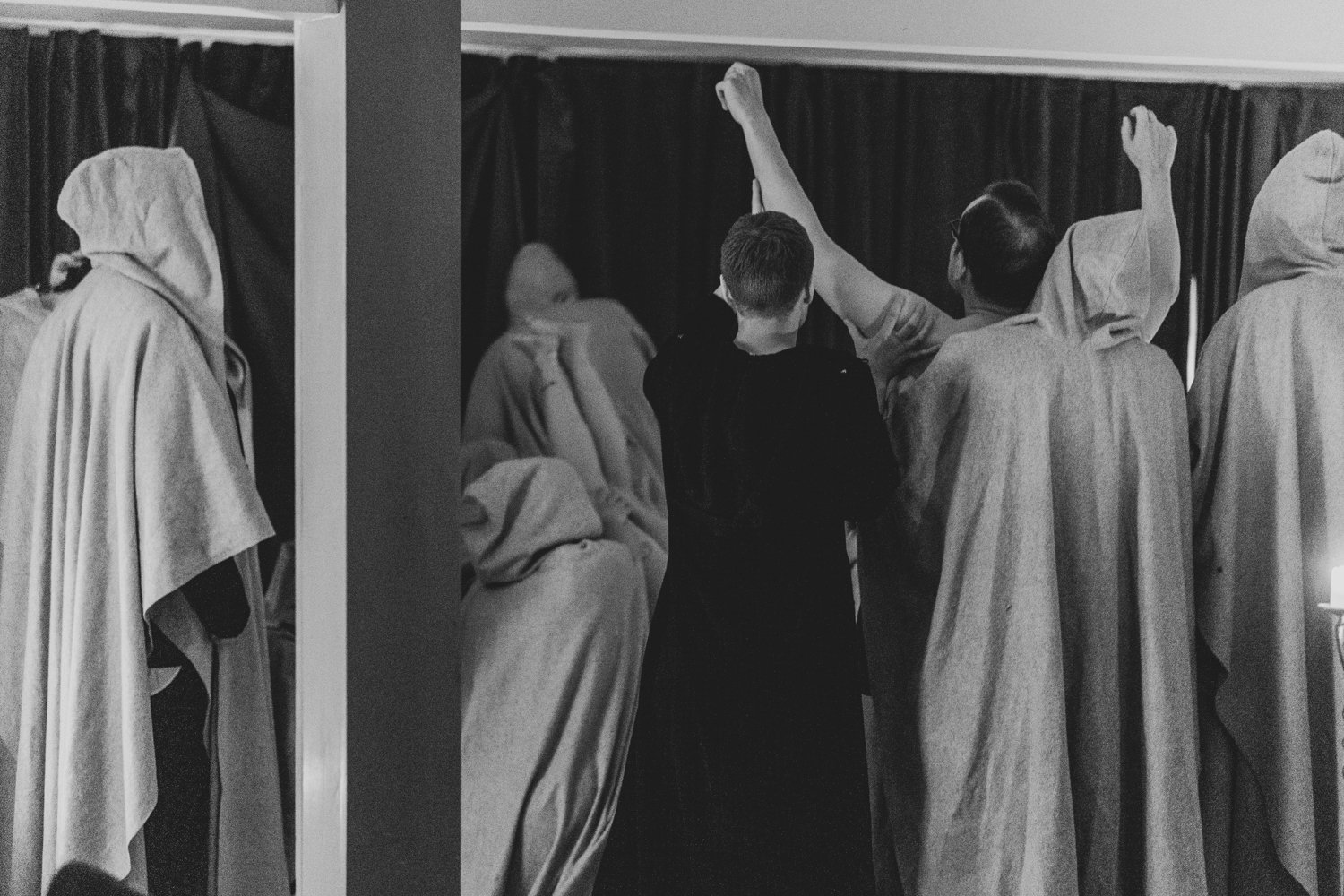
    Cover image: Photo by Carl Nordblom from Lord of Lies, by Atropos. Lord of Lies is a larp about trying and failing to be a satanic sex cult in 1950s America.