Author: Muriel Algayres

  • The Impact of Social Capital on Larp Safety

    Published on

    in

    The Impact of Social Capital on Larp Safety

    Introduction

    This article is partially a complement to the recent ”The Brave Space” opinion piece, but is more generally fueled by long standing discussions regarding status and social dynamics in larp communities, both at the local and wider international scale. It represents my opinion alone and does not mean to establish a universal truth regarding these issues. I will first present a definition of safety and expand it using the notion of zone of proximal development, an education theory proposed by Lev Vygotsky. I will then reintroduce the notion of social capital to argue why imbalances of power between participants should be taken into account while discussing safety and player negotiation of boundaries. I conclude with the idea that you can’t discuss a culture of trust without addressing social capital and the imbalances of power between all people involved.

    The Ideal Purpose of Safety

    Safety techniques as they exist at the time of this writing provide means to both opt-out of sensitive issues of scenes or to opt-in to certain types of play. Furthermore, communication around safety has become essential to establish the role and positioning of the larp organization on safety and inclusion of all players. We can admit that talk of safety mostly focuses on opting out mechanics, such as clear author statements with explicit trigger warnings, safewords, white zones, stating boundaries, etc. However, opt-in mechanics also exist, such as the signal light colors (red/yellow/green), okay check-in, pre-scene negotiations, opt-in color ribbons, and the more recent zoning, which creates opt-in spaces within the physical space of the larp. While the possibility to calibrate opt-out and opt-in is obviously central to giving participants the opportunity to experiment and step out of their comfort zone, each participant has different needs and boundaries in that regard.

    Women cheer and clap for a smiling white man
    Photo: Laflor for Getty Images/iStockphoto.

    In education, Vygotsky’s zone of proximal development (Harland 2003) is considered the ideal space to learn. The zone refers to the space between the comfort zone of what you already know and a yet unattainable zone where the difficulty would discourage or overwhelm you (see Figure 1). We can apply this frame to understand how players can develop skills in larp, such as speaking in public, brawling, handling sensitive issues or emotionally charged conflicts, and even intimacy or sexual scenes.

    Let’s keep in mind that the zone of proximal development is unique to each individual, in the same way as triggers and boundaries are (Brown 2014). As in education, if a player stays too much in their comfort zone, they might miss the opportunity to grow, experiment, and learn. And in larp, some people explicitly prefer to stay within their comfort zone for a variety of reasons, such as escapism, socialization, or love of a certain genre, all of which are absolutely valid. Furthermore, pushing someone out of their zone of proximal development too quickly can be damaging to the players’ development by forcing them to engage with problems that they are not ready for or that could be triggering for them. Brown (2014) especially underlines how triggers exist on a wide spectrum, and how they can be detrimental to their player’s whole experience and impact the player’s agency.

    Therefore, the core idea is that you need a solid comfort zone before you can expand it. The scope of your zone of proximal development is completely personal and calls for personalized handling. Another educational parallel can be drawn here with the notion of scaffolding in education, where progress is built through progressive steps, support from educators, and interactions with other learners. Applied to larp, in order for a person to feel brave and explore out of their comfort zone, they need to feel safe and supported by their environment, which is not a given in larp communities for many players.

    graph of embedded circles demonstrating the zone of proximal development between what a person can do, can do with help, and cannot do Figure 1: The Zone of Proximal Development. Figure by Dcoetzee (CC0).

    There is no denying that larp can provide powerful transformative experiences. Jonaya Kemper (2017) coined the term emancipatory bleed to reflect on the process of steering towards a specific type of play that would reflect one’s own life experience of oppression. Players should be allowed the opportunity to steer towards that kind of play, and designers can support emergent play along those lines. However, how can we support transformative play and exploration while still ensuring safety for those players who most need it? This question usually brings up issues of consent, pre-game or in-game negotiation, and personal boundaries.

    We are Not Equal in Setting Boundaries and Tone

    In the international larp community, we usually remind participants that the players are more important than the game, make sure that enthusiastic content is given and can be revoked at all times, and support negotiation and opt-in mechanisms. Our goal is to build a collective culture of trust. However, to build such a culture, we need to be able to negotiate it as equal participants. I don’t believe that every negotiation and every discussion is carried on an equal footing.

    Games going through reruns and several iterations can sometimes be played more violently or intensely from one session to another. Framing the game experience with hard limits or requirements for consent negotiations in such a way that it sets up cohesive boundaries for the whole experience remains an organizers’ prerogative. However, I would contend that the collective level of intensity is also influenced by the players through their collective interactions. Since we tend to take cues and ideas from other players, I believe that participants are unequal in influencing the tone and intensity. Outspoken participants with a wider comfort zone can influence the game atmosphere more, sometimes for the better, by inspiring others and creating unexpected interactions.

    On the other hand, a single or small group of participants who decide to play for their own agency and to disregard the collective buildup of the game can just as easily derail the tone and cohesion for the whole larp. These are rare occurrences where the domino effect can negatively impact the experience of many players (Bowman 2017). My previous article (2019) on the depiction of rape scenes in larps showed how the introduction of scenes featuring sexual violence used to be the province of a dominant group who used it for power play. Only the introduction of restrictions and safety regulations enabled the minority group — women players in this instance — to refuse playing these scenes if they were not negotiated. Further down the line, we found women participants were willing to play rape scenes for dramatic purposes or to support intense narratives because they feel empowered to choose to do so. This empowerment, though, was entirely contingent upon a corrective intervention upon the social imbalance that had originally prevented these players from voicing their discontent. Thus, safety culture was the crucial thing that allowed these women to feel comfortable to play this content.

    Social Capital in Larp

    Social capital is a notion popularized among others by Pierre Bourdieu as the product of resources conferred due to integration into a certain network and the capacity to act in society (Siisiainen 2003). The chart below illustrates social capital as an aggregate of these resources that allows an individual access to favors or greater resources.

    chart showing how social capital is fed by various aspects of status such as reputation, accomplishments, etc.
    Figure 2: A synthetic representation of social capital (Algayres 2019).

    Since larp groups or organizations are part of society, they are also prone to the same biases that affect us in daily life. Although efforts have been made to support the integration of minority or marginalized groups in larps, some players still accrue social capital by virtue of being or passing for white, straight, cis-, or because of their class and education level. Another major point in the international context is their mastery of English, which will confer advantages to native English speakers and players from countries where English proficiency is especially high, as well as highly educated and internationally-integrated professionals. Finally, social capital as we will discuss it is also dependent on larp-specific criteria: being geographically anchored as Nordic, clout as an organizer and/or larp theorist, visibility on social media, participation at international larp conferences and conventions, playing high status characters, and involvement in high-profile games with a lot of hype.

    I would claim that larpers with higher social capital are in a position to influence their co-players’ choices or leverage their own desires when boundaries are negotiated. Has anyone ever been accidentally pushed out of their comfort zone for fear of missing out certain parts of the game or the opportunity to hang out with this cool larper they’d read a lot about? Could peer pressure and “hardcore larp culture” ever push some people to willfully step out of their zone of proximal development because that’s what a “good larper” would do? I would contend that this can happen, and that it is very easy to be blind to your own social capital, as it can intersect with other forms of oppression. For example, as a woman, I have to contend with sexism and have even been the subject of sexual violence. However, since I hit almost every other marker of status, I have often been in situations where I benefited from my higher social capital and I was sometimes blind to it to my own detriment. I believe it is important for us to acknowledge our own degree of social capital and how it may influence our relative abilities to push play in our desired direction. It is also important for us to listen to people with lower social capital when they request greater safety culture around sensitive topics.

    Regarding the Creation of Safe Spaces and Trust Culture

    I think that safety must be used both as a way to opt-out and opt-in of specific themes and scenes. However, safety also has been used to protect minority groups and players with specific triggers and limits from play that would be oppressive to them, and is especially beneficial to players with lower social capital (Kemper 2017). In larp scenes where safety was introduced more recently, resistance to safety techniques usually comes from the more dominant and entitled groups of players. These groups sometimes feel that safety techniques are not necessary because they feel safe enough not to need them. They may have sufficient trust and familiarity within their local communities of play to feel safe without negotiation, which is a form of privilege that is not afforded to many in the international larp community, who may enter larps without the benefits of established group trust. Only active communication by the organizers compensates for this imbalance of power between groups that feel confident to play without safety rules and those who need to be sure of the implementation of safety structures before they will even sign up for the larp. In other words, players with this social capital privilege may not realize that lack of safety culture in a larp may be actively dissuading players from marginalized backgrounds from ever signing up, which further contributes to issues of inclusion in the international larp community.

    A person feels excluded from a group of people who appear to be talking badly about them

    I don’t believe we can discuss expanding our boundaries, reducing the need for scene negotiations, or exploring out of our comfort zones without taking into account imbalances of social capital, influence, and power. Discussion around opt-out safety was once framed around the protection and benefit of marginalized groups and players most in need of it. I would therefore wish for discussions around trust culture to be built around this issue: how can we build a trust culture that will above all benefit players with the lowest social capital and the greatest need for it?

    I hope that we will develop tools that can enable players to explore and expand their comfort zone. However, when we develop these tools, we should measure their value on how much they actually empower those with the lowest social capital and facilitate a sense of psychological safety. I believe that our capacity to build a collective sense of trust will only be as big as our capacity to compensate for these imbalances and support all players to feel safe doing so.

    References

    Algayres, Muriel. 2019. “The Evolution of Rape Depiction in Larp.” Nordiclarp.org. Last modified on May 20, 2019.

    Bowman, Sarah Lynne. 2018. “The Larp Domino Effect.” Nordiclarp.org. Last modified on February 14, 2018.

    Brown, Maury Elizabeth. 2014. “Pulling the Trigger on Player Agency.” In The Wyrd Con Companion Book 2014, edited by Sarah Lynne Bowman. 96-111.

    Kemper, Jonaya. 2017. “The Battle of Primrose Park: Playing for Emancipatory Bleed in Fortune & Felicity.” Nordiclarp.org. Last modified June 21, 2017.

    Harland, Tony. 2003. “Vygotsky’s Zone of Proximal Development and Problem-based Learning: Linking a Theoretical Concept with Practice through Action Research.Teaching in Higher Education 8, no. 2: 263-272.

    Siisiainen, Martti. 2003. “Two Concepts of Social Capital: Bourdieu vs. Putnam.” International Journal of Contemporary Sociology 40, no. 2: 183-204.


    Cover photo: FreeImages.com. For illustrative purposes.


    Content editing: Elina Gouliou

  • The Evolution of the Depiction of Rape in Larp

    Published on

    in

    The Evolution of the Depiction of Rape in Larp

    Content Warning

    Description of role-played and simulated rape scenes. Graphic or suggestive images of rape, assault, and trauma. Minor spoilers for some French-speaking games.

    Foreword

    This article is the amended translation of a piece that was originally published in French within the context of internal discussions within the French-speaking larp scene regarding emotional safety tools and calibration. I have since come to consider that it could be of interest to a wider audience. However, It should be noted that many of the examples that I will present may only be understood within the context of the French local scene. Furthermore, this article will only focus on rape depiction and simulation within the game’s fiction, not off-game incidents of assault.

    Introduction

    Why is rape such a specific issue in larp?

    Depicting rape in larp is often used as a prime example to demonstrate the importance of organizer communication and emotional safety in larp. When we role-play violence in larp, physical violence can be more easily dissociated and put at a distance. As horrible as the perspective of murder can be, it is rare enough in most of our daily lives that we can accept it as part of the fiction and, in most cases, without thinking that it might happen to us.

    Rape or sexual assault, however, remains a very real risk to women. We might discuss specific numbers and statistics, but it can be said with certainty that among the participants of a larp, there will be former victims of rape or sexual assault.  Most women have been confronted with the fear of sexual assault, including a whole series of measures meant to prevent it, from the way they dress to thinking about how they will manage returning home in the evening. And this is not limited to women either: men, trans, and non-binary people may also have lived through sexual assaults in their past or have reasons to fear assault in the present.

    Consequently, depictions of rape in fiction — and for the purpose of this article, I will consider larp as a form of media — can be more impactful to a significant part of the audience than other forms of violence. As such, choosing to depict or allow role-playing rape scenes inevitably has a stronger impact, and will often fall under close scrutiny, owing to the fact that it is still an issue that impacts a lot of people.  

    I have found it interesting to observe the way that organizers and participants have handled allowing — or not allowing — role-playing rape scenes in larp. I have found these decisions to be emblematic of cultural changes both in larp writing and social perceptions surrounding rape. I will try in this article to present an overview of this evolution, and how, in my opinion, it can inform us of the interconnection between larp, media, and cultural representations. However, this article will only represent my own experience as a larper and creator, and does not aim at being exhaustive or impartial.

    Painting of an ancient city of people engaged in violence and rape
    Jacques Stella, The Rape of the Sabines, mid-17th century.

    Trivializing Rape

    During my second larp, back in October 2001, which was part of a now-terminated Drow campaign, my character was knocked out by two other characters and robbed. Fair enough. That situation was written in the rules, and, as a beginner, I hadn’t learnt to walk with my back against the wall at all times. After that scene, right before leaving, one of the two participants in the scene added, “And before leaving, we rape you.”

    As in many games of the time, there were no simulation rules for sexuality. In campaign games such as this one, sexuality was mostly managed off-game to produce offspring that could become playable characters if your own character died. Games that offered rules for sexual simulation usually used mechanical rules: dice; cards; marbles, oftentimes with some random draw that would determine the quality of the relation; and sometimes a “pillow talk” mechanic, in which sharing intimacy could lead a character to share an important secret to their partner. However, the issue of sexual violence or coercion was rarely broached explicitly  — except in rare cases of complete prohibition, more on that later — and was considered, therefore, possible.

    Here is another emblematic example. In the mass larp campaign La Faille (or The Rift, which ended in 2007), the orc faction would organize fictionalized rape of female characters.  They would mark the victims’ clothes with green at the buttocks to signify what had happened to the character. While some of these scenes might have been discussed beforehand, it is certain that negotiation and consent was neither written into the rules nor systematic.

    In the context of these early games around 2000–2005, integrating sexuality rules was an answer to the objective of creating a 360° realistic representation and mostly “sandbox”-type game. In this style of game, players had to be able to do any action they wanted. Rules only came into play when an action was considered impossible (e.g. magic) or dangerous (e.g. fighting). Physical contact was completely prohibited. In that context, depictions of rape simply represented something “that could happen,” just like in real life. The practice was acceptable because there was no physical contact and because rape was usually only mentioned verbally.

    Rape scenes were usually performed by characters that could, in this manner, display their violence and could establish their role-play as a “villain.” Rape usually had no consequence in-game.

    Rape as a Narrative Device

    Meanwhile, we could also observe games that, while prohibiting rape in-game, used it as a narrative device in the game’s backstory. Rape, in this case, has consequences that take the form of in-game conflicts and dramatic outcomes. As illustrations, I will mention three examples from the so-called romanesque style. I played witness to the plot in the first game and the rape victim in the last two.

    In Greenaway’s Feeling (played in 2007), a Victorian-era game, I played as the governess to a wealthy family. One of the secrets of the family is that the lady of the house was raped before her wedding by a friend of the family. The game ended with the rapist being killed in a duel. In the second game, Spirits (started in 2008, played in 2013) I played as Maggie, a girl from the working class falling in love with an upper class aristocrat. Maggie was then raped by her lover’s cousin in what constituted clearly a punitive action on the rapist’s part. This storyline was lifted directly from the novel that inspired the game, A Dangerous Fortune by Ken Fowlett, published in 1993. In the run I took part in, the rapist also got killed in a duel. The final game, Noces de Cendres (The Ashen Wedding, 2012), was set in Argentina in the years following World War II. My character was a famous socialite, raped as a young woman by her wealthy patron, and bent on getting revenge. The game invites a resolution where she poisons her rapist. In my run, he was shot to death by another of his enemies.

    It must be noted that, in two out of these three cases, the resolution of the storyline resulted in a duel between two male protagonists, taking away the agency from the female victims, and that the “rape-and-revenge” trope was invoked in the last one. Furthermore, due to the historical context, a significant part of the story revolved around the victim being shamed and forced into secrecy.

    Important note: I still consider these games to be good and I generally had strong experiences playing them. However, these games are a reflection of the fictions that inspired them – sometimes picking plots directly from books used as inspiration. In these stories, rape is the traumatic inciting event that kickstarts the narrative arc for the female characters or drives the conflict. However, It feels important to point out that, in spite of their qualities, these games reproduced some of the stereotypes around rape that also can  be found in certain media.

    A woman in a jail cell and western clothing bent over and crying
    Conscience 2.0. Photo by Stefano Kewan Lee.

    The Criticism and Rape Prohibition

    I think that criticism and changes in the way rape is depicted in larp appeared in conjunction with criticism regarding the depiction of rape in media and fiction, as well as demands for changes in that regard. The subject is regularly broached in the media, mostly regarding the use of rape as “shock value.”  Regarding larps, two arguments were at the forefront of discussions: imposing rape scenes without the participants’ consent and using sexual assault as a cheap plot device.

    First and foremost, some members of the community argued that imposing rape in the storyline was neither agreeable nor fun for many participants for the reasons already mentioned in the introduction.  In cases where the possibility of rape was left open on the grounds of realism and 360° immersion, some argued that even a larp with an ambition for immersion has to enforce limitations on its players and some degree of abstraction, if only to accept, for example, that fake weapons will be real and wound the characters. Some participants claimed that letting players impose rape scenes upon others went against their own enjoyment of the game and sense of safety. Even a competitive player vs. player game could find ways for players to act against one another, including violence, without making rape part of the arsenal. Of course, in real life, rape is indeed a tool for humiliation and a weapon of war. Larp, however, remained a fiction, and even the most historically accurate larp makes choices in terms of what it can represent. Therefore, it was possible to contend that taking away rape from the larp wouldn’t change the narration in most cases, but would make the game experience safer and better for all.

    The second argument criticized rape as a cheap and somewhat overused plot device. That critique was not as severe, but pointed out the fact that rape was too often used as a cliché, either to justify a dramatic conflict or to illustrate the cruelty of a character or the world. So it was not so much the existence of rape narration that was at stake as its treatment and recurring aspect, e.g. making it a staple of most pre-written female characters. These critics underlined that there should be other ways to establish the unforgiving quality of a world or set up a character as an antagonist. Additionally, it was important to diversify female narratives using other angles than rape. The use of rape as a “shock factor” to show how dark a situation is, if not used to bring an interesting narrative, tell a good story, or deconstruct prejudices, can simply become derivative; these stories can contribute to trivializing rape; perpetuating stereotypes about rape and sexual assault; or invisibilizing survivors’ experiences.

    Because of these issues, larp design choices and communication surrounding rape depiction has significantly changed in the 2010s, with an acceleration in the wake of the #metoo movement. Sexual assault is frequently forbidden in games, with some games even banning any role-play around sexuality at all. If rape appears in the backstory, it will be explicitly communicated and only played with the participants’ consent.

    Due to these changes, communication and participant consent have improved. Most organizations now present a design document stating which themes and issues can be expected in their games, explicitly asking participants to write down issues they don’t want to play. It must be noted that, when I have handled participants’ sign-ups as an organizer and what they didn’t want to play, I had many male players requesting not to play a rapist. I also know many people who prefer to pass on any game mentioning rape, which in my opinion is a perfectly valid position.

    Can Rape Be Responsibly Depicted in Larp?

    This last question will of course be open to debate. Many people state that rape should be forbidden in larp altogether, which is a very understandable position. However, I would like to give a couple examples of games that, in my opinion, use rape in their scenarios in such a manner that it brings a real narrative depth, avoiding the issues that I addressed previously.

    The Swedish game Last Will (2014) presents a not-so-distant dystopian future in which big corporations have re-established legal slavery. The game fiction takes place in a modern gladiators’ arena and depicts teams of fighters and the arena personnel. One of the categories represented in game is the Pleasers: sex slaves whose purpose is to exclusively serve the needs of the fighters. This game is a Nordic larp with clear expectations in terms of safety: the themes are clearly communicated well in advance, the character distribution is done according to participants’ requests, violent scenes must be negotiated, and any scene can be interrupted with safe words. Ars amandi was used to simulate sex and was practised beforehand during workshops.

    My character was a fighter called Sol. She was forced to perform sexual acts in front of the medical examiners charged to evaluate her. As a reaction, she became in turn abusive to her own Pleaser, Eden. She was then forced to witness Eden’s rape by one of the guards as a punishment for her repeated insolence and transgression. In this game, the presence of sex slaves and the possibility to play rape scenes was part of the construction of a dehumanizing environment for the characters. After the game, discussions among participants and the viewing of a documentary on modern slavery were used to contextualize the whole experience.

    My own game Flowers of May takes place in a Parisian brothel in 1910. One of the prostitutes, Violette, is there against her own will. She has been locked up and blackmailed into accepting it before the beginning of the game. The game doesn’t allow the depiction of rape with violence, but the character being threatened and coerced means that she undergoes at least one rape scene over the course of the game. Using inspiration from Last Will, the game also uses ars amandi and follows along the same lines in terms of safety and communication. Sexuality and sexual violence are a central theme of the game. This character is used to show that rape happens any time there is coercion, not only through direct threat and physical violence. The game in general explores the interconnection between sexuality and power.

    Finally, Conscience 2.0 (2018, created by NotOnlyLarp in Spain, is another recent example. The game was inspired by the TV series Westworld and is set in a Western theme park populated by extremely realistic robots. Sexual violence and nudity were possible, but only in certain predetermined spaces, also called zoning. This practice has been recently introduced as a means to set up boundaries and allow players to steer towards or away the most intensive forms of role-playing (more examples in “The Larp Domino Effect”). As always, communication was extremely explicit about sensitive themes, with workshops and safe words. Participants who wanted to play on physical or sexual violence had to signal it by wearing a small white (physical) and/or red (sexual) ribbon over their costume. Sexual scenes were simulated in full clothing, while real intercourse was explicitly prohibited. Any scene of sexual violence had to be negotiated following a pre-scripted discussion. Here again, integrating sexual violence against robots sets up the action within an abusive context and, the more the robots were gaining consciousness, to question what makes a human being. Between characters who treated the robots as literal objects and those who wanted to defend their humanity and rights, the visible and brutal depiction of sexual violence could be a catalyst in these conflicts.

    In that larp, I played an abusive character who was intended to enable others in engaging in violent interactions. My characters very routinely organized collective rapes and torture sessions. The strict safety rules of the game allowed me to constantly check the well-being of the players who performed as my victims. Playing as an oppressor was way out of my comfort zone; it was indispensable to me to know that playing these violent scenes improved the game experience of other players and was not only there to show my character’s menace and physical superiority.

    I cited these examples because they have, in my opinion, common aspects. They all use sexual violence to show how the environment dehumanizes the victims of violence. They all try to deconstruct the way this violence operates, in particular how it can be trivialized. I believe that an essential difference from the examples I treated in the first paragraph is there: the rapists in these examples don’t see themselves as the “villains” and the characters themselves are not written as such. They simply consider using other human beings’ bodies as their right, whether as a client or simply from their position of privilege. Rape is not used for the mere “shock factor,” but to serve as a discussion about the type of society that renders the banalization of rape possible. I believe that the stories created in this context are all the more poignant for that.

    Members of a western town watch as a woman character straddles a prone man character in the Conscience larp
    In-game photo of the author’s character in Conscience 2.0 (2018).

    Discussion

    I originally wrote all of the above in a French context as a means to promote the importance of safety rules and mechanisms. My goal was to underline the necessity of building a culture of explicit consent whenever sensitive issues are portrayed. I especially wanted to debunk the all too common notion in my local community that implementation of emotional safety structures would condemn any game depicting violence or abuse by highlighting some games that treated such issues while putting participants’ well-being first.

    However, the discussion surrounding that piece of writing and the general handling of controversial themes have also led me to the following reflections:

    1. Larp doesn’t exist in a vacuum. Larp, among other things, exists as a medium and is therefore inspired by societal representations and the media we consume, sometimes explicitly by directly using existing franchises as a setting (e.g Wizarding World, Vampire, etc.) Even with a small audience, a larp will be part of the construction of a certain discourse and representation and should be analysed as such. The criticism that was levied against the abusive use and representation of rape in French larp stemmed from such media criticism approaches.

    2. Change takes time. The evolution that I present in this article stretched over years. I can also personally recount how I deconstructed my own internalized prejudices over those years before taking a more active role in promoting emotional safety rules, creating guidance for prevention of harassment, and defending a culture of consent. Increased global exchanges and digital communication may accelerate some of this process of acculturation, media criticism, and change of opinion, but they still take time nonetheless.

    3. Managing resistance. The cultural shift that is described in this article took time, and was met with quite a lot of resistant comments, one of the most frequent being that depicting rape was just “realistic.” In fact, I have yet to see any safety technique or communication that wasn’t met with some form of resistance. In this instance, change was brought about by a combination of communicating about the subject (e.g arguing why trivialized depictions of rape are problematic), valuing good practices (e.g organizing or promoting games with a clear safety policy), and, in some cases, avoiding games that do not have clear communication on these issues. I also believe that the issue with rape depiction was a good example and gateway to discuss safety issues, since the line between organizers’ freedom of creation and players’ safety was pretty clear in that case: trivialization of rape led players to feel uncomfortable or unsafe in the game, or even to avoid larping entirely. Taking the subject away didn’t hurt the structure of most games. Creators who wanted to handle rape as a sensitive issue could still do it, only with a better knowledge of the kind of communication and careful management that it requires.

    Conclusion

    By writing about the depiction of rape in larp, I hoped to highlight some important cultural changes that occurred in the media around these issues and subsequently in larps as well. Through these examples, I tried to show that you can absolutely handle sensitive issues in larps, but that a clear communication and safety policy is necessary. I used the example of depiction of rape to show how a design choice (or lack of consideration of it) could create a disagreeable, or even hostile environment for some players. Additionally, changes in communication and techniques have made the practice safer and more inclusive. Finally, I opened the discussion by affirming my belief that there are probably other issues and techniques that are still to be explored. My hope is that discussion on these issues will continue.

    References

    Algayres, Muriel. 2015. “Last Will, Second Run.” Electrolarp, February 2, 2015. https://www.electro-larp.com/886-larp-review-last-will-second-run

    Algayres, Muriel. 2017. “Character-Based Design and Narrative Tools in the French Style Romanesque Larp.”  Nordiclarp.org, February 20, 2017. https://nordiclarp.org/2017/02/20/character-based-design-narrative-tools-french-style-romanesque-larp/

    Bowman, Sarah Lynne. 2018. “The Larp Domino Effect.” In Shuffling the Deck: The Knutpunkt 2018 Companion Book. Edited by Annika Waern and Johannes Axner. 161-169. ETC Press. https://nordiclarp.org/2018/02/14/larp-domino-effect/

    Montero, Esperanza. 2019. “Conscience, Layers of Reality.” In “Knudepunkt 2019 Summary.” Nordiclarp.org, February 12, 2019. https://nordiclarp.org/2019/02/12/knudepunkt-2019-summary/

    Orsel, Amelie. 2015. “Les Fleurs de Mai.” Electro-GN, September 29, 2015. https://www.electro-gn.com/9845-critique-de-gn-les-fleurs-de-mai


    Cover photo: Last Will (2014). Photo by Lisa H. Ekbom.

    Editing: Elina Gouliou, Mo Holkar.

  • From Winson Green Prison to Suffragette: Representations of First-Wave Feminists in Larps

    Published on

    in

    From Winson Green Prison to Suffragette: Representations of First-Wave Feminists in Larps

    In this article, I present feedback on my experience playing and writing on suffragettes in larps set in early 20th century Europe. I present the diverse angles through which the theme and characters were approached in these larps and contrast their differences. These games are set up at a time period with clearly separated gender roles, developing narratives around female archetypes and roles in society. As such, any mention of gender in this article will be set along the line of a strict binary division of male-female gender, which was used within the historical context of those games, and obviously does not represent the full extent of gender spectrum, identity, and expression. I examine which themes were mostly presented through these games and the challenges they created.

    The Games

    I have chosen to focus on these three games because they all focus on first-wave feminism by having all or most characters being actively suffragettes, which allows for interesting parallels and comparisons. While many games handle feminism or gender:

    1. Winson Green Prison is a game written by Siri Sandquist and Rosalind Göthberg in 2016, for up to 20 players and 4 hours of play. It sets up a group of women locked in the titular prison after being arrested during a protest march, as well as the men who have the legal authority over their lives (husbands, fathers, brothers) waiting for them to be released. The game starts by having the participants workshopping the characters as pairs, and then separates them for the entirety of the game except for their reunion during a brief epilogue scene. The game allows both groups to play in parallel, but at times only one of the groups play, letting the other group observe the opposite gender’s dynamics.

    2. Sorority is part of the Belle Epoque trilogy, a series of games I wrote in 2017 questioning gender and class inequalities in early 20th century France. It plays for 8 to 12 players over 4 hours. The characters in Sorority are all women, and the game features them in three different time periods: in 1913 when patriarchal control is in full swing; in 1916 when the context of World War I has unexpectedly given women more opportunity to work and act independently; and in 1919 when, after the war, women are being pressured to return to traditional roles while the demand for suffrage gets stronger. The larp allows for the characters to evolve and change their opinions since it is played over a long period in game.

    3. Suffragette! is a game created in 2014 by Susanne Vejdemo, Siri Sandquist, Daniel Armyr, and Cecilia Billskog. It originated in Sweden and was rerun in the summer of 2018 for an international audience, adding four groups of foreign visitors to the original Swedish cast. It played for 70 players over a 12-hour period. The characters are all women meeting in Stockholm for the International Women’s Union conference and preparing for the protest march, which is supposed to take place in the morning.

    A sign that reads Vote for Women, a fan, a glass, and other props
    Post-game picture from Sorority by the author

    The Hopes of Sorority

    The three games all focus on female characters grouping together at the time when women didn’t have voting rights and were usually under the authority of their fathers or husbands. They all question the social dynamics of a non-mixed female group. They all support implicitly or explicitly the ideas that solidarity and union between women can really be a positive force for change, and that women should be more supportive of each other in the face of pressure from patriarchal structures.

    In this regard, Winson Green Prison was especially powerful, since being imprisoned together in the same space instantly sets the stakes for the female characters very high. Trying to support each other and not break down in panic, within the context of being imprisoned, immediately felt important. For some characters, having been arrested meant the possibility of punishments at the hands of the men, when others had participated in the march against their express orders. In that context, those fears played as very real.

    Sorority starts with a group of diverse women coming together over the years. They are clearly divided at first, especially along class lines, but solidarity between the women eventually manages to gain traction, when they are all able to take part together in a protest march. As such, the game is meant to be a metaphor of the collapse of old social structures after WWI, and to illustrate how solidarity can appear among women.

    Suffragette presents a variety of women coming from diverse organizations or foreign countries. Being part of an organization or a specific group was definitely the frame wherein support was the strongest: the solidarity between the French group was a strong part of my personal experience. Solidarity was also quite apparent in the socialist and anarchist groups of the game, who were an active minority that seemed very supportive of their members. With a bigger player base, the sense of companionship worked more within small groups, or during specific activities such as the suffragitstu — a model of self-defense lessons developed specifically for women. On a larger scale, the game presented more the fracture lines around some controversial subjects such as prostitution, the status of natural children, and access to contraception.

    Dozens of suffragette characters holding signs and posing
    Post-game picture of Suffragettes! by Herman Langland / Big Picture Larping

    The Pitfalls of Division

    This part of the experience will obviously differ according to each individual player’s personal narrative. However, I do feel that all games show the limits of female solidarity. They could sometimes have a bittersweet ending in the sense that there were limitations to what women could really accomplish and change, in the world as well as in themselves. Sometimes, the trappings of society and social conditioning just got the better of the characters.

    In Winson Green Prison, the context of the women being arrested is the main conflict: for some of the prisoners, being in prison carries serious consequences, punishment, or social exclusion. In Sorority, the division comes from the class conflicts. In the beginning of the game, there is a strong class divide between the rich ladies and the working-class women. After the Great War, the richer characters get ruined and the class divisions start changing, though they do not disappear completely. As a consequence, some characters decided to leave the group before the final march, feeling that they didn’t belong and were not sufficiently integrated with the others.

    The divisions become even more pronounced in Suffragette, possibly because the game was longer and had a larger number of participants who represented conflicting ideologies. Suffragette is a highly political game, with a significant part of the running time devoted to committees where the participants discuss various subjects such as voting rights, contraception, sex work, and the marching order of the morning march. The end of Suffragette brings together the whole audience to listen to two closing speeches. While to some extent uplifting and unifying, the speeches also emphasized the fact that in reality not much was accomplished, as the divisions remained significant.

    As such, all three games question the difficulties of bringing different feminist views together, and show how solidarity can sometimes be difficult to achieve. It resonates with contemporary issues: there are a variety of feminist approaches and divisions and conflicted views and political takes do exist.

    The Debate: Men Playing Female Narratives

    Interestingly, Suffragette also raised issues regarding the participation of male players in what are clearly female and feminist narratives. This section will focus mostly on this issue  regarding mostly cis-gendered males in light of social expectation and gender roles, which will be the group I will subsequently refer as “men” for this writing.

    All games allowed for any participant to sign up, regardless of player gender. In my opinion, the integration of male participants (as female characters) was made easier in Winson Green Prison and Sorority, as the context of playing in larp conventions involves more abstraction and no costume and setting. Therefore, suspension of disbelief felt easier to achieve. In Suffragette, male players wore women’s costumes, but there were no specific workshops or demands regarding accuracy.

    While the number of male participants playing female characters remained limited, the choice to allow male participants was motivated by expanding interest in sharing female narratives, and promoting the idea that female narratives can and should be of interest to people regardless of their gender. The educational value of playing a different gender as oneself can also be a motivation.  As one of the male players of Sorority wrote to me afterwards,

    “Seeing all the issues and learning more about the situation in France was eye-opening. It would be another 25 years before women secured the right to vote in France — and I’m glad I played it and was made to feel welcome by the other players.”

    However, concerns were expressed regarding the fact that male players could end up taking the space in female narratives, especially if playing high-profile characters such as Emmeline Pankhurst, a role that was played by a man in Suffragette. Some argued that casting men in leading female roles would restrain opportunities for women to play powerful female narratives. Others argued that if female narratives are to be opened and embraced by all regardless of gender, then all roles should be also accessible to all regardless of gender. This is a legitimate issue and, while I support and hope to see more men play female narrative, the conditions to make them more accessible remain to be discussed. This debate is, therefore, still ongoing.

    Conclusion

    These games provide an interesting insight into different approaches to exploring the same theme. They demonstrate the tension in feminist narratives between promotion of sorority ideals and the reality of the conflicts and divisions inherent to any political movement. They also question the place of male players in female and feminist narratives, which, while an unresolved debate, is an interesting aspect of design to take into consideration for any who write and promote female narratives.


    Cover photo: Winson Green Prison by Vicki Pipe for the Smoke Festival 2017.


    Editing by Elina Gouliou.

  • Character-based Design and Narrative Tools in the French Style Romanesque Larp

    Published on

    in

    Character-based Design and Narrative Tools in the French Style Romanesque Larp

    We like to engage in larp through compelling and vivid characters. However, the available tools to create them are many and diverse: whether we go with short or detailed characters, give them a lot of background or just create a short frame for the players to develop, whether we leave the control of the story to the larpwright or give more leeway towards the player’s agenda. All of these approaches are tools that can be calibrated according to each designer’s purposes.

    France has in the past fifteen years enjoyed the development of its specific, character based, drama-oriented larp scene called the romanesque genre. With a heavy emphasis on character development and personal relationships, this type of game has garnered a huge, devoted following. Though it has been but recently documented (Choupaut, 2013; Algayres, 2016a), the romanesque scene has steadily evolved through almost two decades and developed some specific traits regarding game design.

    This article will endeavour to present the romanesque style larp in relation to other similar larp styles in Europe, and establish some tools we use to create characters and narration in this type of larps. The objectives are to expand both the knowledge about larp production in Europe and the narrator’s toolbox to create characters.

    What Is the French Style Romanesque Genre?

    An Overview of the Genre

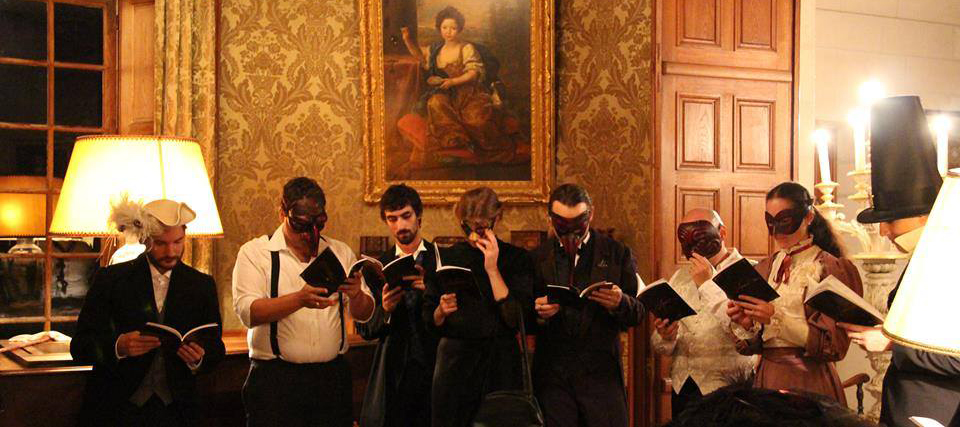
    Harem Son Saat (play, Joram Epis)

    The romanesque term started being applied to games in 2010, by Frédéric Barnabé for l’Agonie du Poète (2010). However, that game was the last iteration of a long series of games coined as “emotional” or “dramatic,” which was almost as old as the practice of larp in the country. In its primary sense, romanesque means “which belongs to the realm of a novel,” a descriptive for dramatic events or actions. Therefore, it is used to describe games that are constructed as rich, narrative experiences, with pre-written characters whose rich backstory and psychology are the driving forces of the larp.

    Since then, the term has been appropriated to qualify many games following the same general features. While these features might still be debated, we have focused on the following traits (Algayres, 2016a):

    1. Focus on the character. Character creation is mostly in the hands of the organisers, and they will be very detailed, with a lot of intertwining backstory and built-in information.
    2. A huge impact of the past which explains the details in the character. The backstory gets a significant importance in building the potential for narration and the character’s psyche. Some elements might be kept secret, to be discovered for dramatic impact.
    3. An environment built as a microcosm. The diversity of characters serves as a means to establish the workings of society in the specific time and context of the game, which is why the romanesque usually love historically inspired settings.
    4. The use of narrative archetypes. Romanesque larps often draw inspiration from literary classics and embrace the romanesque genre’s common tropes as a means to drive narration.
    5. The dominance of tragedy, with character-based narrative integrating a lot of human drama, conflicts and character dilemma. This is not an absolute, though, some games advocate a lighter atmosphere or tragedy-comedy mix, such as Rêves d’Absinthe (Algayres and D’authie, 2011), or Prima La Musica (Primoot, 2016).
    6. Tightly-knit narrative arcs, which are meant to reach their climax during the game, with characters living out an exceptional destiny or a defining moment of their lives over the course of the game.
    7. A focus on the characters’ emotions and on each participant’s identification with their character, in the same manner as a reader identifies with a character in a work of fiction. Bleed may occur as a result of identification with the character.

    The generally recognised strength of these larps is that they provide a very rich, detailed frame, with complex characters thoroughly inserted in their context and network of relationships. However, as a significant part of the world, character-building and control of the story remains in the hands of the organisers. This type of larp places greater limitations on players’ agenda and freedom (in character selection and creation especially). This is usually a design choice that creators justify by that they are using it to enrich the overall story and narrative, to create more closely connected characters and potential for tight narratives and complex story arcs.

    The Historically Inspired Larp in France and in Europe

    While the term romanesque has been coined to describe a very specific sub-genre of French larp culture, we can observe games with similar intent in several other European countries. It is also interesting to see that we can find similar traits in the games in the historically inspired genre. History and larp have always worked well together, since “a historical larp can have a more interesting and challenging gameplay because of the richly faceted social situations history brings with it” (Salomonsen, 2003, p. 94). Game designers from all over Europe have had the opportunity to exploit the richness of history all the while retaining the creative licence to twist accuracy for practical or dramatic purposes, and we’ll quote some significant, but by no means exhaustive, examples.

    In Finland, historically-inspired larps are a part of the scene, with Viking history, the Victorian era, and Finnish history around the time of independence featured as time periods of interest. Finland, like France and for similar reasons, has had a tradition of long, very detailed characters, as the absence of workshops made it necessary to include a lot of information about the character’s psyche and environment in written form.

    An interesting example is provided by the Czech larp Skoro Rassvet (Haladová, Platir et al., 2013).1 Skoro Rassvet is a game set in 19th century Russia, heavily influenced by Russian literature and especially Tolstoy. The game is played in a day, with a half day of workshops, and the action takes place during a family gathering for a formal dinner. In its approach and objectives, this game would certainly have been dubbed romanesque in France. The character design, however, differed sensibly. The written material was relatively short by historical larp standards (less than half a dozen pages), and most of the character development was done during the workshops, essentially through social codes and rituals, and role-playing scenes from the past (Hampejs, 2015).

    Prima La Musica (play, Joram Epis).

    Other examples from the obviously rich Czech scene include Salon Moravia (Bondy and Bondyová et al., 2104), set in a brothel during World War II, De la Bête (Pešta and Wagner et al., 2013), a super-production set in 18th century France, and Legion (Pešta and Wagner, 2015), which combines historical inspiration and hardcore larp in its depiction of a 1915 retreating military unit.

    Norway also has a significant historical larp scene, which used to be dubbed “stocking larps” (Stark, 2013). Norwegian historical larps were presented at the French convention Les GNiales with great interest (Hansen, 2014). They appeared as very rich, deeply layered productions, with high requirements for historical and costume accuracy which put them close to historical reenactment, and, in keeping with Nordic larp, bigger creative agenda for the players where the building of interactions and narrative arcs were concerned. Kjærlighet uten strømper [Love without Stockings] (Voje and Stamnestrø et al., 2004) can be mentioned as an example of the historical drama inspiration. The game, set during a wedding in 1771, presents its objective as a mix of intrigue, personal and societal drama, integrating significant amounts of conflict and romance.

    The rapidly blooming progressive scene in Italy, under the banner of the collective Terre Spezzate, has made several contributions to the historically inspired genre. I Ribelli della montagna [Rebels on the Mountain] (Capone and Bi , 2015) was a rich, vivid rendition of the last months of World War Two which got unprecedented media attention, support from A.N.P.I.—Associazione Nazionale Partigiani Italiani [National Association of Italian Partisans], and praise for its thoughtful and sensitive rendition of the conflict. Chiave di Volta [Keystone] (Tireabasso and Villa Avogadro, 2015), is a lush dramatisation of the 19th century centred around the theme of power, the possibility to play both masters and servants in a complicated power play, and a huge production value. Both of these productions have cleverly integrated design elements and techniques from Nordic larp (safety mechanics, workshops etc.) while retaining their own unique style, resulting in extremely well crafted larps.

    And of course, the blockbuster larp also ventured into the historical drama setting with Fairweather Manor (Boruta, Raasted and Nielsen et al., 2015), a larp set in Edwardian England and inspired by the hit TV-show Downton Abbey. While the brute force design proved partially unfit to cover the complexity of a multi-layered society (including diversity of age, rank and function), the game was effective in carrying over a lot of content and player-generated interactions. The first iteration of the larp warranted an unofficial spinoff, a second run and a sequel over the course of the following year.

    Back in France, the most recent larps of the romanesque genre have shown a clear ambition to expand on the genre and make it evolve for the better through the inclusion of those nordic style techniques whose use has become widespread in recent years (workshops, black box), keener focus on directing themes, and more refined work on the societal frame. Prima la Musica (Primoot, 2016) is a larp about the French opera scene of the 19th century, using opera-inspired dramatics and music both diegetically and non-diegetically through an open, black box system. Still Water Runs Deep (Ruhja, 2014) is a Jane Austen/Dickensian inspired larp with a sharp focus on class hierarchies and gender stereotypes, which was also played as a cross-gender experience, with participants praising the insight it gave them of the opposite genders’ constraints and problematics. Finally, Harem Son Saat (Algayres, 2016b) was the first international game of the genre, using English as a main language,2 built around the themes of oppression, gender segregation and culture shock.

    Therefore, while romanesque is solidly a French term, character-driven literary and historically inspired larps have by no means been limited to a single geographic area. The rich potential of history and its dramatisation has been widely exploited and feels still rich with great potential.

    Character Design and Narrations in the Romanesque Genre

    Archetypes in the Romanesque Genre

    Prima La Musica (play, Joram Epis).

    Romanesque larps are character-centred games, with a significant part of the game design being devoted to the conception of the characters, all of them organiser-created. While length and composition of characters tend to vary from one larpwright to another, a couple of techniques can be pinpointed.

    The first one is what I’d like to call the smart use of archetypes. This is a very thin line to tread, as any overused archetype can become a cliché and damage the necessary suspension of disbelief. Let’s use an example. You might hear French players harp about the “switched at birth” plot, used as an ironic commentary on romanesque clichés, though, to my knowledge, it has rarely been used in the scene, except in the prohibition-game era Chicago. Illegitimate children and foundlings, however, are definitely a staple of the genre, but this is fitting to historical periods when children born out of wedlock had no status in society.

    Classic or archetypal plotlines or characters can be true to period, but also resonate with an audience of participants which has usually grown up learning and enjoying these stories. It has been argued that larp itself can be viewed as an incarnation of the monomyth, each participant’s experience echoing the traditional hero’s journey. (Hook, 2010, p.34)

    So how do we go about practicing the clever use of archetypes? In a romanesque setting, we consider all characters protagonists. Therefore, we’ll use archetypes to define them through several angles:

    • The inner nature of the character: the patriarch, the overbearing matron, the hotheaded, the cynic, the ingénue, the rebel. This is very basic and can turn cliché if the character is limited to the inner archetype.
    • Their contrast in relation to others (also called foil). This is particularly frequent in pairs or trios of characters, such as siblings, close friends, etc. You’ll have the optimist to the realist, the extrovert to the introvert, the by-the-rules personality against the rebellious type, etc. Foils are really useful because, through simple characterisation, they create a lot of potential for conflict between the characters.
    • Their position within a network of relationships and in relation to others. Each character is the participant’s protagonist, but can be another’s sibling, a third’s best friend, the romantic interest of a fourth, the antagonist to a fifth and so on.

    If we just use any archetype, a character stands a sure chance to become cliché, because its archetype will be instantly identifiable, and its characterisation weak. This is where several archetypes used in conjunction with the others become useful: the character becomes more layered, therefore more human. However, the archetypes at work can still have a universal meaning to participants, which makes them particularly effective.

    The Dual Approach in Character Design

    Another element of character design typical to the romanesque genre is what we call the dual approach. While it is by no means limited to the romanesque, it has also become typical of some of the games. The dual approach in character design is a combination of the following elements:

    • The initial approach: the character’s motif or raison d’être, their reason for being present. This can be accomplished through family ties, a function or specific job, a plot-related motif. This must answer the questions: why are they here? Why should they care? Why will they stay?
    • The final approach: what will the character’s potential arc be? What will be their greatest moment? It can be a reveal (hence the predominance of secrets in some larps), an epiphany, a staged grand scene, a necessary evolution, but an element (or several) which will make the character’s journey (and the participant’s experience) significant and meaningful.

    In a typical design, both of these approaches, as well as the archetypes at play, are handled simultaneously, as the character (and the network of characters) is constructed bit by bit. The final criteria is to analyse if the characters are playable, interesting, and enjoyable.

    The objective of this type of design is to provide the participant with potential for a rich story and interactions. Some games tend to follow a more streamlined route, and have even been criticised for railroading the character’s arc too much. However, most of these games definitely have a clear narrativist approach, only limited to what is coherent with the character’s context and psyche. For some time periods in history, these elements of context and the social pressure can really be played as antagonists of their own.

    Conclusion

    With more than ten years of established existence and a very rich history of diverse and celebrated games, the French style romanesque scene is certainly a prime example of a national scene which strives through its own specific identity, all the while getting enriched through contact with other genres and countries.

    Rêves d’Absinthe (post-game, Joram Epis).
    Rêves d’Absinthe (post-game, Joram Epis).

    Bibliography

    Personal Communication

    • Erlend Eidsem Hansen. Days of deeds, Nights of Myth— The Design tricks of Historic Larps in Norway. Les GNiales. Paris, France: Conference, 2014.

    Ludography

    • Algayres, Muriel and Abbaye d’Authie. Rêves d’Absinthe [Dreams of Absinth]. Ouroux, France: Association Rôle, 2011.
    • Algayres, Muriel. Harem Son Saat. Château de Cernay, France: Association Rôle, 2016b. http://www.assorole.fr/haremlarp-en/
    • Barnabé, Frederick. L’Agonie du Poète [The Poet’s Agony]. Joyeuse Castle, France: Association Rôle, 2010. http://agoniedupoete.fr/
    • Bondy, Radim, Veronika Bondyová, Jan Fiala, et. al. Salon Moravia. Brno, Czech Republic, 2014. http://www.pojd.name/salon/
    • Boruta, Szymon, Charles Bo Nielsen and Claus Raasted et. al. Fairweather Manor. Mozna, Poland: Dziobak Studios, Rollespilsfabrikken (DK) and Liveform (PL), 2015. http://www.fmlarp.com/
    • Capone, Andrea and Elio Bi . I Ribelli della montagna [Rebels on the mountain]. Villaggio delle Stelle, Italy: Terre Spezzate, 2015. http://www.grv.it/setteprincipati/item/424-home-ribelli.html
    • Haladová, Markéta, Petr Platil, Martin Buchtík, et. al. Skoro Rassvet [Breaking Dawn]. Translated by Jeppe Bergmann Hamming, Maria Bergmann Hamming. Odense, Danmark: Association Solhverv, 2103. http://rassvet.cz/
    • Pešta, Adam and David František Wagner et al. De la Bête. Valeč Castle, Czech Republic, 2013. http://www.delabete.cz
    • Pešta, Adam and David František Wagner et al. Legion : Siberian Story. Hvožďany, Czech Republic: Association Rolling, 2015. http://legion.rolling.cz/
    • Primoot Team. Prima la Musica ou L’Opéra Terrible [Prima la Musica or the Opera Terrible]. Montbraye Castle, France: Association Urbicande Libérée, 2016.
    • Ruhja Team. Still Water Runs Deep. Paris, France: Association Rôle, 2014.
    • Tirabasso, Chiara and Daniele Cristina Villa Avogadro. Chiave di Volta [Keystone], Biella, Italy: Terre Spezzate, 2015 http://www.grv.it/chiave
    • Voje, Adrian Angelico and Anne Marie Stamnestrø et al. Kjærlighet uten strømper [Love without stockings]. Kleve gård, Norway: 2004. http://www.rollespill.no/rokokko/

    This article was initially published in Once Upon a Nordic Larp… Twenty Years of Playing Stories published as a journal for Knutepunkt 2017 and edited by Martine Svanevik, Linn Carin Andreassen, Simon Brind, Elin Nilsen, and Grethe Sofie Bulterud Strand.

    Cover photo: L’Agonie du Poete (play, Nadine). Other photos by Joram Epis.

    1. Whose international runs were organised in Denmark through the organisation Solhverv. ↩︎
    2. Which stood for Turkish in the 1913 Ottoman background, while French was in-game a diplomatic second language. ↩︎