Author: Johan Dahlberg

  • Rules are Magic: What Larp can Learn From Narrative RPGs

    Published on

    in

    Rules are Magic: What Larp can Learn From Narrative RPGs

    By

    Johan Dahlberg

    Introduction

    Rules for larps have traditionally been framed as having two purposes; safety and simulation. It is time to move beyond that. Rules are magic.

    In this essay, we argue that rules are an essential design element that can be used to fuel player experience rather than define its limits. We will do this by analyzing the design of pen and paper role-playing games (RPGs) that put story rather than simulation at their core, and exemplify how these games frame in-game interactions in terms of rules. We will explore how RPGs use rules to drive particular narratives, and promote specific emotional experiences, and compare and contrast this to how similar effects are achieved in classical larp design.

    We conclude that the application of simple rules, such as those found in narrative RPGs, can be used to create the emergent narratives and the emotional experiences many seek in larp. Finally, we propose a design tool for creating larp rules with this focus.

    The Narrative Revolution

    Traditionally in RPGs, the game master invents a story to lead the players through. They will adapt underway to respond to player actions but, in essence, a so-called ‘adventure’ is planned out ahead of time. This way of thinking about narratives is challenged by RPGs emerging from the American indie scene, such as the ones we will highlight below: Apocalypse World,((Baker, D. Vincent, and Meguey Baker. 2016. Apocalypse World 2nd Edition. Lumpley Games.)) My Life with Master,((Czege, Paul. 2003. My Life with Master. Half Meme Press.)) and Ten Candles.((Dewey, Stephen. 2015. Ten Candles. Cavalry Games.)) These games shine a light on the way rules can be used to support and create narratives. Collectively we will call them narrative RPGs.

    The traditions of RPGs and larps have developed side by side, and we believe that by studying narrative RPGs, we can gain insights into how to design experience-centric rules and meta techniques for Nordic larp, where the rules themselves are fundamental in forming the player experience. Narrative RPGs furthermore form a lens through which rules may be more easily studied: firstly, the rules are written down and explained in a way that a person previously unfamiliar with the game can understand. Secondly, since the designer is, in general, not present to explain how the game is played, they lean less on culture and more on the written rules themselves; in laying the groundwork for the experiences they aim to create.

    What is a Rule?

    We need rules in order to find beauty in playing together, as “they provide a framework for moments of delight to emerge.”((Stenros, Jaakko, and James Lórien MacDonald. 2020. “Beauty in Larp.” In What Do We Do When We Play?, edited by In Eleanor Saitta, Johanna Koljonen, Jukka Särkijärvi, Anne Serup Grove, Pauliina Männistö, and Mia Makkonen, 296–307. Solmukohta.)) Stenros and MacDonald make the analogy of football. The rules of football do not call for specific acts of athleticism, but they provide the context in which those acts can occur. In the same way, rules structure play in larp, to a degree where without explicit or implicit rules, play would not be possible.

    We need rules for a number of reasons. One, is to know what the boundaries of play are, rules for physical, emotional, or psychological safety. A typical rule of physical safety is that you are not allowed to hit your co-player in the head with your boffer sword. These types of rules will not be discussed in this essay. The second type of rules forms the foundation for how we play together. They can often be boiled down to statements of, when A, then do B. For example, when you have been hit two times with a boffer then act as if you are injured or dying. Or, when you touch hands with someone in front of the face, then interpret the action as kissing. Making conscious decisions about these types of rules are crucial to a good larp design.

    This is especially true because, not only do rules dictate what should happen when a particular event occurs, they also make these things happen by forming affordances for interaction. That is, guiding the players into which actions are possible, and expected to be taken within the game. Rules may be diegetic or non-diegetic, the consequences of which have previously been explored by e.g. Nordgren((Nordgren, Andie. 2008. “High Resolution Larping: Enabling Subtlety at Totem and Beyond.” In Playground Worlds: Creating and Evaluating Experiences of Role-Playing Games, edited by Jaakko Stenros and Markus Montola, 91–101. Ropecon ry.)) and Dahlberg.((Dahlberg, Johan. 2019. “High Resolution Larp Revisited.” August 28, 2019. https://nordiclarp.org/2019/08/28/high-resolution-larp-revisited/))

    In this essay we focus on rules that are intended to create particular narratives and promote emotional experiences. Rules have been discussed in the context of larp before, but under different headlines. A snapshot of the current understanding of rules from a larp design perspective is gleaned in Larp Design: Creating Role-Play Experiences.((Koljonen, Johanna, Jaakko Stenros, Anne Serup Grove, Aina D. Skjønsfjell, and Elin Nilsen, eds. 2019. Larp Design: Creating Role-Play Experiences. Landsforeningen Bifrost.)) Two chapters in this book are of particular interest: “Designing the Mechanics You Need”((Wilson, Danny. 2019. “Designing the Mechanics You Need.” In Larp Design: Creating Role-Play Experiences, edited by Johanna Koljonen, Jaakko Stenros, Anne Serup Grove, Aina D. Skjønsfjell, and Elin Nilsen. Landsforeningen Bifrost.)) and “Meta-Techniques.”((Westerling, Anna, and Anders Hultman. 2019. “Meta-Techniques.” In Larp Design: Creating Role-Play Experiences, edited by Johanna Koljonen, Jaakko Stenros, Anne Serup Grove, Aina D. Skjønsfjell, and Elin Nilsen, 262–68. Landsforeningen Bifrost.)) Both these texts take a practical perspective on rules, and see rules as a part of the design. We are interested in how rules can form the core of the design. “Being a game designer is painting with rules and with causality to limit the possible choices that the players and their characters can make.”((Koljonen, Johanna. 2011. “On Games: Painting Life With Rules.” Nordic Larp Talks Copenhagen. March 1, 2011. https://www.youtube.com/watch?v=UOVf06NCBGQ.)) This quote by Johanna Koljonen goes to the heart of the scope of rules as we explore them in this essay. Following Koljonen’s painting metaphor we might say that we are interested in how motifs emerge depending on the colors and tools used by the painter.

    We do not aim to provide a definitive definition or theory of rules as they apply to larp. Rather, we will explore the topic and conclude with a method of rule design that can be used as part of the larp designers’ toolbox.

    Rules and Meta-techniques

    To a large extent, the foundation of rules as they are used in larps can be found in RPGs. These, in turn, emerged from strategy games simulating military combat. The goal of this type of rule set is to simulate a set of circumstances (to a degree deemed pleasurable by the designer). This provides a form of ‘physics engine’ for the fictional world. In a larp context, rules initially served roughly the same purpose: to simulate that which was not possible to be fully enacted by the players, in particular, combat. From there, they have evolved to serve a wide number of functions.

    Historically, many larps in the Nordic tradition have opted for a rules-light approach, relying on a shared cultural understanding of ‘the way the game is played’ to dictate the activities possible within the game. There are however exceptions to this; in particular, games based on the popular RPG Vampire: the Masquerade((Rein•Hagen, Mark, Guy Davis, Jason Felix, and Leif Jones. 1998. Vampire: The Masquerade. White Wolf Game Studio.)) and its derivatives, have (at least in a Swedish context) integrated RPG-like character sheets with attributes, skills and powers marked down.

    In this essay we will consider rules as a term both for what has traditionally been presented as rules (e.g. combat rules), and what Nordic larp calls meta-techniques. The difference between the two is mostly one of context.

    The term meta-techniques was introduced around 2007.((“Nordic Larp Wiki – Meta-Technique.” n.d. Nordiclarp.org. Accessed August 28, 2020. https://nordiclarp.org/wiki/Meta-technique.)) There is no generally agreed upon definition, in the Nordic larp community, of what a meta-technique is. In general, it refers to any action in a game that is not fully present inside the diegesis. The widespread adoption of meta-techniques leads to an understanding in the larp community that this type of construct could be an essential design element. Much of the innovation of rules as a vehicle of narrative has happened in this space.

    One reason that the term meta-technique gained such popularity, over the more general term rule, might be that it felt less “gamey.” This allowed larps with higher artistic ambitions to set themselves apart from their lowbrow cousins in both larp and RPG. Thus, the term rule has mostly been reserved for things like combat simulation. The presentation of certain types of rules in conjunction with the presentation of the larp, for example, the presence of meta-techniques or extensive combat rules, sends a strong cultural signal of what type of larp is being presented and consequently which players it tries to attract.

    Building Narratives through Rules

    Many different types of stories can be told in both larps and RPGs. While these narratives can emerge from pre-game materials, active runtime game-mastering, and player actions; rules in themselves can be made to shape the character actions and thereby create the narratives.

    Apocalypse World (AW) is a narrative RPG that takes place in a largely undefined post-apocalyptic setting, leaning on the player’s shared understanding of post-apocalyptic tropes to set the scene. It is a world inhabited by characters such as the Angel, the Hardholder, and the Gunlugger. The general feeling conveyed by the game is that of high octane post-apocalyptic drama in the vein of Mad Max.

    Rules Directing Fiction

    The rule set of AW is centered around the concept of “moves.” These are made by the game master (GM) as well as the players. Moves are rules that are triggered when certain narrative conditions are met. They focus on fictional outcomes, as opposed to the simulation of the success or failure of a particular action. An example of what a move might look like is: if you meet the wasteland prophet, they will tell you an uncomfortable truth about you or someone you love.

    Person in Apocalyptic gear with a facemask with the names of D. Vincent Baker & Meguey Baker and Apocalypse World
    Cover of Apocalypse World 2nd Edition. Photo courtesy of D. Vincent Baker and Meguey Baker.

    The role-playing conversation thus flows back and forth between the players and the GM, mediated by the rules. The type of narratives that emerge from this conversation comes from the players’ shared understanding of the tropes of the genre, as well as from the way the rules are written. An example of a player move that steers the fiction is the one associated with the character archetype “the battlebabe” and is called “visions of death.” The rules state that, when they enter battle they have to roll the dice, and, on a success, they get to name one non-player character who will live and one non-player character who will die. Note that this rule puts constraints on the fiction: the player that has rolled successfully does not get to choose to not have someone die, nor can the GM overrule the decision on who lives and who dies. When the battlebabe fights, there is always a risk that people will die. In this way, the rules show us that in the fiction of AW, life is cheap.

    In current Nordic larp design, rules are sometimes used to direct narratives, or enact a particular storyline. The most direct way being to use a script; having a specific set of scenes that are played out, one after the other. Another way of achieving this, meanwhile hiding the script from the player, is through the concept of Fate.((“Nordic Larp Wiki – Fate.” n.d. Nordiclarp.org. Accessed August 19, 2020. https://nordiclarp.org/wiki/Fate.)) The fate mechanic involves providing players with instructions for what their characters should do at certain points in the fiction, for example, “when you meet your arch-enemy, you will challenge them to a duel.” These fates can be interconnected into a fate web, where one fate depends on the previous activation of a fate, in an effort to shape a specific storyline.

    A similar effect is found in the larp A Nice Evening with the Family (2007), in which a number of theater plays are re-interpreted in larp form. Here, players read the play’s manuscript before the game starts, and decide together on how to play out the story. However, no explicit rules are in place here other than the instruction to interpret the original play: the larp leans on the players’ shared improvisation to ensure that the story is enacted in the spirit of the original play. How far from the original manuscript this deviates is up to the player’s decisions prior to, and during, the game.

    The reason why it is interesting to compare the fate mechanic, A Nice Evening with the Family, and AW, is because of their different approaches to the concept of story. Fate mechanics try to steer play in a particular direction without revealing the big picture to the players beforehand. In A Nice Evening with the Family the narrative is firmly directed by the scripts, in such a way that players can roughly know beforehand what will happen, and can help each other steer in that direction. In AW, neither players, nor the GM, knows beforehand what the story will be. Still, the rules allow the player to make some probable assessments of what components the narrative will contain.

    Co-Creation through Rules

    In fact, AW goes beyond the moves detailed in the previous section, when it comes to not planning a particular storyline. The game master is specifically instructed not to plan neither a world nor a storyline, but to let it emerge from the characters’ in-game actions, and from the rules. A core concept of the game is presented as part of the GMs “agenda,” and that is to “play to find out what happens.” This tenet of the game separates it from many other RPGs, and indeed also from many larps, as it expressly states not to use the game as a way of telling a set story, but to let the narrative emerge from playing the game.

    One way this agenda is enacted is through game rules. Part of these rules are the GM “principles”, including things such as:

    • “Barf forth apocalyptica”
    • “Name everyone, make everyone human”
    • “Look through the cross-hairs”

    These rules have different functions. For example “barf forth apocalyptica”, is an aesthetic instruction formulated not as a suggestion, but as a rule. The game should be filled with the stuff of apocalyptic imagination. Barren landscapes, grotesque cults, and broken souls.

    Other rules take a more direct role in shaping the narratives. Let’s for example consider the interplay of “name everyone, make everyone human” and “look through the cross-hairs. The first rule instructs the GM that every NPC should be a human of flesh and blood, with motivations of their own and a name. The second instructs the GM that nothing is permanent in the world of AW. Places and people should perish, and the GM should be liberal with letting them go down in flames. These two rules, together, create narratives where there is a real sense of loss when the characters eventually lose those that they desperately try to hold on to. Note again that these are presented as rules. This way, decisions are transferred from the GM to the rules. It pushes the GM clearly into a certain narrative style, while still allowing them to “play to find out what happens.” This way, the rules even out the co-creative balance between players and GM.

    In larp, co-creation outside of the actions of the characters has mostly been seen either in allowing players to create their own characters or factions within the game world, or by directed workshops prior to the game. The first approach is common in sandbox larps, where the designer only aims to provide a canvas for the players to fill with their own ideas. This is for example the case in the Swedish madmaxian post-apocalyptic larp campaign Blodsband Reloaded.((Blodsband (2014-).)) The second approach has been used by games such as Turings Fråga (2013-) (eng. Turing’s Question), a game about what it means to be human, centered around the exercise of distinguishing humans from artificial intelligence proposed by Alan Turing.((Turing, A. M. 1950. “I.—Computing Machinery and Intelligence.” Mind: a Quarterly Review of Psychology and Philosophy LIX (236): 433–60.))

    Some close larp-cousins to the principles of AW, where narrative co-creation is framed in a rule-like manner, can be found in general play-style instructions such as play to lose((Piironen, Willer, and Kristoffer Thurøe. 2014. “An Introduction to the Nordic Player Culture.” In The Foundation Stone of Nordic Larp, edited by Eleanor Saitta, Marie Holm-Andersen, and Jon Back, 33–36. Knutpunkt.)) and play to lift.((Vejdemo, Susanne. 2017. “Play to Lift, Not Just to Lose.” In Shuffling the Deck, edited by Annika Waern and Johannes Axner, 143–46. Carnegie Mellon University: ETC Press.)) While sometimes these are explicitly presented as part of the instructions provided to players prior to a larp, they are often taken more as an implicit part of Nordic larp culture.

    This approach to stories in narrative RPGs questions the GMs role as the main director of the game. Instead, it encourages all participants (GM and players alike) to be equal contributors to the activity. A similar view does exist in larp: the designers may set the implicit and explicit boundaries of the game, but the players themselves are equally important – if not more- informing the actual experience.

    By understanding the role rules play in forming fiction, we can both turn players into more active co-creators within the narrative framework, and form a bridge between ‘anything goes style’ sandbox games and the more tightly controlled “scripted” larps. The affordances provided by explicit rules make the narrative direction of the game clearer, and might be a way to fulfil the agenda of “play to find out what happens” in the context of larp design.

    Rules Deconstructing Genre

    Image of a person in a prison with a monstrous person on the outside of the cage with the words My Life with Master: a role-playing game by Paul Czege
    Cover of My Life with Master. Photo courtesy of Paul Czege.

    One way of understanding the role of the RPG or larp designer is as an interpreter of genre. By deconstructing the type of narrative they want to create, they may use this understanding to make rules from which the desired type of stories emerge.

    In the RPG My Life With Master,((Czege, Paul. 2003. My Life with Master. Half Meme Press.)) the players take on the roles of minions to an evil mastermind, in a Victorian horror setting. The game is intended to play out as a story of gothic horror, as understood by the movie genre.((Costikyan, Greg. 2003. “My Life with Master.” Internet Archive. September 22, 2003. https://web.archive.org/web/20120716191105/http://costik.com/weblog/2003_09_01_blogchive.html#106427832498370748)) The minions live a life of fear and self-loathing, and because of that instill fear in the town folk, until one day they, through their love for the people in town, find the courage to overthrow and kill their master.

    Instead of using the rules to simulate a realistic world, the attributes and rules are based around a literary deconstruction and understanding of gothic horror narratives. Each game begins by creating the “master,” an evil mastermind that everybody fears.((Darlington, Steve. 2003. “Review of My Life with Master – RPGnet RPG Game Index.” September 8, 2003. https://www.RPG.net/reviews/archive/9/9681.phtml)) The master is created through a step-by-step system, and once the master is created, the player characters and local townspeople can be created in a similar fashion and in relation to the master.

    The player characters are torn between their fear for their master, and their love of the townspeople. This is mirrored in game, through the main character attributes: the only attribute of the master is the ‘fear’ they cause, while the townspeople are represented by the single attribute of “reason.” Meanwhile, the players use the three attributes of “self-loathing,” “weariness,” and “love” in different combinations, depending on whether they try to resist their master, follow through on their commands, or seek out the love of someone in town. These attributes fluctuate during the game depending on successful or failed dice rolls, naturally climbing towards a situation where the player’s character can finally dare to oppose and kill their master, thereby ending the game. The game attributes thus become a representation for the feelings of the player’s character, and the rules work to naturally create a narrative that follows the genre format.

    While it is common for larps to replicate literary or movie genres (e.g. Fortune & Felicity (2017), College of Wizardry (2014-)), this is usually accomplished through written larp visions, descriptions of the inspiring genre, and suggested inspirational reading and movies. This can often lead to a lot of reading for the players, while still risking to be ambiguous in how the players interpret the material. Even though it is often non-explicit, and arguably often non-intentional, these suggestions are mirrored in the game through rules, with different degrees of success. One successful example can be seen in how the deliberately short healing time and impossibility to die in the post-apocalyptic Blodsband Reloaded.((Blodsband (2014-).)) leads to fast and fierce pulp-battles where it’s easy to choose the violent solution.

    A more explicit deconstruction of literature, and reinterpretation as rules can be found in Inside Hamlet (2014-), where the game wanted to recreate a classic revenge-tragedy, beginning slowly but where a majority of players die at the end. The rule system for making this happen was quite simple: The game was separated into three acts, where different levels of violence were acceptable. In the first act guns could not be drawn, and violence would not happen in public. In the second act guns could be drawn but not fired, and violence would lead to injury but not death. In the third act all conflict needed to end in at least one death. This explanation through rules leads to an understanding of risk for all players, and also to an understanding of the intended pacing of the game. Even if you would not pick up on the intentions, the rules forced all players into pacing their life-death choices according to the designers’ intention.

    While the examples above discussed re-implementations of older rules, a new rule system can open up completely new forms of play, sometimes echoing well beyond their original use case. While not explicated as rules, the development of Ars Amandi((Wieslander, Emma. 2004. “Rules of Engagement.” In Beyond Role and Play: Tools, Toys and Theory for Harnessing the Imagination, edited by Markus Montala and Jaakko Stenros, 181–86. Ropecon ry.)) for the larp Mellan Himmel och Hav (2003) was an important part in opening up the game to romantic and sexual narratives. Previously, these types of scenes had been performed mainly as off game discussions or awkward semi-out-of-character roleplaying. In making and presenting a rule system for romantic touch and sex in a way that could be agreed on beforehand by all players, the game made it possible to use this as a central theme of the larp. In this way, a rule created the possibility to play in genres such as explorations of gender roles and Jane Austine romance, and also opening up the larp design discussion more broadly to topics such as romance, sexuality, and gender.

    Emotional Experiences through Rules

    Both RPGs and larps aim to create powerful emotional experiences. There is no silver bullet to achieve this, but rules can form a crucial part in enabling these experiences. While the rules themselves do not create the experiences, they can actively set the stage to coax them forth.

    Rules that create a feeling of tension are found in most RPGs, where the outcome of a dice-roll can determine if the dragon is slain or not. What about rules that conjure up other emotions? One example of a rule set that in itself creates a sense of tragedy, horror, and hopelessness is found in the narrative RPG Ten Candles.

    Image of people in a dark place with flashlights with monsters lurking
    Cover of Ten Candles. Photo courtesy of Stephen Dewey.

    Ten Candles is a tragic horror RPG meant to be played in one session in a dark room around ten tea candles lit by the players at the beginning of the session.((Dewey, Stephen. 2015. Ten Candles. Cavalry Games.)) The world has been bereft of light, and some time ago “they” arrived out of the darkness. This is a game without any hope of survival.

    A simple dice mechanic determines the outcome of challenging and oppositional situations. Anytime a dice-roll is failed, one of the candles are darkened, and the game moves on to the next scene. Additionally, if a candle is darkened accidentally, the scene also ends. This continues until there is only one candle left and the characters meet their final fate. At character creation, players write down traits associated with the characters on index cards. These are then literally burned in order to allow for the re-rolling of dice. At that point, the trait in question is to be played out in the scene, for good or ill.

    This connection between dice-roll mechanics and the physical manifestation of the encroaching darkness serves to create a very strong feeling of tragedy and horror. The random element creates a sense of agency for the player, even if the odds are stacked against them in the long run. Establishing this sense of control over the situation is crucial in building to the final end of the mechanic, namely gradually removing agency as the situation becomes more grim.

    In larp, an example of coupling a randomness mechanic to an activity with the potential for great emotional impact is the “lottery of death mechanic” used in Just a Little Lovin’ (2011-).((Waern, Annika. 2012. “Just a Little Lovin’, and Techniques for Telling Stories in Larp.” June 12, 2012. https://annikawaern.wordpress.com/2012/06/16/just-a-little-lovin-and-techniques-for-telling-stories-in-larp/)) This larp builds its narrative around the impact of the HIV/AIDS epidemic  in the 1980’s New York LGBTQ+ community. In the lottery of death players get to pick a number of tickets to place into the lottery based on the sexual risk taking of their characters. The more risk they perceive that their character has taken, the more tickets. Waern (2012) describes the meta-scenes in which the lottery takes place as “among the most emotional in the game.”

    Why is the emotional impact of this scene so great? From a rules point of view, the agency of the players (deciding how many tickets to pick) coupled with the chance element in who lives and who dies creates a strong emotional engagement in the scene. Had the outcome been pre-planned, it is possible that it would have been easier for the players to anticipate it and prepare for it emotionally, thus limiting its emotional impact.

    A game using similar rules when it comes to character creation as those seen in Ten Candles, and that couples this to a gradual loss of humanity in crisis, is The South Will Rise Again (2018). This is a larp based on the tropes of zombie-survival; the characters struggle with each other, putting them at peril to the outside zombie threat. In this larp, the characters are created by writing down things like the names of friends, things you love, and your connections to other players on index cards. In the rules, the players are instructed how to write this down in a way that imbues each thing with backstory and emotions. Throughout the game, these are then used as betting chips to win conflicts and survive the zombie threat. The player(s) with the most cards wins the conflict, but all betted cards are lost. In a meta-scene, each lost card is read, and in quiet contemplation, dropped to the floor. That way, all characters gradually lose their humanity in order to survive, and the rules drive the feeling of loss in the game.

    These examples highlight how rules can be used to elicit specific emotional responses. The excitement that randomness mechanics elicit is one that we see in many RPGs. The quintessential moment of, “will we slay the dragon or not?” But the examples above show how other emotions, such as sorrow, horror or loss of one’s humanity can also be targeted. Where the rules guide play towards inevitable defeat but create emotionally resonant narratives along the way. A stronger understanding of how rules and emotions interact should prove a worthwhile effort for the entire larp community.

    A Design Tool for Narrative Rules

    In this essay we have discussed how rules go beyond simulation and safety in Nordic larp. They can direct narratives and enable emotional experiences. We have done so through the lens of three narrative RPGs, with which we have exemplified different aspects of this topic. We have shown how the rules of Apocalypse World direct the game towards particular types of narratives. With the example of My Life With Master we have explored how its rules deconstruct genre and provide a framework for the construction of novel emergent narratives of the same type. Finally, we have demonstrated how the rules of Ten Candles give rise to specific emotional experiences of horror and tragedy.

    We believe this understanding of rules as a narrative device can be useful for making larps. One suggestion for how to design larp rules is the following method:

    1. Decide on the type of story you wish to tell with your larp. Then deconstruct it into its basic elements. Focus on how and why things happen, not on where and when: avoid thinking in terms of set scenes that should occur during the course of the game.
    2. For every element of the deconstruction, make sure to connect it to at least one rule. Try to make the basic assumptions of how the game is played explicitly instead of leaning on a shared cultural understanding.
    3. Iterate, polish and minimize the rule set to only contain that which actually drives the narrative. While at the same time taking care not to place an unnecessary cognitive load on the players in remembering and following the rules.

    Let us apply this method to a small example. Let us say that we want to make a two-person game about a background checker interviewing a political candidate to find out if they have any skeletons in the closet (which of course they have). We want to create a sense of tension and a feeling of playing a game of cat and mouse.

    The elements that we find in deconstructing this situation are:

    1. an increasingly tense conversation
    2. Secrets being laid bare, one by one
    3. An emotionally escalating situation for both parties: for the interviewer a sense of revelation, for the interviewee shame and a fear of being found out

    What rules may we construct that connect to the things we describe above? We may decide to set the following rules. Which element they connect to is denoted in parenthesis.

    • The game is played sitting on opposite sides of a table, and takes place as a conversation. (A)
    • Before the start of the game, decide who is the interviewer and the interviewee. The interviewee decides on three secrets for their character. They write them down on index cards, and place them face down on the table. (B)
    • Anytime your character lies during the game, you must cross your fingers in a way clearly visible to the other player. (B)
    • When you lock eyes, a staring contest is initiated (C). Whoever looks away first loses. If the interviewer wins, a card is revealed (B). If the interviewee wins, a card is torn, and the secret will consequently not be revealed.
    • The game ends when every secret has been revealed or torn.

    Our intention here is not to give you a fully playable game, but to illustrate the method described above. Using this method, and the example, we encourage you to experiment with larp rules and invent your own methods for creating them!

    Rules, Rituals, and Magic

    While rules can certainly constitute almost the entire design of a game, of course, there are many other factors that also play a part. For the sake of argument, in this text we strip things down to their base components. In reality, a complete and enjoyable game, most often, needs more than rules.

    When Stenros and MacDonald discuss beauty in larp, they highlight that the larp as played is “emergent play” arising in the present, and how “larp magic” often arises from serendipitous moments. This magic cannot be decided on in advance. In fact, we argue that it is counterproductive to do so. The role of the designer is more akin to that of a gardener than that of a playwright. A key part of growing the garden of larp is putting its rules into place. Can you walk on the lawns of this garden? Are you allowed to eat the fruit? Is it mandatory to take your shoes off and walk in the stream?

    Conjuring up larp magic is not an easy task. Like a ritual, it requires the chalk circles to be drawn just right. The right words need to be spoken precisely at the stroke of midnight. If you follow those rules, then, finally, you might just get a glimpse of it.

    Acknowledgements

    The authors would like to thank our editor Nadja Lipsyc for her helpful feedback in the development of this text, and Sara Engström for reading early and late versions of the manuscript and suggesting improvements.

    References

    Baker, D. Vincent, and Meguey Baker. 2016. Apocalypse World 2nd Edition. Lumpley Games.

    Costikyan, Greg. 2003. “My Life with Master.” Internet Archive. September 22, 2003. https://web.archive.org/web/20120716191105/http://costik.com/weblog/2003_09_01_blogchive.html#106427832498370748

    Czege, Paul. 2003. My Life with Master. Half Meme Press.

    Dahlberg, Johan. 2019. “High Resolution Larp Revisited.” August 28, 2019. https://nordiclarp.org/2019/08/28/high-resolution-larp-revisited/

    Darlington, Steve. 2003. “Review of My Life with Master – RPGnet RPG Game Index.” September 8, 2003. https://www.RPG.net/reviews/archive/9/9681.phtml

    Dewey, Stephen. 2015. Ten Candles. Cavalry Games.

    Koljonen, Johanna. 2011. “On Games: Painting Life With Rules.” Nordic Larp Talks Copenhagen. March 1, 2011. https://www.youtube.com/watch?v=UOVf06NCBGQ

    Koljonen, Johanna, Jaakko Stenros, Anne Serup Grove, Aina D. Skjønsfjell, and Elin Nilsen, eds. 2019. Larp Design: Creating Role-Play Experiences. Landsforeningen Bifrost.

    Nordgren, Andie. 2008. “High Resolution Larping: Enabling Subtlety at Totem and Beyond.” In Playground Worlds: Creating and Evaluating Experiences of Role-Playing Games, edited by Jaakko Stenros and Markus Montola, 91–101. Ropecon ry.

    “Nordic Larp Wiki – Fate.” n.d. Nordiclarp.org. Accessed August 19, 2020. https://nordiclarp.org/wiki/Fate

    “Nordic Larp Wiki – Meta-Technique.” n.d. Nordiclarp.org. Accessed August 28, 2020. https://nordiclarp.org/wiki/Meta-technique

    Piironen, Willer, and Kristoffer Thurøe. 2014. “An Introduction to the Nordic Player Culture.” In The Foundation Stone of Nordic Larp, edited by Eleanor Saitta, Marie Holm-Andersen, and Jon Back, 33–36. Knutpunkt.

    Rein•Hagen, Mark, Guy Davis, Jason Felix, and Leif Jones. 1998. Vampire: The Masquerade. White Wolf Game Studio.

    Stenros, Jaakko, and James Lórien MacDonald. 2020. “Beauty in Larp.” In What Do We Do When We Play?, edited by In Eleanor Saitta, Johanna Koljonen, Jukka Särkijärvi, Anne Serup Grove, Pauliina Männistö, and Mia Makkonen, 296–307. Solmukohta.

    Turing, A. M. 1950. “I.—Computing Machinery and Intelligence.” Mind: a Quarterly Review of Psychology and Philosophy LIX (236): 433–60.

    Vejdemo, Susanne. 2017. “Play to Lift, Not Just to Lose.” In Shuffling the Deck, edited by Annika Waern and Johannes Axner, 143–46. Carnegie Mellon University: ETC Press.

    Waern, Annika. 2012. “Just a Little Lovin’, and Techniques for Telling Stories in Larp.” June 12, 2012. https://annikawaern.wordpress.com/2012/06/16/just-a-little-lovin-and-techniques-for-telling-stories-in-larp/

    Westerling, Anna, and Anders Hultman. 2019. “Meta-Techniques.” In Larp Design: Creating Role-Play Experiences, edited by Johanna Koljonen, Jaakko Stenros, Anne Serup Grove, Aina D. Skjønsfjell, and Elin Nilsen, 262–68. Landsforeningen Bifrost.

    Wieslander, Emma. 2004. “Rules of Engagement.” In Beyond Role and Play: Tools, Toys and Theory for Harnessing the Imagination, edited by Markus Montala and Jaakko Stenros, 181–86. Ropecon ry.

    Wilson, Danny. 2019. “Designing the Mechanics You Need.” In Larp Design: Creating Role-Play Experiences, edited by Johanna Koljonen, Jaakko Stenros, Anne Serup Grove, Aina D. Skjønsfjell, and Elin Nilsen. Landsforeningen Bifrost.


    Cover photo: Photo by Alexas_Fotos on Pixabay.

    This article will be published in the upcoming companion book Book of Magic and is published here with permission. Please cite this text as:

    Dahlberg, Johan, and Jon Back. 2021. “Rules are Magic: What Larp can Learn From Narrative RPGs.” In Book of Magic, edited by Kari Kvittingen Djukastein, Marcus Irgens, Nadja Lipsyc, and Lars Kristian Løveng Sunde. Oslo, Norway: Knutepunkt, 2021. (In press).


  • Review of Larp Design: Creating Role-Play Experiences

    Published on

    in

    Review of Larp Design: Creating Role-Play Experiences

    By

    Johan Dahlberg

    In 2006, I was 18 years old, and I organized my first larp: a three day fantasy larp set in the ongoing campaign of Gyllene Hjorten (Eng. The Golden Deer). All things considered, it went well, for the most part thanks to the players, who made sure they had fun. We did make one mistake that I still remember. We had failed to foresee that once the group of evil soldiers got their hands on the magical ring everyone was looking for, they might leave the area. This made sense for their characters to do. We, the designers, had failed to provide a reason for them to stay on site. We were lucky and this happened on the last night of the game, which meant it did not disrupt the larp too much. If Larp Design: Creating Role-Play Experiences had been around at the time, could we have avoided this mistake?

    The Larp Design book is gorgeous, with a striking cover and clean design. It is also massive with its 428 pages. Edited by Johanna Koljonen, Jaakko Stenros, Anne Serup Grove, Aina D. Skjønsfjell and Elin Nilsen, it contains a collection of essays about designing Nordic-style larp. With 66 authors from 10 different countries, it is an impressive feat. The stated goal is that the essays should be practical and useful for beginners as well as experienced designers.

    The content is divided into five parts:

    1. The Foundations of Larp Design, where the basics of larp design are introduced.
    2. Designing What Happens Before Runtime, which contains advice on things such as communication before an event and how to run workshops.
    3. Designing the Runtime. This part makes up the bulk of the book and deals with a wide breadth of topics from character design to questions of signaling consent.
    4. After Runtime. This is a short section covering post-play activities and how to gather player feedback.
    5. How to Export Nordic Larp. The final part is also very short, covering Nordic larp in other larp and art traditions.

    Front cover of the Larp Design book with an artistic background

    The book starts off with an introduction to the foundations of larp design. It then goes on to outline how to design what happens before, during, and after the runtime of a larp. The final part is a discussion of how Nordic larp can interact with other larp traditions, and how to collaborate with other art forms.

    The essays range from offering concrete advice to providing perspectives to consider. An example of the former is the essay on “How to Schedule the Participants’ Time on Site” by Alma Elofsson. How long are people able to stay still and listen? About 30 minutes. How often do you need to serve coffee to Nordic players? The answer is every 3 to 4 hours. While these questions might seem trivial, when they are botched, it can drag down an otherwise excellent larp experience.

    An example of an essay exploring perspectives on a more complex issue is “Designing for Queer and Trans Players” by Eleanor Saitta and Sebastian F. K. Svegaard. Here, the authors offer up questions to consider to make your larp more inclusive to queer and trans players, rather than offering clear cut answers to those questions. For example, they explore how statements like “this larp will not feature homophobia or transphobia” can be troublesome. While signaling inclusion, it also risks erasing the erasing the identities they are meant to include. It does so by removing the structures that created those identities to begin with. These questions are complex and this essay offer a starting point for thinking about them.

    Together the two examples above show the breath of questions explored in this book. There is so much great stuff in this book that it is difficult to decide what to highlight. Nevertheless, I would like to bring up three of my personal favorites. The first is “Basic Concepts in Larp Design” by Jaakko Stenros and Markus Montola. This is a succinct and elegant summary of the subject and its terminology. As part of the introductory chapter of the book and to the field as a whole, it is indispensable. For those that have read the existing literature surrounding Nordic larp, such as the Knutepunkt books, much of this will be familiar. However, for someone just getting acquainted with larp design, inter-immersion, steering, and herd competence, may be new concepts. Readers can see the entire glossary for the book here.

    The second one is “Functional Design” by Kaisa Kangas. This essay states that “a functional larp design is one where the players have meaningful things to do during the larp, and where those things serve a purpose in the larp as a whole” (p. 143) whereby Kangas manages to capture the crux of larp design in one sentence. How can designers make sure that the things that the characters do in the fiction are actually doable in the larp? How can they balance playability vs. plausibility? The essay explores these questions with the help of a well-selected set of examples.

    Finally, I very much enjoyed “Spatial Design for Larps” by Søren Ebbehøj, Signe Løndahl Hertel, and Jonas Trier-Knudsen. This essay opened my eyes in a new way to how the space in which a larp is set shapes play. For example, they suggest that using a smaller space will catalyze tensions and facilitate play focused on relationships and interpersonal conflict. And this comes with the added benefit of saving money on rent. What is there not to like?

    A number of practical anecdotes are mixed in with the essays. In these, larp designers tell a story and make a judgment on whether they “nailed it” or “failed it.” Most of these are absolute gold, especially the ones describing failures. For the novice, there is plenty to learn there, and I am sure there are many veteran larp designers smiling at how they themselves made the same mistakes.

    The Larp Design book in front of a bookshelf

    There are a few minor things to grumble about. There are some unfortunate typos, and I find the sans-serif font in the section introductions difficult to read. My main criticism of this book is that, at least at the time of writing, it is very difficult to get a hold of. To fulfill its full potential this book needs to reach people outside of those that attended the Knudepunkt 2019 conference. Otherwise it risks primarily preaching to the choir. The good news is that according to the editors, while the book is currently out of print, it will be made available in 2020. To be kept up to date on release information, sign up by clicking this link

    Is anything missing? To my mind, there are two things. The first one is an essay about writing larp scripts. In an age when more and more larps are run more than once, and often by different people, advice on how to efficiently document the organizing materials for a game would be useful. The second thing I miss is a discussion about running a series of connected larps. Others will certainly find other things they would have liked to see included — with that said, this book covers a lot, and leaves few stones unturned.

    Larp Design sets out to be a practical book and it hits the mark. For absolute beginners, it might be a little bit too much to chew off. I imagine it would be a lot to take in for someone with no practical design experience. That said, I do think this is a book that has plenty to offer for anyone interested in larp design, from the beginner to the experienced. I sincerely hope it will be more easily available. That way, future 18 year-olds might realize how to make the evil soldiers stay on-site.

    Credits

    Editors: Johanna Koljonen, Jaakko Stenros, Anne Serup Grove, Aina D. Skjønsfjell and Elin Nilsen

    Complete list of contributors

    Cover artist: Anne Serup Grove

    Country: Denmark

    Language: English

    Published: 2019

    Publisher: Landsforeningen Bifrost

    Pages: 428

    References

    Johanna Koljonen, Jaakko Stenros, Anne Serup Grove, Aina D. Skjønsfjell, and Elin Nilsen, eds. 2019. Larp Design: Creating Role-Play Experiences. Copenhagen, Denmark: Landsforeningen Bifrost.

  • High Resolution Larp Revisited

    Published on

    in

    High Resolution Larp Revisited

    By

    Johan Dahlberg

    Recently I rediscovered one of my absolute favorite texts about larp, “High Resolution Larping: Enabling Subtlety at Totem and Beyond” by Andie Nordgren. Now, eleven years after it was written, it is a topic well worth returning to.

    In the article, Nordgren introduces the concept of high resolution larps as a way of trying to understand the larps Mellan himmel och hav (English: Between Heaven and Sea) (Wieslander et al 2003) and Totem (Andreasen 2007). Mellan himmel och hav was a science fiction game exploring gender, sexuality, and relationships inspired by the writing of Ursula K. Le Guin (Stenros 2010). Totem explored the life of a post-apocalyptic tribe as they carried out their traditional coming-of-age rites (Munthe-Kaas 2010). Nordgren found both of these games to be were powerful, fulfilling experiences. The question she asked herself was, why? The larp community at the time did not have a terminology to describe what made these games special.

    The Foundation Stone of Nordic Larp (book cover image)
    The Foundation Stone of Nordic Larp (book cover image)

    High resolution here is an analogy to computer games, in which high resolution is a description of the level of detail in the computer graphics. Nordgren suggests that some larps have higher resolution than others; however, she does not see this as a function of the level of detail of props, character descriptions, etc. Instead, she argues that high resolution games are characterized by high fidelity in two dimensions of play. Firstly, they have a high level of depth (subtlety) in interactions between characters. Secondly, they are able to represent a wide spectrum of the human experience in play. This is defined as width (“High Resolution Larp – Nordic Larp Wiki” n.d.). She presents the game Totem as an example of a high-resolution larp, proposing that “maybe the interaction in the tightly knit tribe at Totem felt so real and powerful because we had managed to create a game world and vision about the game that enabled subtlety across a wide spectrum of possible diegetic interactions.” (p. 91) Her main thesis, as I see it, is that high resolution interactions are (or at least can be) a design feature of a game and not a matter of player skill.

    A term that is often used to describe these types of powerful experiences is immersion. However, the exact definition of this proves difficult to pin down, and varies in use and understanding between traditions (Bowman 2017). In this article I will instead define these powerful experiences as flow-like experiences, as discussed in a larp context by (Hopeametsä 2008):

    Flow gives a deep sense of enjoyment through the feeling that we are in control of our actions. According to Csikszentmihalyi, the best moments occur when a person’s body or mind is stretched to its limits in a voluntary effort to accomplish something difficult and worthwhile. Optimal experience is an end in itself: the act of doing is a reward in itself. This is an accurate description of larp experience at its best.

    p. 190

    This type of flow-like experience can be found in the heat of combat in a larp focusing on epic battle simulation, or in the glances between lovers in a modern day drama. Different players will seek out different experiences. The strength of the concept of high resolution is that it can be applied equally well in both situations.

    In this article, I attempt to summarize Nordgren’s thoughts on high resolution larp and high resolution interaction, and expand on them, mainly from a designers’ perspective. I argue that the terminology of high vs low resolution interactions is a term that is useful for designers in understanding the games they create. I also discuss the idea that rules in themselves act as affordances of interaction and tools for emergent storytelling, beyond simulation and safety mechanisms. While player skill is likely an important factor in enabling high resolution interaction, it will not be covered in this text.

    Tools for Lowering the Cognitive Load

    Nordgren presents two main tools for achieving high resolution larps: diegetic rules and ensemble play. Diegetic rules are rules that are part of the fictional world and take place within it, i.e. the character and the player both experience the same thing. Ensemble play describes the practice of running communal pre-game workshop where the players co-design the larp.

    I find that both diegetic rules and ensemble play focus on depth of interaction, rather than on the width of interaction. However, these tools implicitly broaden the spectrum of interactions that can be included in the game; they allow the designers of a game to explicitly state which interactions are a part of the game, instead of relying on common culture between the players to dictate it. Both of these tools are commonly used in Nordic larp today. However, the idea of differentiating between low and high resolution larps and interactions seems to have been lost to time.

    The framework presented for the interaction with the game is a three-fold model of person, player, character. The negotiation between these three and the game itself dictates which topics, and interactions are broached in the game. The person exists in the wider social context of real life and takes on the role of a player in the game. The role of player has a certain set of encouraged modes of behaviour as decided by explicit game rules and common culture. Finally, the player embodies a character, which interacts with the diegesis. Nordgren makes the point that the person constantly needs to recognize at which level any interaction during the game is taking place, and that high resolution play emerges when character-to-character interactions are as unambiguous as possible. That means that the player needs to spend less time thinking about at which level an interaction is going on, thus lowering the overall cognitive load. This in turn serves to make the experience feel more immediate.

    Interestingly, the contextualization of experiences during a game as in-character has been indicated to be an important factor in preventing negative bleed-out. The ability of a person to manage their experiences is decided both by their individual capabilities, as well as by the circumstances dictated by the game design (including unforeseen factors). In particular, the cognitive load placed on the player by the game is an important factor here (Leonard and Thurman 2018). However, the purpose of high resolution interactions is a different one. Instead of aiming at acting as a psychological safety mechanism, the purpose is to increase the probability of flow-like experiences. While the two are not mutually exclusive, the intent from a design perspective is different.

    An example of how players need to properly contextualize experiences in a game could be that a person in-front of them is screaming at them. The player needs to decide if the person standing in front of them screaming is doing so in-character or not. Preferably the cognitive load of making that decision should be low enough that the player is free to scream back with gusto (or react in whatever way it would make sense for their character).

    Diegetic Rules

    We use rules when we cannot trust players to represent a topic inside the game in a safe, coherent way that doesn’t spoil the game. Using diegetic rules is a way of moving these topics back inside the game world rather than excluding them or representing them with rules that are clearly off-game in the player’s head.

    Nordgren 2008

    As can be seen above, rules are presented as a tool for incorporating topics that would otherwise be risky to represent in games. An example of such a rule is ars amandi. Ars amandi represents sensual situations by touching only the hands, arms, and neck (Wieslander 2004). This interaction can be either diegetic or non-diegetic depending on how it is understood in the game. Hence the distinction of diegetic vs. non-diegetic rules.

    Portraying Love and Trying New Genders, Eliot Wieslander (Nordic Larp Talks)

    The difference between the two lies in whether the player and the characters are experiencing the same thing or not. If the characters experience kissing when the players touch each others’ hands, the hand-touching would constitute a non-diegetic (or simulating) rule. On the other hand, if the fiction of the game is such that touching of the hands would be concidered an erotic act in itself, the discrepancy between the character and player interaction is lessened. For example, in Mellan himmel och hav, touching the arms was erotically charged in the fiction. Thus when players touch each others arms, the player and the character were experiencing the same thing. Nordgren argues that the latter increases the opportunity for high resolution interactions. The reason for this is that it lowers the amount of the players’ mental capacity that has to be spent in interpreting at which level the interaction is occurring.

    The resolution of the interaction is a key here. The strength of a rule like ars amandi is that it allows for the expression of a wide spectrum of interaction, from the shy first kiss of a teenager to the wild orgy of a rock band. Compare this to another common diegetic rule: fighting with boffer weapons. Boffer weapons, at least for the most part, will represent lethal violence. This loses out on a large part of the spectrum of human violent experience. Before cold steel, there are many other forms of violence, often progressing from one to the other: first shoving, on to a fist fight, and finally weapons drawn and used. With this in mind, designers can inspect the interactions in their design, and decide on which parts they want to be of high vs. low resolution.

    Rules Beyond Safety and Simulation

    I am not in complete agreement with Nordgren on the function of rules. I believe that rules in themselves fulfill a wider role than acting as a safety mechanism for the game. The rules in themselves act as affordances of the game, thus encouraging particular modes of behaviour. Introducing boffers into a game increases the probability of there being a fight in the larp. Thus, the rules in themselves have a wider function than acting as a safety or simulation mechanisms.

    Both of the techniques described above tend towards simulation; however, the idea of increasing the fidelity of interaction can also be applied from a narrativistic perspective. An example of such a technique is the use of in-character, monologues as an expression of a character’s thoughts and emotions. While the other characters do not hear what is said, the other players will. Thus, they can steer (Montola, Stenros, and Saitta 2015; Pohjola 2015) their own characters interactions with that character to create the most appealing narrative. In this case, the resolution of the narrative itself, as well as that of individual interactions, increases, as more nuances of the characters’ inner lives come into the light. One game using monologues is A Nice Evening with the Family (Westerling et al. 2007). This game adopts nine theater plays into a larp set in a modern-day upper-class birthday celebration.

    Steering has been introduced mainly as player skill by Montola et al. (2015); however, they also note that it is something that can be more or less encouraged by the design of a game. The example of the monologue above demonstrates how steering can be facilitated through selection of appropriate rules and techniques.

    Rules can also be used in creating emergent narratives. One example of this is the use of acts to divide the time of a game. A Nice Evening with the Family utilizes this rule. In each act, the perfect facade of the happy birthday party, breaks down a bit more, until, in the final act, nothing is kept hidden, and not even murder is out of the question. This way of explicitly stating the narrative structure beforehand lowers the cognitive load of the players in steering for the appropriate interactions in each act. Thus, this structure increases the chance of flow-like experiences.

    I appreciate the aesthetics of diegetic rules over non-diegetic rules, that said, I am not convinced that non-diegetic rules cannot achieve the same effect in terms of facilitating flow-like experience. However, such rules add to the game at the player level, rather than the character level, by providing a context through which players can interpret and steer their characters’ actions. The use of acts, as described above, provides and example of how a non-diegetic rule can facilitate steering. However, my understanding is that Nordgren is trying to articulate what she felt has been special about Totem and Mellan himmel och hav, rather than pass judgement on what is a fulfilling larp experience in general.

    Ensemble Play

    The second tool for enabling high resolution interactions presented by Nordgen is ensemble play. The idea here is that the players, as a group, are taking an active part in designing the game itself, i.e. going through things like communal character creation workshops.

    Nordgren focuses on how ensemble play allow the players to negotiate and strengthen the boundaries of the game. This negotiation of a common understanding of game boundaries has the effect of making diegetic interactions less ambiguous. That is, a player needs to spend less energy deciding which interactions are diegetic and which are not. While this is not specifically addressed in the text, I think it can be argued that a significant part of this strengthening of the game boundaries comes from the establishment of trust between the players. Getting to know everyone out of character prior to the game, as well as the act of collaborative creation, establishes trust within the group. To aid in this, many workshops will contain silly elements. As Nordgren (2007) puts it, “When you have acted like screaming monkeys hunting for mango, everyone has already embarrassed themselves in front of each other, and can afford to take game relationships to a more serious level without any significant risk of further embarrassment.” (p. 96)

    High Resolution Larping, Andie Nordgren (Nordic Larp Talks)

    In a sense, this trust established prior to the game can be seen as a type of currency in the game. This is spent towards ensuring that actions are interpreted at the appropriate level of the game. Returning to the example of a person screaming at you, it is easier to interpret this as an in-character action if you have established a higher level of trust with that player.

    An additional component to ensemble play in the form of pre-game workshops is that they blur the line between designers and players. The extent to which this happens depends on the original design. In some cases the players are asked to create a large part of the fiction, from details about the world to their own characters. In other cases, they are only asked to create their own characters. Finally, sometimes there is little novel material generated in the workshops, but instead, players are asked to work on interpreting their characters, relationships, etc.

    The co-creational aspect of ensemble play does more than strengthen the game boundaries. It increases the players’ understanding of what interactions to expect in the game. In a game where the players are made co-designers, they will have a greater degree of understanding for the parts that they have designed themselves. It can be argued that this greater degree of understanding increases the resolution of those interactions, and decreases the cognitive load placed on players, hence facilitating flow-like experiences. This suggests that it may be an effective design decision to allow players to co-create the parts of the game which require higher resolution, leaving the low resolution parts entirely in the hands of the designers. Exactly how to design the co-creation process is an important decision for the designer. Too much freedom may move the game away from the designers intent, and/or leave the players facing decision paralysis. On the other hand, to little freedom may reduce the resolution of the interaction.

    Two examples of recent games using workshop to enable ensemble play is Here is my Power Button (Atwater 2018) and The Naked Truth (Hanska and Katko 2017). Here is my Power Button is an American freeform game about people forming relationships with an artificial intelligence. The game uses the workshop to familiarize the players with each other (thus building trust), as well as to develop the short characters that are assigned to each player. A large part of the game is played in pairs with one player portraying a human, and the other player an artificial intelligence. In the workshop, the pairs can also discuss what they want to experience in the game, as well as decide on topics to avoid, etc. These pre-game discussions facilitate steering, as discussed earlier.

    The Naked Truth is a slow-paced game about friendship in which four Finnish men gather for a sauna evening. In this game, the pre-game workshop takes on an almost ritualistic tone, where short pieces of text are read by the gamemaster as an introduction to each exercise. The exercise in the workshop develops the characters, but also bring the players into the slow contemplative mood of the game itself.

    Ensemble play is very common in Nordic larp today. In particular, it appears to be common in games where characters and relationships are the focus rather than world building.

    Constructing Shared Realities

    Both of the tools presented above have the added benefit of making all interactions more transparent to all players. This point of the high resolution idea is stressed by Nordgren in her presentation of the text in the Nordic Larp Talks series, where she says: “And another interesting question is how can you make interactions between two people visible to others?”

    Extending from the idea of high resolution interactions, when it is clear what a particular type of interaction represents, you need to spend less energy in parsing the interactions you see around you. This frees up mental space for players. It can also be used by players to better steer their characters through the fiction, thus, once again facilitating flow-like experiences.

    Just a Little Lovin' (photo, Frida Sofie Jansen)
    Just a Little Lovin’ (photo, Frida Sofie Jansen)

    An example of a technique which makes interaction visible to other players comes from the much celebrated larp Just a Little Lovin’ (Edland and Grasmo 2011). This larp is set in the 1980’s and deals with themes of friendship, desire, and fear of death in the wake of the HIV/AIDS epidemic in the New York LGBTQ+ community. Just a Little Lovin’ utilizes a technique called the phallus method to simulate sex. In this method, the players use a phallus to simulate sex while fully clothed. This method could be used to emphasize whether a condom was used during sex or not, which played into the setting, as the spread of HIV/AIDS is central to the story (“Phallus – Nordic Larp Wiki” n.d.).

    Indices to Icons

    Previously in this text, I have discussed how a property of high resolution interactions is that they put a relatively lower cognitive load on the person interpreting an interaction. One way of understanding why this might be is to take a semiotic view on the interaction. With this perspective, we understand everything that is part of a game as signs (of communication).

    These signs — everything from the locale and props to interactions — can be interpreted as indexes, iconics, or symbols. Or, indeed, they can be interpreted as any combination of these at the same time. Icons are linked to the concept they represent by being similar to the object, e.g. a boffer sword can be seen as an iconic representation of a real sword. Indices are linked to the concept they represent by having a relationship to what they represent. An example of this is using a cardboard card with a picture of a skull to represent poison. Symbols are understood to relate to a concept only by convention. An example of this is the use of words, which in general have no direct relation to the concept they represent (Loponen and Montola 2004).

    Loponen and Montola (2004) write about the interpretation of props in larps, stating, “The problems arise when players are confused as to whether to interpret a sign as an iconic, indexical or symbolic sign“ (p. 42). The same can be said for the interpretation of interactions. Iconic interactions are generally the easiest to interpret, as they are close to “what you see is what you get” (WYSIWYG), i.e. boffer fighting represents a real fight. Iconic interactions place a low cognitive load on the player. As interactions become more indexical, i.e. touching of the hands represents sex, the interpretation of exactly what is happening becomes more difficult. The cognitive load consequently becomes higher. According to Loponen and Montola’s model, meaningful role-play will occur when the players’ subjective diegesis — i.e. their understanding of the fiction in the head of each player — are equifinal. That is, their understandings of a situation are similar enough to have indistinguishable consequences. (Loponen and Montola 2004).

    Returning to the concept of high resolution, we see how diegetic rules work by making symbolic or indexical interactions iconic. Touching each other’s hands no longer represent having sex in the diegesis; it is having sex in the diegesis. Alternatively, ensemble play works with teaching the correct interpretation of symbolic and indexical concepts. By knowing the interpretations well, players need to spend less mental energy on parsing them once the game starts. Furthermore, it hopefully makes the players’ interpretations of the interactions equifinal, which according to Loponen and Montola, is critical for role-playing games to work.

    High Resolution and Bleed

    Nordgren closes with discussing the question of how much we want games to resemble reality with regards to relationships. She posits that the higher the resolution of the game, the more lifelike these relationships are bound to become. When the resolution of the interaction increases, the boundary between player and person becomes thinner, thus increasing the risk of the game impacting real life. This concept of things leaking through the semi-permeable boundaries between character, player, and person, are commonly referred to as bleed in today’s Nordic Larp discourse (Bowman 2015; Kemper 2017; Hugaas 2019). Strikingly, in Playground Worlds (2008) in which the text was first published, this term is not used to describe this phenomenon; however, in the foreword to the reprinting of the essay in The Foundation Stone of Nordic Larp (2014), Nordgren brings up the term and identifies that the text formed a foothold into that part of the Nordic Larp discourse.

    Closing remarks

    The term high resolution larp has not caught on to describe specific games. However, the idea of high resolution interactions is one well worth bringing back into the discussion.

    High resolution interactions can be understood as a way for larp designers to better understand the tools they have at their disposal. Nordgren identifies diegetic rules and ensemble play as two components of high resolution larp. I believe that these can be understood from a slightly different perspective.

    Diegetic rules should be seen as one of the tools in the designers’ toolbox – one that can be used to create high resolution interactions by transforming symbolic or indexical interactions into iconic ones. This is likely to prove successful in games that focus on simulation, either in the sense of having 360 degree aesthetics, or in the sense of simulating relationships and personal interactions. This may be why they worked so well in Mellan himmel och hav and Totem.

    Totem (photo, Rasmus Høgdall)
    Totem (photo, Rasmus Høgdall)

    If we change the perspective from simulation of character-to-character interactions to the narrative structure of the game, rules are still interesting. In this context rules can enable steering on the parts for the player, which in turn increases the resolution of the narrative. Thus, both ars amandi in Totem, and monologing in A Nice Evening with the Family, are examples of high resolution interactions. The first increases the resolution of the character-to-character interactions, while the second one increases the resolution of the player-to-game interaction.

    Ensemble play on the other hand is mainly a facilitator of high-resolution interactions. Its main purpose is the establishment of trust within a group. However, it also has a number of auxiliary functions, such as teaching the game, setting the mood, etc. As noted previously, ensemble play in the form of pre-game workshops is very common today in Nordic larp, probably owing to the fact that it has strong positive effects on the game, as well as having many practical benefits.

    To analyze the level of resolution (depth) in an interaction, consider a keyboard, with one or more keys available to the musician. It is possible to make music with a single key, for example pressing it to create a rhythm. If we add more keys it suddenly becomes possible to play a melody. However, just as the music is limited in which keys are used at a particular time by the musical key and time signature, the designer can select which interactions to make available to the players in order to create the desired experience. Incorporating the concept of resolution into a design framework, such as the FAtE (From Activity to Experience) model (Back 2016), could prove an interesting way forward. Briefly, the FAtE model suggests that the larp designer creates a construct (e.g. characters, workshops, etc) that encourages certain activities. These activities are what creates an experience in the player. Exactly how to create constructs that elicit high resolution interactions, beyond what has already been discussed in this text, requires further study.

    Cognitive load has been a key concept discussed throughout this article. While important, I think it provides only part of the explanation of why some interactions are more likely to produce flow-like experiences than others. As always, larps are very complex interaction systems, and understanding the whole from the parts will only provide part of the truth. Furthermore, I recognize that the concept of flow-like experiences is in itself inadequate in capturing what a good roleplaying experience is, however I think that it has served its purpose in this text.

    When Nordgren wrote her original text, she wished to express what was special about larps such as Totem. The language to describe it was lacking, so she came up with the high resolution analogy. Language lets us not only understand the world, but also shape it. I believe that by adding the resolution analogy to our vocabulary and refining it further, we can make more powerful, fulfilling games in the future.

    Acknowledgements

    I would like to extend my sincere gratitude to Sara Engström for reading this text and providing feedback. I would also like to thank Sarah Lynne Bowman for her excellent editing and feedback, pushing me to take this text much further than I could have done on my own.

    Ludography

    A Nice Evening With the Family (2007): Anna Westerling, Anders Hultman, Tobias Wrigstad, Elsa Helin, Anna-Karin Linder and Patrik Balint. Flen, Sweden.1

    Here is My Power Button (2017): Brodie Atwater. USA.

    Just a Little Lovin’ (2011): Tor Kjetil Edland, Hanne Grasmo. Lunde Leirsted, Oslo, Norway.

    Mellan himmel och hav (2003): Emma Wieslander, Katarina Björk & Ars Amandi. Stockholm, Sweden. Eng. “Between Heaven and Sea”.

    The Naked Truth (2017): Arttu Hanska and Joonas Katko. Finland.

    Totem (2007): Peter S. Andreasen, Rasmus Høgdall, Mathias Kromann Rode, Peter Munthe-Kaas and Kristoffer Thurøe. Copenhagen/Randers, Denmark.

    References

    Back, Jon. 2016. “Designing Public Play: Playful Engagement, Constructed Activity, and Player Experience.” Uppsala University. http://www.diva-portal.org/smash/record.jsf?pid=diva2%3A876519&dswid=4262.

    Bowman, Sarah Lynne. 2015. “Bleed: The Spillover Between Player and Character.” Nordiclarp.org. 2015. https://nordiclarp.org/2015/03/02/bleed-the-spillover-between-player-and-character/.

    ———. 2017. “Immersion into LARP: Theories of Embodied Narrative Experience.” First Person Scholar. 2017. http://www.firstpersonscholar.com/immersion-into-larp/.

    “High Resolution Larp – Nordic Larp Wiki.” n.d. Nordic Larp Wiki. Accessed July 13, 2019. https://nordiclarp.org/wiki/High_Resolution_Larp.

    Hopeametsä, Heidi. 2008. “24 Hours in a Bomb Shelter: Player, Character and Immersion in Ground Zero.” In Playground Worlds: Creating and Evaluating Experiences of Role-Playing Games, edited by Markus Montola and Jaakko Stenros, 187–98. Ropecon ry.

    Hugaas, Kjell Hedgard. 2019. “Investigating Types of Bleed in Larp: Emotional, Procedural, and Memetic – Nordic Larp.” Nordiclarp.org. 2019. https://nordiclarp.org/2019/01/25/investigating-types-of-bleed-in-larp-emotional-procedural-and-memetic/.

    Kemper, Jonaya. 2017. “The Battle of Primrose Park: Playing for Emancipatory Bleed in Fortune & Felicity.” Nordiclarp.org. 2017. https://nordiclarp.org/2017/06/21/the-battle-of-primrose-park-playing-for-emancipatory-bleed-in-fortune-felicity/.

    Leonard, Diana J., and Tessa Thurman. 2018. “Bleed-out on the Brain: The Neuroscience of Character-to-Player Spillover in Larp.” International Journal of Role-Playing, no. 9. http://ijrp.subcultures.nl/wp-content/uploads/2018/12/IJRP-9-Leonard-and-Thurman.pdf.

    Loponen, Mika, and Markus Montola. 2004. “A Semiotic View on Diegesis Construction.” In Beyond Role and Play: Tools, Toys and Theory for Harnessing the Imagination, edited by Markus Montola, Stenros, and Jaakko, 39–51. Ropecon ry.

    Montola, Markus, Jaakko Stenros, and Eleanor Saitta. 2015. “The Art of Steering: Bringing the Player and the Character Back Together.” In The Knudepunkt 2015 Companion Book, edited by Charles Bo Nielsen and Claus Raasted, 107–17. Rollespilsakademiet.

    Munthe-Kaas, Peter. 2010. “Totem – Body Language and Tribalism in High Definition.” In Nordic Larp, edited by Jaakko Stenros and Markus Montola, 255–61. Fëa Livia.

    Nordgren, Andie. 2008. “High Resolution Larping: Enabling Subtlety at Totem and Beyond.” In Playground Worlds: Creating and Evaluating Experiences of Role-Playing Games, edited by Jaakko Stenros and Markus Montola, 91–101. Ropecon ry.

    “Phallus – Nordic Larp Wiki.” n.d. Nordic Larp Wiki. Accessed August 17, 2019. https://nordiclarp.org/wiki/Phallus.

    Pohjola, Mike. 2015. “Steering For Immersion in Five Nordic Larps – A New Understanding of Eläytyminen.” In The Knudepunkt 2015 Companion Book, edited by Charles Bo Nielsen and Claus Raasted, 95–105. Rollespilsakademiet.

    Stenros, Jaakko. 2010. “Mellan Himmel Och Hav.” In Nordic Larp, edited by Jaakko Stenros and Markus Montola, 158–67. Fëa Livia.

    Wieslander, Emma. 2004. “Rules of Engagement.” In Beyond Role and Play: Tools, Toys and Theory for Harnessing the Imagination, edited by Markus Montala and Jaakko Stenros, 181–86. Ropecon ry.

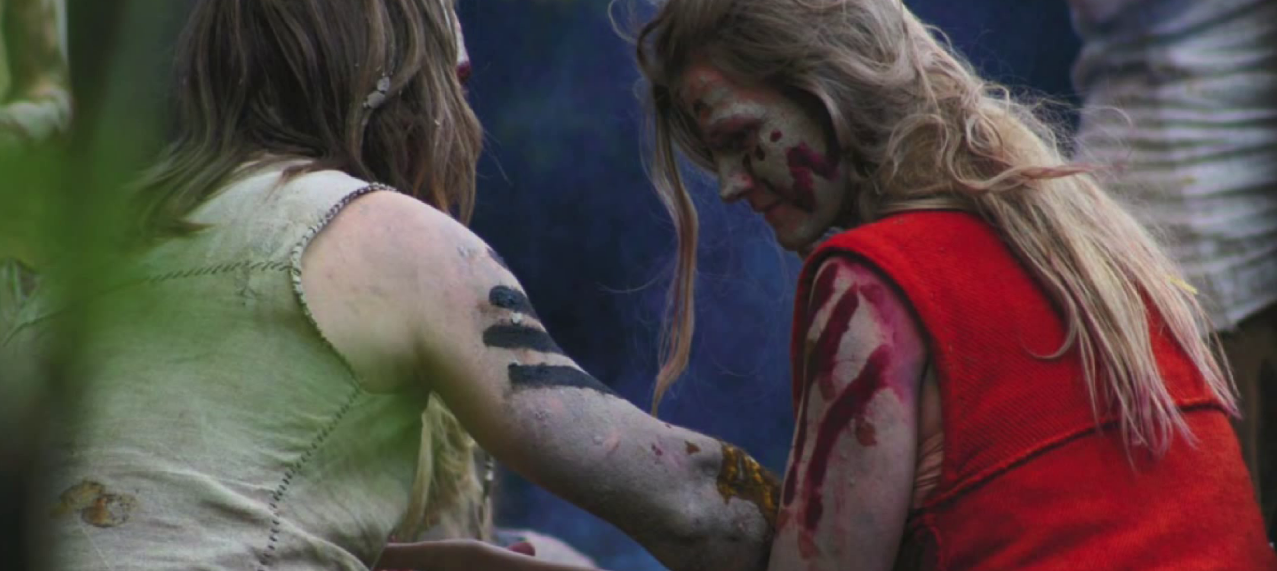
    Cover photo: Arm painting at Totem (photo, Mathias Kromann Rode).

    Content editing: Sarah Lynne Bowman.

    1. A Nice Evening with the Family was redesigned by Tor Kjetil Edland, Elli Garperian, Kajsa Greger, Susanne Gräslund, Anders Hultman, Caroline Holgersson, Frida Sofie Jansen, Maria Ljung, Gustav Nilsson, Martin Rother-Schirren, Daniel Sundström, Anna Westerling and Emma Öhrström in 2018, and subsequently re-run in 2018 and 2019. ↩︎