Author: Gerrit Reininghaus

  • Actual Plays of Live-Action Online Games (LAOGs)

    Published on

    in

    Actual Plays of Live-Action Online Games (LAOGs)

    By

    Gerrit Reininghaus

    Summary

    This article introduces the reasoning for making recordings of larps played online. We present our core concepts and provide a categorisation of motivations, followed by an overview of the historical development of LAOG Actual Plays (APs). We also discuss some theoretical concepts and design goals around AP-informed play, and point to some further avenues of exploration.

    What are Live Action Online Games (LAOGs) and LAOG Actual Plays (APs)?

    Live-Action Online Game – LAOG

    One of the truisms of larp design is that “everything is a designable surface” (Koljonen 2019, 27). It is not surprising, therefore, that different communities have used the specific characteristics of the online medium to design games that can be considered a larp. The term LAOG stands next to similarly used terms like online larp, digital larp, VORP (virtual online role-playing) and others. We suggest that something should be considered a LAOG if it corresponds to the components of the abbreviation: it is to be played as live-action, with a sense of a full-body experience; it is designed specifically for an online context; and it is a game (however one wants to define that term). LAOG as a term was first established in A Manifesto for Laogs in 2018 by one of the authors of this essay (see Reininghaus 2019).

    Actual Play – AP

    An Actual Play is a representation of game play – either live or recorded – that is prepared and made available for an audience. Actual Plays of digital and analog games have become a significant aspect of today’s popular culture. Platforms like Twitch and YouTube provide space for creators to host their own APs, some of them live, others pre-recorded. Actual Plays can present board games, video games, Tabletop role-playing games (TTRPG) – or larps.

    The history of and some current community perspectives on LAOG APs

    The history of AP recordings is connected to the development of technologies that make live-action online games and their recording possible. For some time, Skype was the most popular software that offered possibilities for online play, but this required paid accounts and had some technical drawbacks, like limited screen-sharing possibilities. TeamSpeak, as an audio-only platform popular for massive multiplayer online role-playing games (MMORPGs), offered possibilities to play online but to our knowledge was only used for TTRPG online sessions.

    The introduction of Google Hangouts provided a video chat platform which can be considered a game changer. Google Hangouts was a service offered by Google from 2013 to 2022 without any financial cost to users. It brought playing TTRPGs online to a wider audience, and allowed players from all over the world to connect and play together. Recording and hence making APs was easy, as the direct connection to the YouTube platform allowed users to stream or record and later publish their games with a few clicks after doing an initial setup. For example, Google Hangouts enabled the growth of The Gauntlet (now known as Open Hearth Gaming), an Indie TTRPG online community, where for many years it was used as the main medium of play. The resulting large library of APs is still available on YouTube.

    Already before the rise of Google Hangouts, in 2012, Orion Canning and Robert Bruce designed and played The House online. It does not fall within our narrower definition of LAOGs as it is not played synchronously, but players are invited to upload videos recorded in-character as inhabitants of a Big Brother-like reality TV show to a YouTube channel offered by the creators. Other players then react to these videos, again by recording their reactions and uploading them. The game is entirely based on the “confession video” format popularized by reality TV shows, in which participants of the show are talking to the camera by themselves, without the other participants present, about their motivations and strategies. As an AP, it is difficult for the audience to follow the exact stream of events, which possibly replicates the feeling of the source material quite closely.

    ViewScream by Rafael Chandler came out in 2013 and became the cornerstone for LAOG APs for the next six years. The game referred to itself as “Varp”, or “video-augmented role-playing”. In ViewScream players play people on a spaceship doomed to destruction. The mechanics guarantee that not all characters can get out alive. The video call setting is an in-game element: not only the players but also the characters are all in a video call together, calling in from different areas of the spaceship. The run time is approximately one hour. The game provided virtual backgrounds, several scenarios as variations of the game’s story, and included a captain role with some typical game master functions in the sense that this player was specifically asked to help create a dramatic story. All these ingredients and the novelty of the format helped to create a small ViewScream community and the creation of at least 30 APs.

    Interestingly, ViewScream did not emerge out of a larp community but was developed in the context of a TTRPG community, mostly active and connected on the platform Google Plus, which at the time was important for Indie TTRPG creators.

    In 2017, Gerrit Reininghaus started creating APs for LAOGs on his YouTube channel “betafunktion”, with Jason Morningstar’s Winterhorn (2017) as the first AP. Soon after, in 2018, Reininghaus published A Manifesto for Laogs and established the genre. Today, betafunktion contains the largest collection of LAOG APs, presenting more than 20 games by different creators (see Reininghaus 2020). The YouTube channel has become a reference point for LAOG creators, with the recordings with the largest view count making it to more than 1.6K views (of So Mom I Made This Sex Tape, 2016) at the time of writing.

    The pandemic brought increased attention to online larp. Many creators have since then entered the design field and shared design ideas (see e.g., D.& Schiffer 2020; Marsh & Dixon 2021). However, few APs have been created during the pandemic. The LAOG The Space Between Us (2020) became an underground hit and its APs and fan productions went viral in interested circles. Why LAOG APs did not become even more popular during this time of elevated attention for online play is a question that cannot be fully answered here. One suggestion the authors can offer is that larpers have a) a more rigid understanding of the social contract in larp, specifically that a larp shall not have an audience, b) that familiarity with the technology required to make APs was not immediately available, and c) that one platform which became a home for many designs during the pandemic was Discord, which – unlike Google Hangouts – does not allow for simple recordings. However, Zoom, which also became popular during the pandemic, does (see Otting 2022).

    Over time, the larp scene has recognised the existence of LAOG APs. For example, the German association of larpers (Deutscher Liverollenspiel-Verband, DLRV) awarded the FRED award in 2020 for advocating larp to a larger audience to the aforementioned YouTube channel betafunktion.

    Why should we make APs of LAOGs?

    There are many reasons to produce Actual Plays of Live-Action Online Games. We provide a structured overview here that hopefully reflects most motivations. In any concrete project, there often will exist a combination of different reasonings for producing AP recordings.

    APs as entertainment

    Currently, the most prominent form of role-playing APs are productions to entertain an audience. Actual Play video shows like Critical Role or podcasts like The Adventure Zone have become part of the entertainment industry. But even shows without large profit ambitions have created their own style and offer high production values. Nameless Domain is a producer of such APs, now award winning for GUDIYA, a Bluebeard’s Bride (2017) one-shot. The Magpies, a Blades in the Dark AP-podcast by Clever Corvids Productions is another example. Some of these APs can be both watched live and in recorded forms, with the recordings usually edited and enhanced for a better audience experience. Live shows make use of the entertainment format and excitement present in something like live sports – with the unexpected luring behind every corner. The actual game play is just one contributing factor in APs for entertainment, while participants’ performances, the production values, and pre-written story arcs often play a similarly important role for the end product.

    While TTRPG-APs have today become part of a growing entertainment industry, as far as we are aware not many LAOG APs have so far been (professionally) produced purely for reasons of audience entertainment. However, some of the larger commercial TTRPG shows like KOllOK have recently included live-action elements with success (when measured in terms of public appraisal and audience size).

    AP production can also be part of a LAOG’s design concept. The recording can be a diegetic feature of the game as in a reality show larp. Or, if watching or listening to a recording of (parts of) the game is itself considered an element of gameplay by the designer and hence it can be a source of entertainment for the players. In The House (2012), for example, directly interacting with the camera in-character is a central design element.

    APs for demonstration purposes

    APs can also be produced to demonstrate how to play. The teaching of games through play itself has always been an important part of play cultures, and assumes that people best learn about a game when they see how the rules work in practice. This is especially true for role-playing games and larps, which have a large body of implicit rules of engagement not laid down in scripts or rulebooks.

    In a certain sense, recording LAOGs for demonstration purposes allows non-larpers access to a first-person perspective of a larp. The audience sees exactly what the player themself has seen during play. Such APs also provide insights to the designers about how their game works “out in the wild”. Designers can benefit from seeing specific mechanics and techniques in play, for example to analyse player engagement and dynamics, and their effects on pacing.

    Play cultures in larp differ significantly: another proper reason to produce APs is to showcase your own playstyle, although this is often a side effect rather than the intended production reason. One exception might be if larp production companies want to showcase their specific playstyle, making it easier for potential players to identify if a larp is right for them.

    APs as a community contribution

    We do not larp alone. As larp communities, we share our joy, we like to engage in discussions of games, and of our play experience. We like to see people we have played with in other games, and we watch out for each other.

    Recording a game for the community can happen to establish facts about how the community is playing (safety, inclusivity). This is not the same motivation as demonstrating game play or showcasing play culture as previously described. APs from and for a community are revealing community norms in less intentional ways.

    Producing an AP from and for the community is sending a signal on what is played, who is playing, who is visible, and consequently who is relevant. It is a way to emphasise community structures and relationships.

    APs for posterity

    Making an AP can be an artistic expression. In this case, the game itself might be designed around the AP concept or the production might be focused on turning the game into an artistic expression.

    APs can make contemporary play culture visible, and that might also be a goal: to help future generations understand how live-action games were played online, who was playing, and what unwritten or undocumented elements were relevant to players at the time. Archivists and researchers will be grateful for live recordings of games from past decades.

    When participating in a LAOG, recording it can also be motivated by the idea of creating a personal memory. Just like taking photos at events, an AP is a form of conserving an experience in some form, to be able to return to it later in life.

    Audience in online game design and LAOG facilitation

    Making an AP of a LAOG is in most cases different from documenting a larp played in physical space. The recording button is not as intrusive as it is to have a person with a camera circling around the players in-character. Even when the camera is an in-game element, recording has a more direct effect in physical larps.

    It remains an open question if recording, both live-streamed or published later, is a violation of a central aspect of the sort of social contract (also called the “role-play agreement”, Stenros & Montola 2019, 17) often seen as a unique and required ingredient of larp: the fact that play is not performed with an audience in mind. Some players have reported that they cannot enjoy being in a recorded play session, as they start playing performatively. Other players explain that playing in a recorded session does feel different to them during an initial short period of time, often just minutes, in which they get used to the situation. This is similar to the inhibition expressed by players towards non-diegetic LAOGs (see Reininghaus 2021). Non-diegetic in this context means that the characters of the game are not speaking through a video call to each other but in the shared imaginative space might be physically close together. Some players report that they cannot enjoy the dissonance between the players’ distance and their characters’ potential closeness.

    From a safety perspective, recording online play requires a couple of specific considerations. The following procedure can be considered good practice:

    1. Announce in the sign-up process for the game that a recording is planned.
    2. Remind players at the beginning of the game that the session is going to be recorded and offer an Open Door, i.e. the option to drop out at any time for this reason (or any other, without having to offer any justification).
    3. Break debrief into two parts: a recorded and an unrecorded part.
    4. Do not stream the game live, instead offer a 48-hour hold-off period before publishing the video. Inform players that they can express a veto after play, meaning that the recording is not going to be published as an AP.

    From a game design perspective, APs offer an interesting additional creative dimension. A game designed to be recorded for AP purposes has specific requirements. If the video call’s chat is used as a communication dimension in the game, for example, a typical recording will not capture this and hence the AP will present only an incomplete version of the session.

    Games which assume that players move between different virtual video rooms require choosing the recording perspective. The audience will either follow one player through their experience of the game session in multiple rooms, or experience everything that happened in only the one virtual room that was being recorded. If more than one player is recording their play, the audience can shift between views and create their own experience of the game. The APs of End Game (2016) allow for such an experience, as players are shuffled between the two in-game rooms exactly every ten minutes, allowing the audience to choose whose story to follow next.

    Gerrit Reininghaus designed the game Last Words (2019) with an “audience first” approach in mind. Some players play the game muted, some without a camera or sound, due to the asymmetrically-designed communication setup. While during the game no player therefore fully experiences what is happening, an audience can have access to this experience – in a single recording.

    Conclusion

    Both for players of larps and for future researchers, an archive of APs of contemporary larp play styles online could turn out to be invaluable. This alone should encourage more community members to consider recording their games.

    We also see plenty of potential avenues for further theoretical and practical explorations around APs of LAOGs. For example, we do not know much yet about the concrete effects that being recorded has on online play. We equally should consider the possible ethical implications of recording and distributing records of LAOG play, like a near-future use of public video libraries for training generative AI models. On the positive side, APs could positively contribute to making minorities in the larp and LAOG communities more visible.

    Regarding future potential design avenues, we are excited – as facilitators, designers, players, and audiences – to further explore how LAOGs can be designed to make AP production easier, how the recording and re-watching of APs can be a tool for iterative game design, and what APs as a designable surface can contribute to larp. We are looking forward to seeing these questions explored in the future.

    Bibliography

    Quinn D. and Eva Schiffer (2020): Writing Live Action Online Games. NordicLarp.org. https://nordiclarp.org/2020/12/19/writing-live-action-online-games/

    Critical Role (2012–) [Multi-Platform AP-productions]. https://critrole.com

    F.R.E.D. – Preis für Fortschrittliche Rollenspiel Entwicklung in Deutschland (in German)
    http://www.larpwiki.de/F.R.E.D.

    Jaakko Stenros & Markus Montola (2019): Basic Concepts In Larp Design. In Larp Design: Creating Role-Play Experiences, edited by Johanna Koljonen & al. Kopenhagen: Landsforeningen Bifrost (Knudepunkt 2019), p. 16–21.

    Johanna Koljonen (2019): An Introduction to Bespoke Larp Design. In Larp Design: Creating Role-Play Experiences, edited by Johanna Koljonen & al. Kopenhagen: Landsforeningen Bifrost (Knudepunkt 2019), p. 25–29.

    KOllOK – a Live Interactive Series
    https://www.hyperrpg.com/kollok

    Erin Marsh and Hazel Dixon (2021): Accessibility in Online Larp. NordicLarp.org. https://nordiclarp.org/2021/03/17/accessibility-in-online-larp/

    Nameless Domain – an award winning AP show cooperative
    https://www.twitch.tv/namelessdomain

    Open Hearth Gaming Community – over 5.000 APs of LAOG and TTRPG sessions
    https://openhearthgaming.com/

    Ylva Otting (2022): The Online Larp Road Trip. NordicLarp.org https://nordiclarp.org/2022/10/21/the-online-larp-road-trip/

    Gerrit Reininghaus (2019): A Manifesto for Laogs – Live Action Online Games. NordicLarp.org. https://nordiclarp.org/2019/06/14/a-manifesto-for-laogs-live-action-online-games/ (first published in 2018 at https://tinyurl.com/laogmanifesto)

    Gerrit Reininghaus (2020): An Overview of Existing LAOGs. Alles-ist-zahl.de. https://alles-ist-zahl.blogspot.com/2020/03/an-overview-of-existing-laogs-live.html

    Gerrit Reininghaus (2021): Three Forms of LAOGs. NordicLarp.org. https://nordiclarp.org/2021/05/27/three-forms-of-laogs/

    The Adventure Zone (2014–) [AP-podcast]. https://maximumfun.org/podcasts/adventure-zone/

    The Magpies Podcast – A Blades in the Dark Actual Play Podcast (2018–2021). https://magpiespodcast.net.

    Evan Torner (2021): The Golden Cobra’s Online Pivot. Japanese Journal of Analog Role-Playing Game Studies. https://jarps.net/journal/article/view/23

    Ludography

    Blades in the Dark (2017) by John Harper. Evil Hat.
    Available at: https://evilhat.com/product/blades-in-the-dark/

    Bluebeard’s Bride (2017) by Whitney “Strix” Beltrán, Marissa Kelly, and Sarah Richardson. Magpie Games.
    Available at: https://magpiegames.com/pages/bluebeards-bride

    End Game (2016) by David Hertz. Glass-Free* Games.
    Available at: https://preview.drivethrurpg.com/en/product/179639/end-game

    Last Words (2019) by Gerrit Reininghaus. Gauntlet Publishing.
    Available at: https://www.drivethrurpg.com/product/293711/Codex–Melancholy-Jul-2019
    AP: https://www.youtube.com/live/Zi7FGdZ_7JE?si=B5iP1mGw0CKiKif5

    So Mom, I Made This Sex Tape (2016) by Susanne Vejdemo. #Feminism Anthology. Pelgrane Press. Available at: https://feministnanogames.wordpress.com/
    AP: https://www.youtube.com/live/yp9VHDnBAqw?si=CgWhgTOBCSyGKeTG

    The House (2012) by Orion Canning and Robert Bruce.
    Available at: https://thehousethegame.blogspot.com/2012/06/
    AP: https://www.youtube.com/@thehousethegame/videos

    The Space Between Us (2020) by Wibora Wildfeuer.
    Available at: https://wiborawildfeuer.itch.io/the-space-between-us
    AP: https://www.youtube.com/watch?v=8TgXj7N5tNw

    ViewScream, 1st Ed. (2013), 2nd Ed. (2016) by Rafael Chandler. Neoplastic Press
    Available at: https://www.drivethrurpg.com/product/187177/ViewScream-2nd-Edition
    AP playlist:
    https://www.youtube.com/playlist?list=PL5aYJUQzFBqWMQ8bXYddx1PMp4hDYmibY/

    Winterhorn (2017) by Jason Morningstar. Bully Pulpit Games.
    Available at: Game: https://bullypulpitgames.com/games/winterhorn/
    AP: https://www.youtube.com/live/sMx3K7ljNNI?si=4iWbrYBp81lT2lmv


    This article has been reprinted with permission from the Solmukohta 2024 book. Please cite as:

    Reininghaus, Gerrit, and Adrian Hermann. 2024. “Actual Plays of Live-Action Online Games (LAOGs).” In Liminal Encounters: Evolving Discourse in Nordic and Nordic Inspired Larp, edited by Kaisa Kangas, Jonne Arjoranta, and Ruska Kevätkoski. Helsinki, Finland: Ropecon ry.


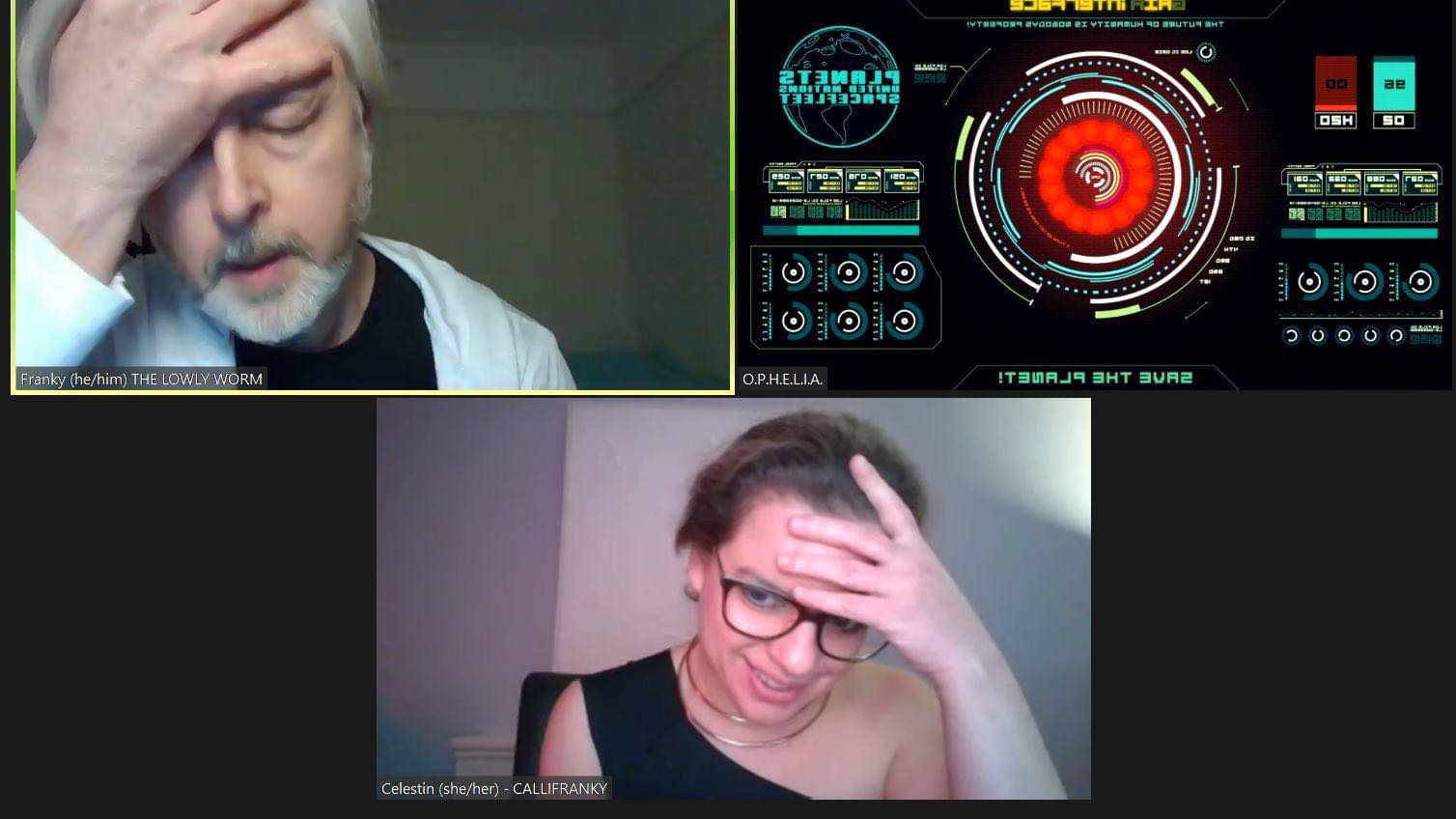
    Cover photo: Screenshot by Simon Rogers from online larp The Space Between Us, written by Wibora Wildfeuer, run by Sydney Mikosch

  • Three Forms of LAOGs

    Published on

    in

    Three Forms of LAOGs

    By

    Gerrit Reininghaus

    In this article, I present a categorization of LAOGs – depending on how they make use of the communication channels in place. I identify three different forms: The Diegetic Call, The Invisible Call, and The Metaphorical Call. Let me take you on this journey of design exploration. Then make up your own mind how your experience fits or does not fit into this picture.

    Three forms of LAOG, illustration by Gerrit Reininghaus
    Three forms of LAOG, illustration by Gerrit Reininghaus

    LAOG stands for Live-Action Online Game. As the name indicates, this is a category of games which have a strong live-action component and are designed for online play. LAOGs have dramatically increased in popularity due to the pandemic of 2020 / 2021 when many larpers turned online to find an outlet for the grief for the loss of their hobby in the time of social distancing. Many people also use the terms online larp, digital larp or LORP (Live-Online Roleplaying) for more or less the same thing. It does not matter that much how it is called.

    However, LAOGs have the distinct claim that they are designed for the online space and are not a mere replacement for something else. Moreover, as the author of this piece is personally coming from a TTRPG background, the word LAOG nicely combines these worlds: taking the LA from larp, the G from RPG and then merging the two and their design world in the O for the online space.

    The concept existed already before. The LAOG manifesto was published in early 2018, first as a collaborative Google Doc, then later on the larp theory website nordiclarp.org. The first LAOG in existence though at that time was already a few years old. ViewScream by Raphael Chandler came out in 2013 and already had all the ingredients in place.

    The Golden Cobra freeform / larp competition recognized the existence of the design framework first in 2019 when the jury made LAOG its own category to win a Golden Cobra. The 2020 competition of the Golden Cobra was then already all and only about LAOGs (plus epistolary games).

    With the plethora of LAOGs now in existence, it is time to take a step back and see if they can be categorized in a meaningful manner. Categorization is not to be understood to once and forever put ideas and designs into a box and never let them out again. It will also inevitably fail to recognize the beauty of imagination of game design and how it slips out of any attempt to pin it down on one definition. Quite the opposite, the following categorization shall be an invitation to break it. Designers, please look at this and prove it all wrong!

    The video call – communication kernel of LAOGs

    The core of most (not all, more about exceptions later) LAOGs is the video call. Google Hangout was the first and most prominent service for many years in which RPGs could be played in a video call for free (well, paying with your personal data in your Google account, that is).

    In a video call you have many ways to express yourself: there is your voice, with all its nuances, your face expression, your background, i.e. what is behind you, the side chat. In some services you see yourself as a group (gallery view), other services provide an AI controlled speaker focus, most modern services allow you to choose whatever you prefer.

    Virtual backgrounds add another dimension (thanks to AI identifying your upper body that even now works without a proper unicolored background – aka green screen). Many side chats allow for direct messages to other participants, allowing for secret communication. You can mute yourself and switch your video off. Hosts often can do so for others.

    Features, fancies and the future

    Every platform has its own set of features beyond that – allowing for very different design surfaces. However, as a designer it is a big bet to rely on a non-standard feature. Not only will the game be less likely played if players are forced to use a platform they are not on yet. More so, if the service your game relies on switches that feature off or goes completely out of service, your game is dead.

    Another array of video platforms has arisen in 2020: 2D or spatial chat services like gather.town or spatial.chat imitate a two-dimensional landscape one can wander on. A video call is established as soon as people are in a certain proximity to each other. For some services, the sound volume depends on how close you are to somebody.

    Finally, Discord is until now the most elegant way (though by far not the most elegant video call service) to connect many video, voice and chat channels together in a meaningful way. Games designed for a Discord use channels to imitate real world places or thematically separate players and their in-game-abilities.

    Forms of LAOGs

    Yet, the dominant play form still is the video call in one version or another.

    Given this preset, what forms of LAOGs have we seen emerge in the last years? The following is the attempt to categorize some of the games we have observed and how to set them into position to each other. A disclaimer right at the start: no form is better than the other. However, I have to admit that I personally am more excited by some forms than by others at the moment. You can probably guess which.

    Cover of The Space Between Us, composite image by Wibora Wildfeuer
    Cover of The Space Between Us, composite image by Wibora Wildfeuer

    The Diegetic Call

    The first category or form of LAOGS, diegetic video calls, has been around since the very beginning. This is about LAOGs where the video call is a video call in-game or something very close to a video call for the characters.

    Already in 2013, ViewScream was published and immediately a success in TTRPG circles (not in larp circles interestingly). ViewScream, by Raphael Chandler is a space drama to be played fully in-character about a crashing spaceship with just not enough tools to rescue everybody. Players are connected via video call which is interpreted as the board communication system. The call is a call. Characters are at different locations. They connect through a video call – just as the players do.

    Another example is So Mom, I Made This Sex Tape. This game by Susanne Vejdemo came out in the #feminism anthology in 2016. The LAOG variant was first played in 2018. In the original game, female family members meet for coffee and cake to discuss the involuntary publication of a private sex tape. In the LAOG variant, the setting is naturally modified to have the family members only be connected through a video call. Bad connection, grandma not finding the unmute button, etc: you can build all your technology troubles into your game play.

    The same principle applies to Winterhorn by Jason Morningstar. The LAOG variant was first played only a week after the game was published in 2017. A group at the Gauntlet Community, which is known for being at the forefront of work on online play, played the game as a LAOG. In its original version it is supposed to be a series of office meetings of secret agents and state policy to sabotage a group of political activists. Obviously, these meetings can equally be held in online meetings – as the rest of the world learned in the pandemic of 2020.

    There are plenty of games now using the video calls in this diegetic manner. The Space Between Us by Wibora Wildfeuer, maybe the most often played LAOG until now, and winner of the prestigious German larp award FRED as the Best Mini-Larp 2020, is returning to the video call as a remote connection between spaceships as did ViewScream seven years before.

    There are games which go a bit further in the diegetic interpretation. For example, games in fantasy settings consider the video call as “magic crystal balls of distant communication.” But in the end, the call is a call.

    This seems important to many people coming from a physical larp background. I have heard voices who claim that their immersion fails if games consider the video call in other ways. It seems difficult to imagine doing what you did before out in the world, face to face, now disrupted by screens, headsets and microphones.

    However, I would suggest thinking about this: wasn’t it equally difficult to imagine at the beginning of your larp career that you could ever take foam swords or foam fireballs seriously? That people with crossed arms on their chest can be ignored as if they were not there although they obviously are? Suspension of disbelief is a difficult beast. But I ask myself why it should stop at a video call but has not for other meta techniques.

    This especially goes for safety techniques. I still remember the days when safety techniques were considered as making our games lame. The disruptive nature of the X-card or an out-of-game check-in if somebody is ok with certain content seemed problematic. But safety techniques did not take away the fun, instead quite the opposite. People got over it. We now have a widened repertoire of techniques and more games available than we had before. The same goes for LAOGs in which video calls are not diegetic. Which brings me to the next form of LAOGs.

    The Invisible Call

    Second-generation LAOGs did not mind about the video call. The call stayed invisible in the background. That you and the other players could not interact physically was considered as much of a fact as that you would not hurt or sexually interact with other players in a physical larp although your characters would possibly do that.

    They might have taken inspiration from freeform RPGs like Witch: Road to Lindisfarne or Fall of Magic, which were already played freeform widely online without trouble and often enough pretty much all in-character within a scene. More likely though they were inspired from the Nordic Larp tradition of chamber larps or black box larps.

    Digital Black Box cover from The Election of the Wine Queen, illustration by Gerrit Reininghaus
    Digital Black Box cover from The Election of the Wine Queen, illustration by Gerrit Reininghaus

    The first was The Election of the Wine Queen which started as an adaptation of a physical larp but quickly turned into its own beast. It was labelled as a “digital black box larp” back then (that was before the LAOG manifesto was published) and it delivered on these terms: The game ignores the video call. Players who are not in a scene switched off their camera. As this game is about a competition in a wine region (a bit like a beauty queen contest), players not in a scene are invited to make wine drinking noises, like pouring water or wine close to the mic, or letting two glasses clank. This is purely for ambience. Between acts, each consisting of 4 to 6 scenes, players step out of character to plan scenes and discuss the progress of the story. Then scenes are played without further breaks.

    Inner monologues are part of the game: while everybody else has their camera off, the monologuing player talks to themselves as if they are alone in the room. Sometimes this can be interpreted as a video diary. Sometimes it is seen as talking with your mirror.

    LAOGs with invisible calls might be designed to be about people sitting together at a table (like in The Wizard’s Querulous Dram or in the Society of Vegan Sorcerers) over the whole play time, and so by design not interacting physically. But, like in The Election of the Wine Queen, they can also focus simply on the dialogue. Aspects of the surrounding can be brought in easily as direct speech, in the same way that an audio play would do it: “How do you like my new green dress?” establishes smoothly what your character is wearing. “Shut up, little sis’, I’m now talking to mom” introduces an NPC without ever hearing an actual word from them.

    While Diegetic LAOGs have to care less about the limitations of an online connection compared to being physically present in the same space, Invisible Call LAOGs have more freedom in the design.

    Another important thing is tone setting: Diegetic LAOGs inherently emphasize the isolation between the players. We are not in the same space and this fact is part of the game. Invisible LAOGs allow us to forget the physical distance for a moment. We can feel like sleeping together in a room with bunk beds, focusing on hearing the others breathing: in the flow of play, we can forget about the fact we are bound to a computer screen and a keyboard. Especially in times of a pandemic, many people consider games an escape from feelings of isolation. So Invisible LAOGs might be a better choice for them.

    The Metaphorical Call

    Finally, the call can be a metaphor. This goes beyond coming up with a different interpretation of what the call stands for. Instead, what I mean by the metaphor is that the call is stripped to its essential ingredients, re-interpreted in some of its elements and transformed into an integral mechanic of the game. This might become clearer after some examples.

    The communication setup of Last Words, illustration by Gerrit Reininghaus
    The communication setup of Last Words, illustration by Gerrit Reininghaus

    Last Words is a three-player LAOG about a deceased and a living person who still has unresolved business with each other. The Living frequently comes to the grave of the Deceased and tells them what is changing in their life. The spirit of the Deceased is responding but cannot be heard by the Living. An Angel, the third player, is instead communicating for the Deceased by sending images into the Living’s dreams. This is all realized by a video call in which the Living is putting their volume to zero as does the Angel. If the session is recorded, which is especially recommended for this game, the player of the Living can later listen to what the Deceased had to say. The Angel still can hear what the Deceased has to say but not what the Living says, as Angel and Deceased are connected through a separate voice-only call. The dream images are sent through a shared Google Drawing. If you want to go full in, the Deceased can play the game from their bed, in the dark, emulating the feeling of lying in a grave.

    As we see, the call is dissected into its communication components: who sees whom and can hear or express themself is limited by the game’s logic. The Metaphorical Call feels much less like a call than an intermittent medium subordinated to the meaning of the in-game equivalent.

    Other games do not go that far and yet turn the video call into something new. In Makeup Moments players are a group of friends or colleagues preparing for a big event, by putting up makeup on together. Players actually put makeup on in the game and are asked to use their webcam view as a mirror. The intimacy of caring about your appearance is literally mirrored by the secret not so secret observer who can look at you as if they are behind the mirror. The webcam as a mirror is a powerful re-design of a tool which is in its original design meant to look at others, not yourself.

    In The Batcave players play a family of bats hanging from the ceiling of their cave to figure out which cave to inhabit next. Feeling like a bat is achieved by putting a blanket around your shoulders – and by turning the camera view upside down – a feature Zoom currently offers and which can also be reached through the OBS video processing software. That way, players look like they are hanging from the ceiling. While in the game, one gets quickly used to that view – a group of people in a call all upside down is absurd enough – and players turn fully bat in their body motions and noises they make

    Screenshot from The Batcave, by Gerrit Reininghaus
    Screenshot from The Batcave, by Gerrit Reininghaus

    What’s next

    I have given a short introduction into the art of LAOG and offered a categorization on what forms a video call can take in a LAOG. The LAOG manifesto will present to you more important stuff I could not pack into this article, like talking about the many aspects of inclusivity LAOGs are providing or discussing safety issues in LAOGs.

    More and more sources about the potential and interpretations of this design framework are getting published. Scholars also discuss questions around accessibility of the format, extending on what has been laid out only roughly in the LAOG manifesto. The best place to stay in touch with the latest developments currently is a Facebook group called Remote, Digital Larp and Live-Action Online Games. There, you will also find out how many other forms LAOGs can take, far beyond the expected video call.

    Playing a LAOG through sending songs to each other alone (Radio Silence by Hannah J. Gray) or a text chat based LAOG accompanied by its own pace setting soundtrack (Alice is Missing), playing through Instagram by sending euphoric and supportive comments to each other’s best yoga poses (#instayoga) – there are more options that “Online” can provide to us.

    Give it a try. LAOGs come in all kinds of flavours and forms.


    Ludography

    Chandler, Raphael. ViewScream, 1st Edition. Neoplastic Press. 2013

    Cowman, Ross. Fall of Magic. Heart of the Deernicorn. 2015

    Gorman, Wendy. Society of Vegan Sorcerers. Gauntlet Publishing. 2017

    Gray, Hanna J. Radio Silence. Game and a Curry. 2021 (still to be published)

    Lacy, Richard & Barthaud, Kevin. Witch: Road to Lindisfarne. Pompey Crew Design. 2012

    Morningstar, Jason. Winterhorn. Bully Pulpit Games. 2017

    Reininghaus, Gerrit. Last Words. Gauntlet Publishing. 2019

    Reininghaus, Gerrit. Makeup Moments. Gauntlet Publishing. 2019

    Reininghaus, Gerrit. Outscored. Golden Cobra Challenge. 2019

    Reininghaus, Gerrit. The Batcave. Golden Cobra Challenge. 2020

    Reininghaus, Gerrit. The Election of the Wine Queen. Gauntlet Publishing. 2018

    Roske, Shawn. #instayoga. 2019

    Stark, Spenser. Alice is Missing. Hunters Entertainment. 2020

    Stark, Lizzie & Morningstar, Jason. The Wizard’s Querulous Dram. Bully Pulpit Games. 2020

    Vejdemo, Susanne. So Mom, I Made This Sex Tape. #Feminism Anthology. 2016

    Wildfeuer, Wibora. The Space Between Us. 2020

    Bibliography

    D, Quinn & Schiffer, Eva. Writing Live Action Online Games. NordicLarp.org. 2020

    Felton, Acata. LARPs Playable Online. Google Sheets. 2020

    Marsh, Erin, and Hazel Dixon. Accessibility in Online Larp. NordicLarp.org. 2021

    Reininghaus, Gerrit. The LAOG manifesto. NordicLarp.org. 2019

    Reininghaus, Gerrit. An Overview of Existing LAOGs. Alles-ist-zahl.de. 2020


    Cover photo: Negative Space from Pexels.

  • A Manifesto for Laogs – Live Action Online Games

    Published on

    in

    A Manifesto for Laogs – Live Action Online Games

    By

    Gerrit Reininghaus

    Laog is short for live action online game – and that says it all, doesn’t it? We can larp – live action role-playing – when being behind our video camera. We can play with people all around the globe and be 100% in-character. We can make use of meta techniques, be 360 degrees in or break out of character for scene setting on intervals.

    Laog is a design realm we want to explore and define it by making and playing games in it.

    This document is about what we learnt, what we imagine and what we recommend.

    [Disclaimer: we are not bound to the term laog – ‘digital larp’ or ‘online larp’ work just as well. What speaks for laog: it’s not a derivative from other play forms.]

    Screenshot by Gerrit Reininghaus from a game session of The Election of the Wine Queen.
    Screenshot by Gerrit Reininghaus from a game session of The Election of the Wine Queen. The game is published in Codex Sunlight, to be found on DriveThruRPG soon. People visible have given permission of this screenshot’s use. Used with permission by the author.

    Playing Online

    Playing online provides us with some extra tools, demands good care and imposes certain constraints.

    More Tools

    Having a chat window for everybody in a game defined as out of character is an opportunity for many aspects: meta techniques, safety check-ins, technical and rules questions etc.

    That there is a physical distance between players allows us under certain circumstances to feel safer. The door which is always open is just a click away. You can return home a second after you decide to go. Private chats between players can be an additional and non-intrusive way to check-in, to continue debrief, to work through the experience.

    Good Care

    The Leave Call Button Is Always Available

    Safety tools are important for laogs as they are for larps or online tabletop RPGs. Laogs shall not be run without everybody willing to take care for each other. People are always more important than the game. The “Leave Call” button is always available. We don’t play laogs with people who don’t respect others boundaries, who can’t accept diversity and that people are different. laogs shall be as inclusive as possible.

    Safety Tools

    The X card is an important tool and an easy to grasp safety technique. For every laog, provide a way to include the X card or a similarly efficient safety technique. In video calls the X card can easily be tapped by typing an X into the chat window and if necessary name the content you like to X card. Nicely, some chat tools (including Google Hangouts Video chat sidebar allow for anonymous posting. To increase visibility and that people pay attention to the use of an X card you can additionally cross your arms while being on camera or verbally call for the X card.

    The Safety of Your Space

    Not part of the game but part of your responsibility as a laog player is taking care for the people in your surrounding being affected by the game. Have you informed everybody what you are planning to do and that nobody needs to be worried? Does somebody need to sleep or could otherwise be negatively affected by your play?

    De-role and Debrief

    Good aftercare is an important part of every laog. Nobody has to participate in a debrief. No technique fits all laogs. Every laog shall carefully consider what structure and method they want to follow. It has to be adequate to the degree of intensity and sufficient time should always be made available.

    Constraints

    Set-up

    Online play brings with it some hurdles.

    It is good practice to check your technical set-up before the game. Your microphone and webcam should be ready to go and your internet connection needs to be sufficiently fast and stable.

    Surroundings

    Will your surroundings be suitable for the play time – think of background noises, phone calls, light. Check in with other players what constraints you have for play and if it’s alright for them.

    No Physical Space

    The virtual room we create in a laog is lacking many features a physical space can provide. A laog takes these constraints into consideration in its design (and might find interesting ways to circumvent the shortcomings). One on one discussions are more difficult to be organised. Body language is far more limited and players should find suitable ways in written format (e.g. emojis) or with mimic to alleviate communication to physical level. Physical interaction like touching, the sheer presence of another human being need less intuitive re-interpretations.

    Screenshot by Gerrit Reininghaus from a game session of the LAOG adaption of ‘End Game’.
    Screenshot by Gerrit Reininghaus from a game session of the LAOG adaption of ‘End Game’. End Game is by David Hertz, published by Glass Free Games. People visible have given permission of this screenshot’s use. Used with permission by the author.

    Playing Live

    This section is looking on laogs from the perspective of online tabletop roleplayers.

    Playing 100% in-character will sound frightening to some – even very experienced online RPG players. That is totally alright and indeed it is for some a great experience, for some an interesting experience and for others not what they are looking for.

    Being in Character – All the Time

    When you play a laog you should always be in character when your webcam is on. That means every motion of your head, how close you are to the camera, the tone of your voice, your eyes rolling, your tongue snarling is in-character. There will be exceptions as there are and shall always be exceptions from aesthetic rules everywhere in the world.

    When you look at other player characters find an element in their habits or appearance which lets you lock your imagination of the character they incorporate. Such an anchor makes it easier for you to stay in character while interacting with others.

    Switch your camera off any time you need a moment out of character.

    Online Immersion Is Possible

    How immersive a laog experience is depends more on the combination of the laog, the other players and you than on the format. If all three are a good fit, you probably will have a good time in that regard.

    Being for a longer time fully in character can be intense. Incorporating somebody or something else with your full body means that you might have a full body experience. Listen to your body and mind accordingly in terms of safety but also in terms of getting the full experience of the laog. Continue listening to your body and mind when the laog is over and the cameras are off. The immersive part of a laog might flow through you again when you allow yourself to return to the game.

    Then again, don’t worry too much about immersion. No matter if you are larping, playing tabletop games, story gaming or however you call what you are doing, you shouldn’t get lost in your character. There are safety techniques, meta techniques, time limits, story considerations and many other things which will float through your mind while you do this thing called roleplaying. And that’s right as it is.

    We Are Larping Online

    Some people raise the question if a laog is essentially a larp. The answer is: yes and no and however you like to see it. Larp is a different kind of thing and the same. If you haven’t larped so far, you should try it. There is boffer larp, there is chamber larp, there are jeep forms, Dogmas, black boxes, American Freeform and so many other forms of larps out there. There will be something in it for you.

    A laog is different to a good degree. We get the best of playing online in our own spaces and feeling play in every dimension without interruption. So in many aspects a laog will cause the same sensation than a larp.

    Practical Lessons

    We still don’t have enough experience to give you the full list of tools you need. It’s up to you and me and everybody else who is interested in this design and play space to make laogs better.

    For your use, here is a template you can copy to facilitate your laogs (or other roleplaying games) which includes some of the elements described in more detail below:

    https://tinyurl.com/OnlineGamingTemplate

    Responsibility Roles

    From the laog session of Winterhorn (by Jason Morningstar) I developed this set of responsibility roles. Splitting these rules among several people shall make the game smoother and relieve the workload from the facilitator’s shoulders.

    Responsibilities

    One person can have multiple roles, but it’s better to distribute them.

    • Orientation: Welcoming and introduction, character assignment moderator
    • Time: Setting the timer, reminding in chat when time is getting short
    • Tech Help: Help desk for technical difficulties
    • Rules: Help desk for rules clarifications
    • Debrief: Moderator for the debrief

    Before you start playing, discuss which player is taking over which role and what that contains for your game. It’s alright if one person has several roles as long as everybody feels comfortable with that.

    Archetypical Structure

    Sitting together in front of a computer screen is an advantage when it comes to presenting and sharing a structure for your session. Exemplary, this structure for the laog version of Susanne Vejdemo’s So Mom I made This Sex Tape is presented.

    • Welcome players, check technical set-up with all, distribute responsibilities (10 minutes)
    • Read the Background and Play sections out loud, including the relevant characters (10 minutes)
    • Players choose a character and re-read it (5 minutes)
    • Decide on why the characters have a video call together (postponed birthday chat, one person returning from a journey,…) , etc. (3 minutes)
    • Get accommodated with the meta-technique spreadsheet (3 minutes)
    • Each player presents their character in 30 seconds, use timer (3 minutes)
    • Take a short break before the in-character part of the game begins. (5 minutes)
    • Start a 25-minute timer and begin playing, add 5 minutes for every player above 3
    • When the timer rings the final scene begins (5 minutes)
    • Debrief (15 minutes)

    Adapt the structure for the purpose of your game. Never forget to include breaks if you player longer games.

    Tools for Breaking the Virtual Wall

    The following tools are just examples and wait for you to be improved, thrown out of the basket or extended.

    A pretty effective technique in laogs is to make use of the physical boundary – and break through it. One example of how this can be done is to touch somebody on the screen. Please ask the other players if they feel comfortable with using this technique.

    Purposefully establishing eye contact is another very effective measure to drastically reduce the felt distance between players in an online game.

    Asking players to turn their volume down so much until they can only hear you when they get close to their speakers can create the idea as if you live in their sound system.

    Offer several video rooms between players can switch to replicate having separate rooms between to move. In the laog version of End Game by Glass Free Games, one of the rooms represents the video game the players play together.

    De-role and debrief

    De-roleing is about leaving your character behind. An efficient way to do that is leaving the video call altogether. However, you might want to still use it for the debrief. So if that is the case, you can at least switch the camera off for as long as you need. Stretch your muscles after sitting for quite a while in a chair and staring at a screen. Leave the room in which you played and leave your character outside. Change a piece of clothing (a hat, scarf etc.) before you return to the video.

    A good debrief can have many forms. The following set-up has been used in the laog version of So Mom I Made This Sex Tape:

    When the game is over, turn your camera and mic off. Earliest after 30 seconds you can switch your cameras back on. But take your time if you need more. Don’t immediately start talking about the game. Free yourself from the character you played, possibly by shortly leaving the room you played in or by changing something of you or the environment. Stretch your muscles after all this time sitting and staring at a screen.

    When everybody is back with cameras on the moderator starts the debrief by thanking everybody who participated.

    Who doesn’t want to be part of it, can leave, no questions asked.

    Go around the table for what impressions you had:

    1. What you enjoyed, which parts were challenging for you. Stay with you if possible.
    2. In a second round you have the opportunity to praise other players, the game designer or whatever comes to your mind.

    The debrief will last a maximum of 15 minutes.

    The facilitator can ask for feedback if they want. They can also hand that over to somebody else. Feedback can then be given in private channels. If there is a lesson to be learnt for all players, the facilitator / feedback moderator will write to all players. Please leave some time between the game and the feedback lesson.

    Workshopping

    Many roleplaying games nowadays follow the good tradition of doing some exercise of the special situations we want to bring each other in, in-game. For example, practicing screaming at each other is worth an exercise for safety reasons, to learn what you can do and that you already get an idea what could happen in the game.

    Workshopping can highly alleviate your laog experience. Give it a try. And surprise us with your design ideas about workshops.

    Laogs in Action

    A playlist of recorded live action online games can be found here:

    End Game

    This is a laog – by Gerrit Reininghaus adapting a larp by David Hertz (Glass Free Games).

    End Game is a game about a team of eSport professionals who just got relegated from the professional league and need to make a tough decision if they feel ready to continue on amateur level without payment etc. It’s the one hour before the end of their time as professional gamers. They meet their fans, journalists, but are mainly just among themselves to find out why they have been a team.

    The special part about this laog is that it is the first laog designed for two separate video rooms between which the players / characters can move freely while the game is running.

    Here is the link to the template with everything you need for play:
    https://docs.google.com/spreadsheets/d/1QU-W5mJ1LcPBXMckyVrTr4yMZZPVLkRQNr-k26Y4wgM/edit

    Actual Play (Game Room)

    Actual Play (Social Room)

    So Mom I Made This Sex Tape

    Author of the original larp: Susanne Vejdemo

    Published in the #Feminism anthology

    laog version by Gerrit Reininghaus

    Link: https://docs.google.com/spreadsheets/d/1OVTyOz7rJ2I1YHvcGZEflKT7-295B-dtZl1wy5QrwOE/edit#gid=175294368

    Actual Play Video

    What Happens

    In the original larp version we play a family meeting of three to five women. The Daughter has made a sex tape which her partner had sent without consent to an alternative porn festival. The festival likes it. The family members represent different generations of feminism with differents stands on sex and pornography. In the laog version the family meeting happens online.

    Winterhorn

    Author of the original larp: Jason Morningstar

    Published by Bully Puplit Games

    laog version by Gerrit Reininghaus

    Link: please request personally from Gerrit

    Actual Play Video

    What Happens

    The original Winterhorn larp is about a meeting of government officials and agents. They develop a strategy how to destroy a group of political activists. The game represents three separate meetings. Between meetings the results of the actions taken are evaluated through mechanics.

    In the laog version of this game, the meeting happens online. So good to have government institutions to offer home office opportunities – that is very important for example for young families. So we play three online video chats. Everything in the surrounding of the officers and also the online tools (Google Drawings, Spreadsheets) are part of the game.

    ViewScream

    Author: Raphael Chandler

    Published by Neoplastic Press

    considers itself as a varp – a video augmented role-playing game

    Link: http://www.drivethrurpg.com/product/113064/ViewScream

    Actual Play Video

    What Happens

    Depending on the scenario you play a group of people on a spaceship which is destined to be destroyed. They can only communicate through the ship’s intercom, i.e. through a video chat. Conflict arises from exchanging problems and potential solutions. But there are not enough working solutions for all the problems around.

    The Election of the Wine Queen

    Author of the laog: Gerrit Reininghaus

    Authors of original larp: Silvia Ochlast, Björn Butzen

    Link to the larp: http://minilarp.de/wordpress/?page_id=330

    Link: https://drive.google.com/open?id=10B6ZuDlNP_-ZEVOhLvdt4s6aFOnF9T7m

    A refined, edited and improved version is included in the Gauntlet’s Codex Sunlight. Soon to be found on DrivethruRPG.

    The Election of the Wine Queen is a digital black box laog about a wine queen competition in which the players play promising candidates and the jury of such a traditional rural event. Who will be the next wine queen representing the region for year on national fairs? How will this year’s competition change the village to the better – or worse?

    As a metatechique the laog uses singing: a drinking song can be brought into any scene any time to violently break the mood.

    Players are also supposed to drink wine (or water in replacement) while playing.

    The laog version makes heavy use of what the author calls digital black box scenes: Whoever is not in the scene switches their camera and mic off. Play is organized in Acts. Between Acts, players go out of character to plan for scenes and who is in there for the next Act.

    Actual Plays Videos

    German:

    Auszug aus dem Feenwald [German only]

    This is a German laog written as a stretch goal for the #RollInclusive Kickstarter by Feder & Schwert. It will be published as an essay end of 2019.

    Auszug aus dem Feenwald is a ‘play to cheer’ game in which the ethereal beings of a magic forest meet to discuss the future of the forest. Players play the wind, the plants, the animals and the faerie. Each player has a unique setup how they communicate. In practice, this means restricting access to voice, view and being seen.

    Makeup Moments

    This is a laog designed for The Gauntlet’s Codex,  monthly zine, and will be published in Codex Glamour 2 in June 2019. It’s about putting makeup on together before going out. The camera is used as a mirror while the other players can watch these intimate moments.

    Last Words

    This laog is specifically designed to cater for two goals:

    • Create something to watch for an audience, with the audience having more insights than every single player.
    • Use asymmetric communication as a central game element.

    In Last Words, three players incorporate the Living, the Deceased and the Angel. The Deceased and the Living have unresolved business with each other of which the Living talks about at the Deceased’s grave. The Deceased can hear the Living, but not reverse. The Angel can hear the Deceased but not the Living. In the next phase of the game, the Angel communicates with the Living through a shared online drawing tool representing a dream.

    Last Words will be published in The Gauntlet’s Codex Melancholy.

    Actual Play of a Play-test

    Other laogs

    Monster Squad by Thomas McGrenery (as made for the RPG Geek One Sheet Contest 2015)

    They’re Onto Me by Banana Chan as made for the Golden Cobra Award 2016. (www.goldencobra.org/pdf/2016/TheyreOntoMe_Chan.pdf)

    Digital Larps by The Geek Initiative

    This is the best place to learn more about Tara M Clapper and her team’s initiative to make digital larps / laogs more popular:

    https://www.facebook.com/groups/tgilarps/


    This manifesto was originally published at https://tinyurl.com/laogmanifesto and is published here with the authors permission.

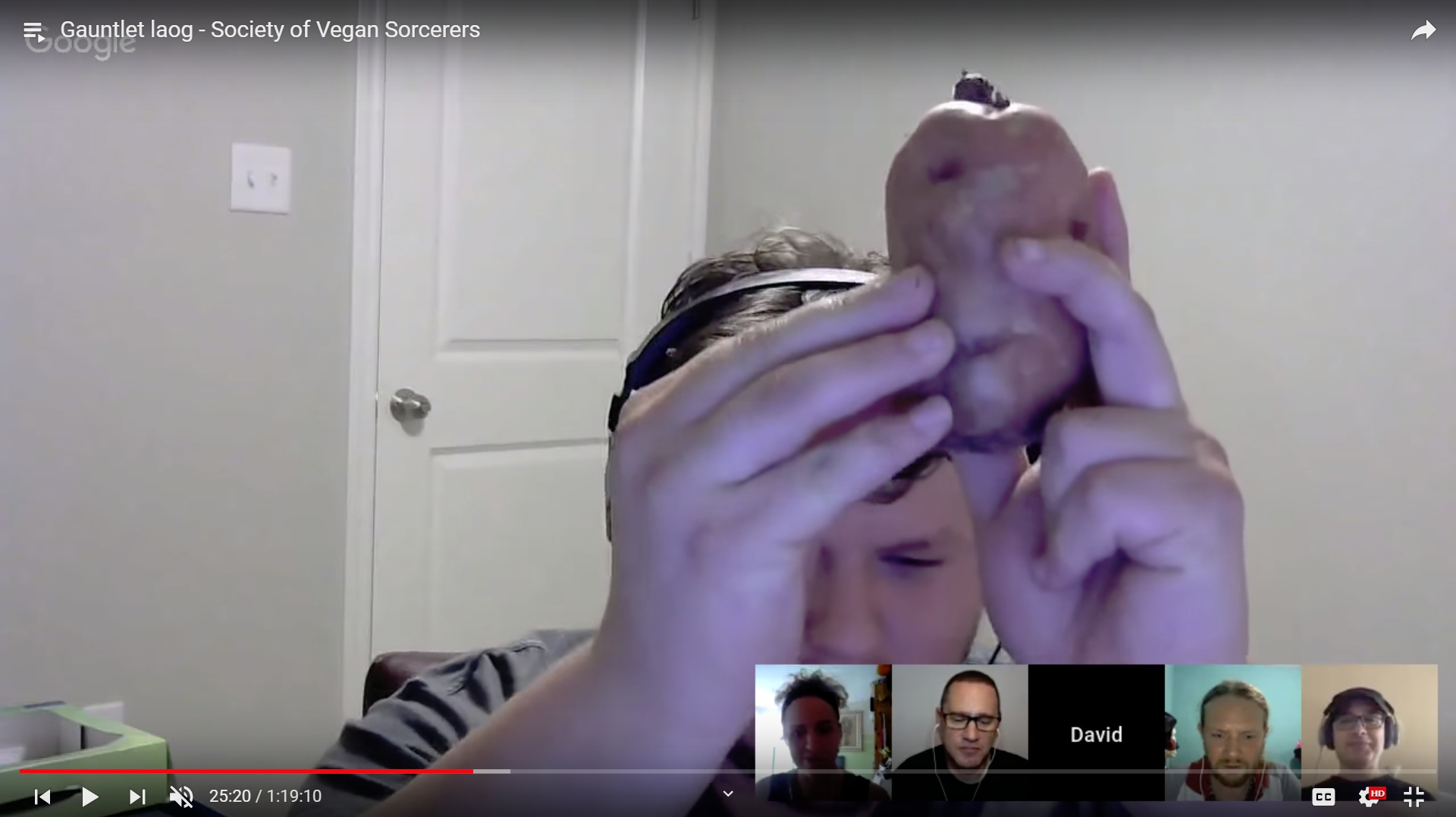
    Cover photo: Screenshot by Gerrit Reininghaus from a game session of Society of Vegan Sorcerers. The game is by Wendy Gorman and can be found in Codex Yellow which can be found on DriveThruRPG. People visible have given permission of this screenshot’s use. Used with permission by the author.