Editorial note: This article was originally published in the Knutpunkt 2026 book Seasons of Larp. It has been reprinted from there with the editors’ and authors’ permission. It has not been edited by Nordiclarp.org.
A humid jungle with muddied sneakers, an oversized black t-shirt and two hard foam rods to protect me. By the end of the day, I was covered in sweat and bug bites. One of my white socks turned red due to leeches. That was what it was like when I first started larping in Malaysia.
While it may sound horrible, I’m still here. I’m even running things now as the head admin for the Malaysian Live Action Roleplaying Community.
So, why did I stick around? One word. Community. It was the community that made me feel welcome and made larping in Malaysia so fun, and through this article, I will dive further into what made the community here work and some of the challenges we’ve faced as we grew.
Early beginnings
Malaysia is no stranger to events that involve dressing up. Our city centre of Kuala Lumpur has a large-scale cosplay event every other month. Urban life is saturated with anime, comics and games, but despite that larp is still pretty young here.
The first recorded larp was an unnamed one held in 2013, followed by a Marvel-themed larp based on Thor: The Dark World at Comic Fiesta, a major local anime, cosplay and games convention. When Wira Games & Hobbies, a local wargaming shop, opened soon after, the small but passionate community finally had a space for parlour larps like White Wolf Publishing’s Vampire: The Masquerade.
In 2015, Malaysia saw its first long-form fantasy larp campaign, Maelstrom (Malaysia, 2015), adapted by Sacha Djikshoorn from Vortex Adventures LARP (Netherlands, 2003). It was the first Malaysian larp with structured mechanics, safety calls, and boffer combat. Costuming was more prominent but they were still quite simple due to budget constraints.
In 2016, Aaron Lim Fei Hoong created The Quest (Malaysia, 2016) at KDU University (now known as University of Wollongong Malaysia), a larp with sci-fi/fantasy elements. This evolved into Tales of Kowloon (Malaysia 2016).
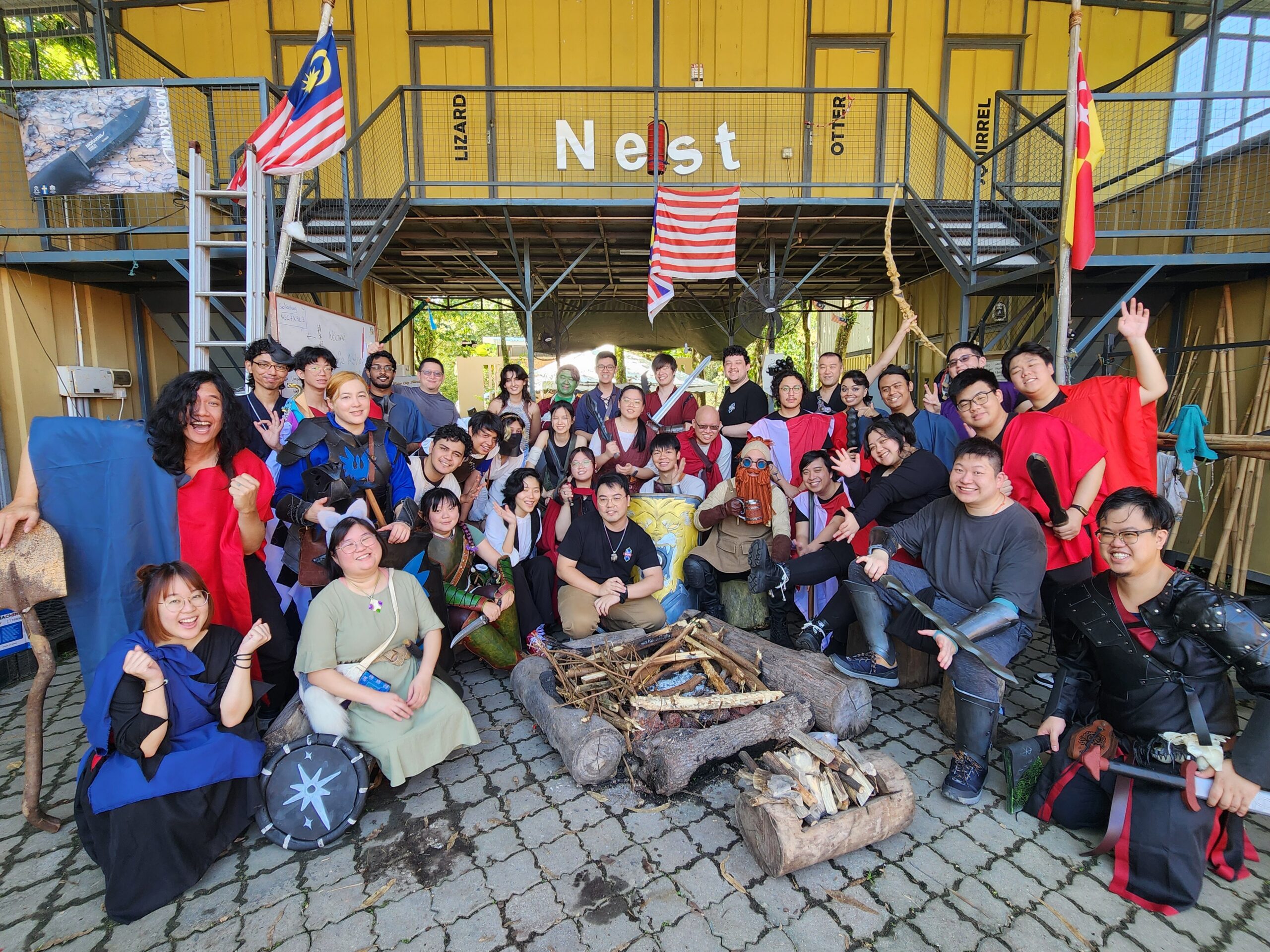
Since then, the community grew from fewer than ten players to about forty active participants, mostly concentrated in the Klang Valley, a central location in Malaysia where most of the playerbase resides. The hobby had participants from 18 years old to even folks in their early 40s.
Maelstrom was still an incredibly popular larp as it started to diversify from just the yearly 2-day-1-night larps to day larp and the occasional parlour larp.
The crossroads
The COVID-19 pandemic hit us hard. The ‘live action’ aspect of larping was not feasible for the few years of Movement Control Order, a series of national quarantine measures implemented by the Malaysian federal government. All we could do was bide our time and wait for the government to lift movement control restrictions. Then, another blow to the community came in 2023 when Sacha, our head admin, migrated with his family back to the Netherlands.
It was at this time, as one of the remaining organisers of Maelstrom and with no other volunteers, I took over as the head administrator to the community. Honestly, it wasn’t easy. I was inexperienced and felt underqualified. And to make things worse, I was having troubles with my day job. Furthermore, interest in larp in Malaysia was waning as significant numbers of people were leaving the community after the pandemic, pursuing other hobbies.
With no one else taking up the mantle of leadership, I almost considered dispersing the community altogether, effectively ending larp in Malaysia.
The Renaissance of Malaysian larping
It was around this time that Aaron Lim returned from Australia to Malaysia. He brought his insight and expertise from his experiences with playing at Swordcraft (Australia, 2011), a long-running fantasy larp, to games in Malaysia by advising me and also developing his own larp, Crucible Conflicts (Malaysia, 2023). His contributions to the community were invaluable, as it was due to his oversight and advice that the Malaysian larp scene had a resurgence, with around 20 new players making the community their home.
The Malaysian larp scene also saw significant expansion in 2023, as it expanded its horizons beyond the fantasy genre, for the first time since the Vampire: The Masquerade games all those years ago. This was with the introduction of Minutes to Midnight (Malaysia, 2023) by Cheryl Bates. The game was a cosmic horror parlour larp loosely inspired by stories like the SCP Foundation, an online webseries about anomalous objects that are being contained by an enigmatic organisation.
Since then, the Malaysian larp community began to flourish, as more larpers started developing their own games across genres and with varying levels of rules complexity, such as Secret Brews (Malaysia, 2024), a superhero-themed comedy larp, and Murder Party (Malaysia, 2025), a freeform larp where people play as crows.
Meanwhile, Maelstrom has only continued to grow. With a rules overhaul inspired by Crucible Conflicts, the strategic combat larp, it was easier than ever to get into Malaysia’s flagship campaign larp. Now, Maelstrom was attracting about ten players from outside of Malaysia, with players travelling up from Singapore, Indonesia, and Australia to join our fantasy events.
MyLARP, the Malaysian Live Action Roleplaying Community platform, also continued to increase its reach in the country by facilitating outreach programs through conventions like Animangaki and Season4Otaku, craft bazaars like Craft Affair, and universities like Asia Pacific University. It is through these outreach efforts that our presence is made known and the local larp scene grows steadily.
What does larp in Malaysia look like?
In Malaysia, we have a phrase borrowed from our regional neighbour Thailand, ‘same same but different’. Similarly, I think that larp in Malaysia is very similar to many of our Western counterparts but we have a few things that we do differently.
Costuming in Malaysia
When looking at videos of larps outside of Malaysia, you’d often see intricate industrially-made injection-foam moulded boffer weapons and costumes made of real leather and steel. In Malaysia, you’d see very little of that. There are two reasons for this: low spending power and low accessibility.
As Malaysia is a growing economy with a weak currency, our spending power is on the lower end. The median individual income in Malaysia is estimated to be around RM 2,864 (around 600 EUR) a month. This means that Malaysians have to be incredibly selective on how we spend money on hobbies.
As there are no major larp equipment distributors in Southeast Asia, purchasing ready-made larp gear like boffers and armour would have to be done with European manufacturers like Calimacil or Epic Armoury. This would prove to be prohibitively expensive for the average Malaysian, especially when you factor in shipping costs and customs fees.
Due to this, Malaysians mostly opt to build their own boffers and armour.
Initially, any material that was ‘safe enough’ was used. Early Malaysian larp boffer weapons had everything from broom handles to metal rods as cores and high-density foam coated in rubber paint. Now, we primarily use fibreglass rods wrapped in low-density EVA foam, sanded down and coated in latex. We even introduced stab tips made of various soft yet malleable materials to allow for safe stabbing.
We test our weapons rigorously by squeezing them to test for softness, twisting them for core adhesion and ramming them against solid surfaces for stab-safety. Now, many of our weapons are on par with the safety standards of other larps as seen by some of our players bringing their Malaysian-made weapons to larps like Swordcraft in Australia.
As for armour, due to the high cost of getting steel plate armour in Malaysia, we primarily use EVA foam painted the appropriate colour to represent the material it is made from. For example, steel armour is painted silver to represent that it is made of metal. This differs from some overseas games we’ve heard of that only allow armours to count as heavy armour if they are made of metal.
Aesthetics-wise, since we do not have dedicated tailors for larp gear in Malaysia, most first-time players rely on practical solutions. Many start with affordable costumes from online malls like Shopee, while others repurpose old cosplay outfits or modify thrifted clothing to fit the setting.
Costuming with the climate in mind is essential for Malaysian larpers. The humidity is intense, and the sun can be overwhelming, with temperatures often sitting between 30 and 40 degrees Celsius. Because of this, most cloth costumes are made with breathability in mind, using thinner fabrics that allow heat to escape. Foam armour traps heat easily due to poor airflow, so many of us score small vents into the foam to help release warmth during combat or extended scenes.

Our weather also brings sudden tropical thunderstorms. When events are scheduled outside the rainy seasons, a downpour can arrive without warning. For this reason, many Malaysian larpers carry multiple costume sets. It allows us to swap into a fresh kit after getting soaked, muddy, or simply overheated, which helps maintain comfort and immersion throughout the event.
Language in Malaysia
Malaysia is a cultural melting pot consisting of three major ethnicities (Malays, Chinese, and Indians), each bringing their respective cultures, languages and practices into their hobbies. Malaysia’s majority race is Malay, and the national language is Bahasa Malaysia. Due to our shared colonial roots, many people in Malaysia speak English as at least their second language. It is due to this unifying factor that larps in Malaysia primarily use English as their lingua franca.
As English is often a second language for many of our participants, we had to take that into account when developing game rules. For this article, let’s take a peek behind the curtain with the rules overhaul we had for Maelstrom, Malaysia’s longest-running campaign larp. In short, our approach was to simplify the language as much as possible without compromising clarity.
In the earliest stages of Maelstrom’s development, the rulebook was about 5 different books, each tailored to a different aspect of the game, such as Spellcasting, Rituals, or Potioncrafting. Since then, to improve language accessibility, we’ve not only trimmed all the rulebooks to one book but we’ve also gone over everything to reduce language complexity and added lots of visual aids to help.
An example of a significant change to the game was how we handled spellcasting. Initially, each spell required a sentence to be spoken before it could be cast. The long sentence led to memorisation issues, and the intent of using it as a means to create a cast-time for spells was not effective as people began to rap through the chanting if they could remember it. When we updated the Maelstrom rules in 2023, we removed the chant altogether. Instead, players may use any means they’d like to symbolise their spellcasting, from chanting in any language to weaving sigils with their hands. All that mattered was an effect call that was shouted at the end.
Effect calls are also something that received a lot of changes as we tried to make the language accessible to the average Malaysian. During earlier builds of Maelstrom, there were upwards of 40 different effect calls, each with specific effects. While most of the calls were quite straightforward, like ‘Freeze’, there were a few that were a bit less so, like ‘Sunder’. So, when we were updating our rules, we compressed the calls into around 20 calls instead. Each call functioned significantly differently from each other with simple 1–3 syllable words like ‘Slow’, ‘Fear’, or ‘Silence’.
Furthermore, initially damage types were also spoken when spells or attacks were used. This meant that people had to tack on types like ‘Fire’ or ‘Frost’ to their attacks. While flavourful, this caused unnecessary cognitive load. So, we removed it wholesale. Instead, the only calls used are calls that have a mechanical function in the game, like the previously mentioned ‘Fear’ call.
Outside of game rule design, we also do our best to integrate different languages into the game’s stories. This led to interesting events where some characters spoke Mandarin Chinese and could not communicate with the English-speaking characters. The players had to find ways to communicate or find a player who could speak the language. We’ve also integrated multilingualism in some of our background lore, like the Wind Elementals speaking Mandarin Chinese and the Earth Elementals speaking Bahasa Malaysia. These integrations make for fun representation of our shared cultures and languages while making as many players’ cultures feel seen in the larps.

Culture in Malaysia
Malaysia as a culture is steeped in South-east Asian traditions. Despite there being many different cultures present in Malaysia, there are overlapping themes like repressing emotions, respecting authority and embracing conformity. This means that there are certain hurdles that Malaysians face when trying larp.
One of the immediate challenges is that it takes time for many players to come out of their shells. Malaysians as a whole are extremely shy and emotionally reserved. Because of this, the first few games for new players often involve game organisers and veteran community members gently encouraging newcomers to open up, experiment and express themselves more freely. Once the initial mask falls and players realise how much they can explore through roleplay, they begin to thrive. As a result of these efforts, we’ve started to see more players come to larp as a place to escape from the strict norms of our conservative society.
Malaysia also has a very strong collectivist culture. This mindset shapes the way people play. Players tend to prioritise group harmony, cooperation and shared success, which naturally tilts our larps toward PvE-focused gameplay. People enjoy facing monsters, puzzles and story challenges together rather than fighting each other. PvP requires a level of emotional separation and social maturity that not all players have developed yet, so while we do not prohibit PvP, we rarely encourage it. Our players generally prefer teamwork and narrative-driven collaboration.
This is also why Malaysian larps tend to be warm, lively and collaborative, often blending serious storytelling with the chaotic humour that is so characteristic of Malaysian social life.
A conservative upbringing means that many Malaysians were not raised with values that help keep larp communities safe. Many of us grow up in environments that prioritise hierarchy, restraint and conformity over open dialogue, emotional expression or boundary-setting. This is further compounded by religious upbringings that may not offer healthy education on interpersonal behaviour, gender dynamics or inclusivity. As a result, some individuals may unknowingly carry rigid expectations, sexist attitudes or prejudiced views into shared spaces. When people who come from such backgrounds enter a larp environment, they might not naturally understand the importance of consent, communication and emotional awareness. What feels like harmless roleplay to one person might be deeply uncomfortable to another.
To help with this, we developed safety tools that allow players to express boundaries without disrupting the flow of the game. One such tool is the ”Okay” sign. If a person seems distressed, another player can flash the sign to check if they are acting or genuinely uncomfortable. If the sign is returned, everything is fine. If it is not returned, gameplay pauses and a game organiser steps in to mediate and assist. Because this tool is expected, taught and normalised across the community, players use it freely to check on one another.
Larp organisers must remain vigilant. We establish clear guidelines, encourage open communication and address problematic behaviour quickly, regardless of ignorance or intent. Our Code of Conduct outlines what is expected in our community and is enforced by a team of Community Leaders who guide, educate, and if needed, take corrective action. We believe that most missteps come from inexperience rather than malice, but serious violations still result in suspension or removal to keep the community safe.
Because Malaysia consists of many different faiths and cultural groups, we also take care to avoid sensitive topics that might upset participants. In games set in the real world, we intentionally avoid references to real-world religion or politics as these subjects are deeply personal and can easily cause discomfort or conflict. We also generally discourage inter-character romance or sexual themes. This is not about moral policing but about recognising that the community is still developing the emotional tools and boundaries needed to handle intimacy and potential bleed responsibly.
Despite these cultural limitations, Malaysian players are incredibly enthusiastic and open-minded within boundaries that help them feel safe. Players embrace cooperation, shared objectives and immersive storytelling. They enjoy all aspects of larp, from fast-paced combat to comedic shenanigans. With the wide range of cross-genre games available in Malaysia, including cosmic horror in Minutes to Midnight and whimsical roleplay in Murder Party, there is truly a larp for every kind of player we have met so far.
By setting thoughtful limits and cultivating a healthy community culture, we create a strong foundation for players to grow together. As the community matures and gains experience with consent-based play and emotional safety frameworks, we can expand the kinds of stories we tell. For now, the priority remains ensuring that everyone feels respected, comfortable and safe while engaging in collaborative storytelling.
What to expect in the coming years
Overall, the Malaysian larp community still has a lot of room to grow in the coming years and as some of our members bring back their positive experiences from events in other countries, we aim to adapt what we can from the successes and learn from the challenges. Ultimately, our goal is to foster a larp community here in Malaysia that is an inclusive and safe space to express ourselves in our favourite hobby. Hopefully, as the Malaysian larp community grows, it would be synonymous with weekend activities as tabletop roleplaying games like Dungeons & Dragons. We will continue to bring mainstay larp activities like Maelstrom and Minutes to Midnight in the coming years, but we also aim to hit the freeform larp genre more frequently, both with self-developed games and games adapted from other larps overseas.
Anyone curious about joining us can find our community page under MyLARP on Facebook and Instagram, where we post upcoming events and newcomer-friendly introductions.
Ludography
Crucible Conflicts (2023) Lim, A., Malaysia
Maelstrom (2015) Dijkshoorn, S., Malaysia, MyLARP
Minutes to Midnight (2023) Bates, C., Malaysia
Murder Party (2025) Wang, S., Malaysia
Secret Brews (2024) Lim, C., Malaysia
Swordcraft (2011) Krins, J., Australia, Swordcraft Ltd.
Tales of Kowloon (2016) Lim, A., Malaysia
The Quest (2016) Lim, A., Malaysia
Vortex Adventures (2003) Unknown, Netherlands, Vortex Adventures
This article is republished from the Knutpunkt 2026 book. Please cite it as:
Wang, S. and Bates, C. 2026. ‘The Rise of Larp in Malaysia.’ In Seasons of Larp eds. Erlandsson, A., Svanevik, M., Holkar, M., and Brind, S. Gothenburg. Knutpunkt.

