Editorial note: This article was originally published in the Knutpunkt 2026 book Seasons of Larp. It has been reprinted from there with the editors’ and authors’ permission. It has not been edited by Nordiclarp.org.
We are a Pagan and a Quaker, with a sense of the religious, who are happy to approach and explore that within larp. We both collaborated on Nine Candles LARP (UK, 2025) (inspired by the TTRPG Ten Candles), and previously have written/organised other larps that have made use of religious or sacred elements.
In this article we will consider the means by which one can evoke the sacred within the format of larp, and use it to craft a transformative experience in play. We’ll look at some general techniques, how they are represented through some specific religious traditions, and some of the results of the past use of the sacred in larps we have run.
Within our games we have used the tools of religion to create spaces, both physical and psychological, in order to feel, process, and transform. By tools of religion we mean: the following of the timings of Christian hours,1 repetitive phrases used in specific circumstances, or the use of the Quaker ‘being moved to speak’2 within a silent group. These all give what larpers might recognise as alibi, but are specifically used as alibi within a religious context. So including the tools of religion in the larp design allows players to engage spiritually as well as emotionally, even if they don’t engage with the underlying meaning of the rituals.
We will concentrate on three techniques:
- The use of borders and boundaries around the sacred as a means to quieten the sounds of everyday life upon approach – On Borders and Boundaries
- Sacredness as an individual openness to transformation through direct engage-ment with concepts taboo in unsacred life – On Children and Death
- Sacredness as captured in a defined tradition and ritual that connects one to a wider community of ritualists – Adherents on the Organising Team
On Borders and Boundaries
In order to create the possibility of a numinous experience within a larp, the players need to be open to it. To have this openness, the players need to feel safe both within the game space, and in the special space created for the religious elements. When we use the term special space, this can include an actual physical space or a delineated time. Some games, where the whole setting is the religious space, can rely on pre-game workshops or detailed descriptions of the expectations for the setting3 to create a sense of safety. In a more historical setting these might be a plethora of documents on expectations of social norms, gender roles, etc. especially when they explicitly differ from modern expectations. For example, the word of a Christian Man in a trial may be deemed more reliable than a non-Christian Woman.4 Other documents encourage practising recitations before the larp – so that your character might use them in game – or spend time considering in advance what the words mean to your character.

If you have sacred and secular places within the game, you need to establish where and what the boundaries are. Boundaries define the space (physical or temporal) in which you are able to explore the numinous: The lighting and snuffing of candles, the starting and ending of some music, a physically designated space between standing stones, or indeed the room of a chapel, can all be used this way.
Many games with religion as a central theme make use of music, sounds, and singing or chanting as a cheap and simple way to do this. The music creates a feeling of community when a group is singing together and gives the player a sense of safety within the group to play. It also gives simple access to a sense of the sacred, depending on the choice of music and what expectations this evokes. Repeating words and actions together can instil a sense of communal understanding which is easy to use for larp religious purposes. That in turn allows the player to step outside of their everyday life. A5 number6 of7 larps8 set in religious communities have done this, and it is likely the reader will be familiar with at least one.
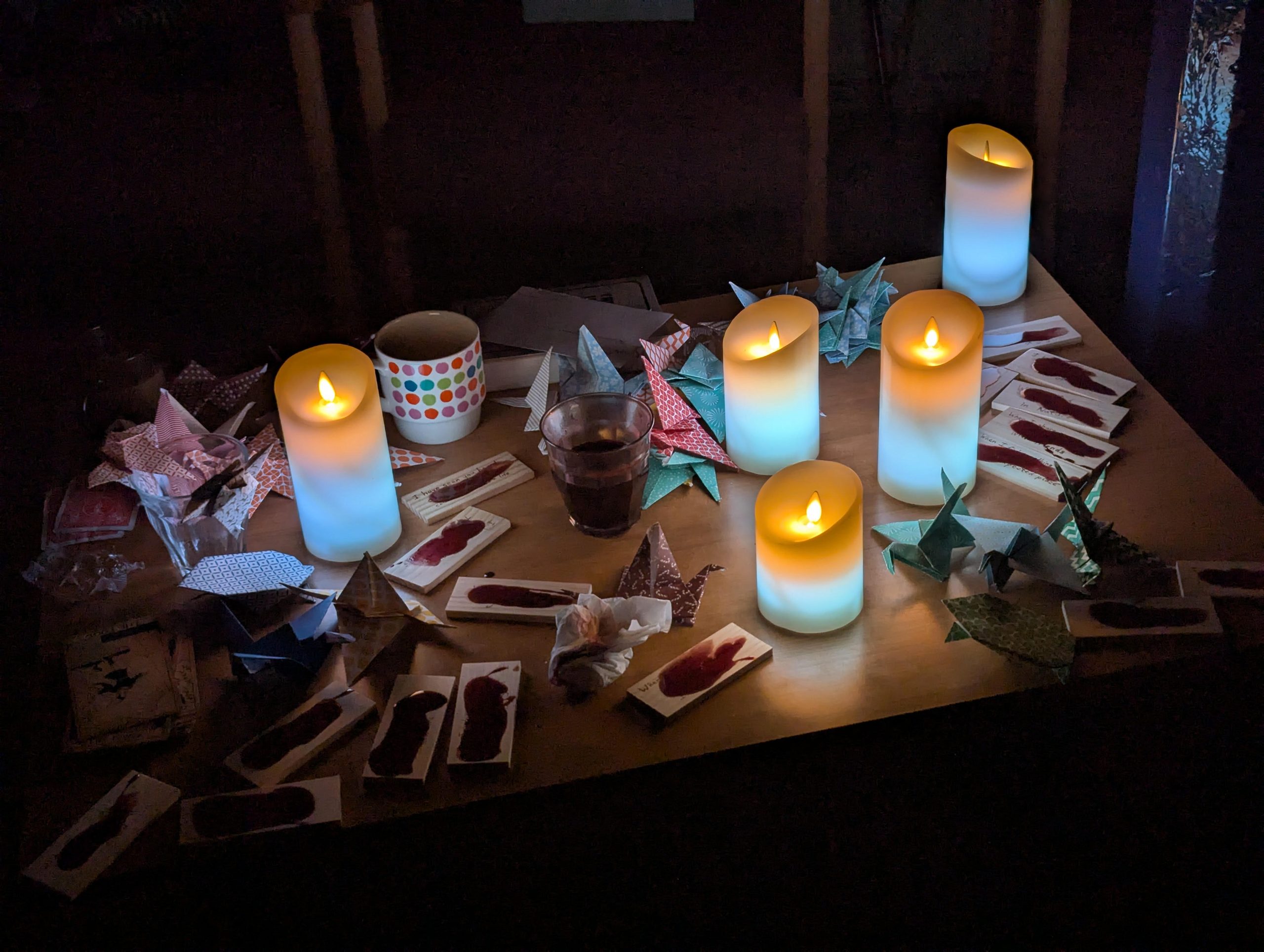
Quaker theology tends to reject the use of sound (or, more accurately, to encourage the use of silence) for the forging of a border around sacred space. We tried to reflect this in our larp techniques. In Nine Candles, we asked the player characters to recruit the NPCs from the playerbase for each scene, as characters who needed to hold a silent vigil for those who ventured out into the darkness (while the player took on NPC roles for the black-box scene). Players would sit in silence for a while, then leave the room to play their NPC role. When they were done, they would come back to the room and sit in silence until they were rejoined by the players who had recruited them. The use of NPC roles to support the forging of spiritual connections between characters gives a sense of witness and upholding to the choices faced by the characters within the sacred space, akin to the Quaker sense of “holding in the light” – that communal silent witness may hold a person closer to the experience of the divine possible within themselves. Players commented that it forged connections between the characters that were then possible to play out further on in the larp.
On Children and Death
Larp is for some of us a way to experience emotions and situations in a space separate from normal life. Depending on your definitions I (Mish) play to bleed in that I play to feel within the space created by the larp and I wish to allow others the chance to do the same.
At a player event set in Profound Decisions’ Empire (UK, 2013–) game I set up a small sacred area of “swampland” (if you want to know why swampland you’ll need to read up on the in-game religion).9 One of the players, a kid, headed over appreciating the calm of the space and curiously looking at all the props. Immediately her Mum bustled over to ask what the little side alcove had been set up for and as soon as I explained that it was a place to think about the dead she tried to shoo her child out, saying “Oh no, you can’t be here, it’s sacred.”
I said that it was fine and that children should be present where the dead are (I won’t get into the in-game nuance of why my character thinks that or if it’s correct in game as that’s not relevant here) to me that illustrated a difference between perceiving religion as a performance or as a practice. In the UK we’re very used to a secular society in which the majority religion’s places of worship cross over with museums and galleries of the type that the artefacts are displayed to be looked at but not used, to be known about in a scholarly manner but not experienced. If you don’t practise a religion then it seems very likely that you appreciate it only as a performance or something to be looked at.
Though the art world (encompassing music, visual arts, theatre et al) has seen an increase in interactive and installed works over the past thirty-plus years, a large majority of mainstream art relies on the passivity of the viewer and the agency of the artist(s). In larp we have an interesting opportunity for this not to be the case, being based upon the interplay between creators of varying agency rather than a traditional viewer/artist relationship. As a religious person I find the response of atheists to feeling and existing with a setting that allows them to feel an experience of numinosity utterly fascinating, as I view religion as something to be lived within in my everyday life. Obviously to me, in a lived religion children should be allowed to access sacred places, albeit you may need to give them rules that wouldn’t exist outside of a fantasy setting: no summoning circles here, little necromancer.
Could we mis-step and offend? Absolutely: but when the possibility exists for creating understanding through an experience that would not be offered in one’s everyday life, then it seems worth that possibility.
With a similar conclusion, I (Kes) come to this from a very different theological angle. I have had several raised eyebrows and queries of “really?” when insisting that players of my larps at Pardshaw Quaker Centre are entirely allowed to camp in the burial ground. This is despite its active use for the interment of bodies. Quaker burial grounds reject the idea of sacredness of place – or rather, reject the idea that any place is less sacred that might be implied by the establishment of a place as more. If it’s inoffensive to the divine to camp anywhere on this earth, it’s inoffensive to camp in a Quaker graveyard. To Quakers, young adults are considered within the “youth” category, and larp could be considered somewhat equivalent to children’s play – a means by which the inexperienced fumble and learn to engage with deep concepts. I concur with the fact that many people now engage with religion primarily through the means of heritage, museum, and gallery – something carefully curated for mass viewing but also othered away from a living practice towards a dead thing preserved behind glass. No touching! This is in my view a crying shame, because all ash was once fire, and to engage with something as if it were always ash is to deny the presence of the living flame that can be found today.

Quaker religious beliefs involve that of God in everyone, an ever-present linkage to the divine that, if listened to by quietening other sounds, can enact a personal transformation that calls you into your needed place in the world. While they don’t evangelise, they do believe that spiritual education should be made accessible to all who wish it, rather than gatekept behind barriers of exclusivity or finances. This mirrors the idea of use of the arts for spiritual development and personal transformation, with a particular focus on non-materialistic and community-oriented philosophy. Quakers don’t think the experience of art itself as a consumer is the priority: to many of them faith, without subsequent faith-led action, is entirely missing the point. Probably the most blasphemous bit of evoking the sacred in larp from a Quaker perspective would be the idea that you could charge a lot of money for tickets, deliver in return a genuine experience of encounter with the divine, and not expect your playerbase to go away changed.
From a practical perspective, what this looks like is that when I asked some of the local Quakers if I could design a larp based on Quaker theological perspectives, they counted it as a form of spiritual education. They offered me affordable hire of their building (leading to affordable ticket prices) and also asked me if I would write about it in their local newsletter. Now I’m a site trustee. It also looks like the fact that I have so far recruited three new weekend larp organisers from my time running this game, having structured it in such a way as to make the transition from player to organiser as easy as possible.
Experienced roleplayers knowledgeable about setting up environments and games with transformational play intended are going to find a lot of the techniques and tools involved in games involving the sacred really familiar.10 All that differs is the notion that the player may have a spiritual experience in addition to the emotional, ethical, or other secular transformations that are sought or expected within mainstream larps.
Adherents on the Organising Team
It’s a lot easier to play with notions of sacred and create separate spaces when the religion is entirely fictional; everyone is happy with the alibi that of course we’re not worshipping any real deities.
But some of the most profound experiences I’ve had have been in games that have played with a fictionalised version of real religions (mostly these have been Christian, some Pagan). There has been an unconscious assumption that in order to treat a religion with respect within your larp you need someone of that tradition, or at least with a grounding within it, on the writing team. I think that that’s true; certainly within Paganism it helps you to navigate between shared and closed practices with respect for the boundaries. When you’re creating any sort of art you owe respect to your subject matter. Even in larp which blurs the boundaries between subject and medium that respect is still due. This is reflected in the amount to which the writers and organisers research both the facts as well as the techniques that the practice uses.
Running religious games for larpers inexperienced with religion has included the experience of answering basic theological points of the religion in question. I have had to explain that despite a spiritually arisen testimony against the use of alcohol or drugs in any of their buildings, Quakers are totally fine with coffee (you’re thinking of Mormons), and also hand sanitiser (it’s not about whether ethanol is molecularly involved) – which broadens into the con-versations of why such a rule is in place, and related discussions about testimonies to simplicity and community and what they might mean in the context of a larp event. Quite frankly, you can’t have those discussions if there aren’t any actual Quakers around. I would worry that running a game about a lived religion with no adherents of the religion on the organising team could lead to the proliferation of misinformation about religious practice.
There’s also the problem of misuse of religious language. With Nine Candles, we ended up using a lot of deeply religious Quaker words such as “overseer”,11 “Friend”,12 “concern”13 and “hope so”,14 in the larp, in ways that went over the heads of the non-Quakers in the playerbase and ended up completely misused linguistically. The Quakers in the playerbase mostly treated this as hilarious in-jokes rather than religiously disrespectful. I would imagine that in a different religious tradition, far more offense would be taken by religious adherents in your playerbase, and you might need something like a dictionary workshop before the larp starts to limit the misuse of any language you introduce.
This article is republished from the Knutpunkt 2026 book. Please cite it as:
Ward, K. and Liddle, M. 2026. ‘Approaching the Sacred in Larp.’ In Seasons of Larp eds. Erlandsson, A., Svanevik, M., Holkar, M., and Brind, S. Gothenburg. Knutpunkt.
- See also https://www.nordiclarp.org/2025/07/31/christianity-is-an-immersion-closet/ ↩︎
- https://qfp.quaker.org.uk/passage/2-12/ ↩︎
- Such as a dedicated section on the larp’s website, e.g. https://www.profounddecisions.co.uk/empire-wiki/The_Way ↩︎
- Circa Regna Tona (UK, 2016–2020) https://shunnedhouse.co.uk/circa-regna-tonat/ ↩︎
- Wise Women (UK, 2025) https://rhiannonsp.wixsite.com/website ↩︎
- Our Lady of Absolution (UK, 2015) https://aeonhorror.com/2015/05/15/our-lady-of-absolution/ ↩︎
- Redemption (Finland, 2021, 2024) https://nordicrpg.fi/redemption/|https://nordicrpg.fi/redemption/ ↩︎
- Alma Mater (UK, 2023) https://www.almamaterlarp.com/ ↩︎
- See: https://www.profounddecisions.co.uk/empire-wiki/Wintermark_culture_and_customs#Funerals ↩︎
- For a more detailed look at this from a secular perspective, see https://www.nordiclarp.org/2019/12/10/transformative-role-play-design-implementation-and-integration/ ↩︎
- A person serving in a Quaker role of non-religious welfare support and guidance, which we used for our mental health first aider NPC. In modern British Quakerism the role name is now ”pastoral Friend” after the original term was deemed a little creepy. We kept the original term for exactly this reason, so admittedly we were leaning into the in-joke. ↩︎
- A member of the Religious Society of Friends – that is, a Quaker. Quakers do not refer to each other as Quakers when speaking internally, and differentiate between ”friend” and ”Friend” verbally via subtle differences in pronunciation or context. Most of the playerbase missed this and probably just thought certain people had large friendship networks. ↩︎
- A sense of irresistible spiritual calling to a task that may require support from other Quakers to ensure that God’s will is enacted and the person experiencing it is not harmed by going through the experience alone. We used it so the GMs could drop plot on people and the playerbase had to respond, leading to some very unusual grammatical patterns around usage and a complete lack of the usual process for the corporate testing of concerns, because every player could see the GM. ↩︎
- A version of ”yes” that acknowledges that only God can answer certain things in the affirmative, and our translations of God’s will are always imperfect. Generally used to affirm your belief in God’s living presence within a statement (i.e. a higher standard of approval than ”yes”, though it sounds lower). ↩︎
