Larping conflict as a loop as a way to sustain drama
Editorial note: This article was originally published in the Knutpunkt 2026 book Seasons of Larp. It has been reprinted from there with the editors’ and authors’ permission. It has not been edited by Nordiclarp.org.
Inventing the wheel
What kind of conflict happens in toxic groups that never dissolve? How do we as players feed the drama without running out of steam? How to play a group full of conflicts without final escalation or ending with someone being shunned or ostracized?
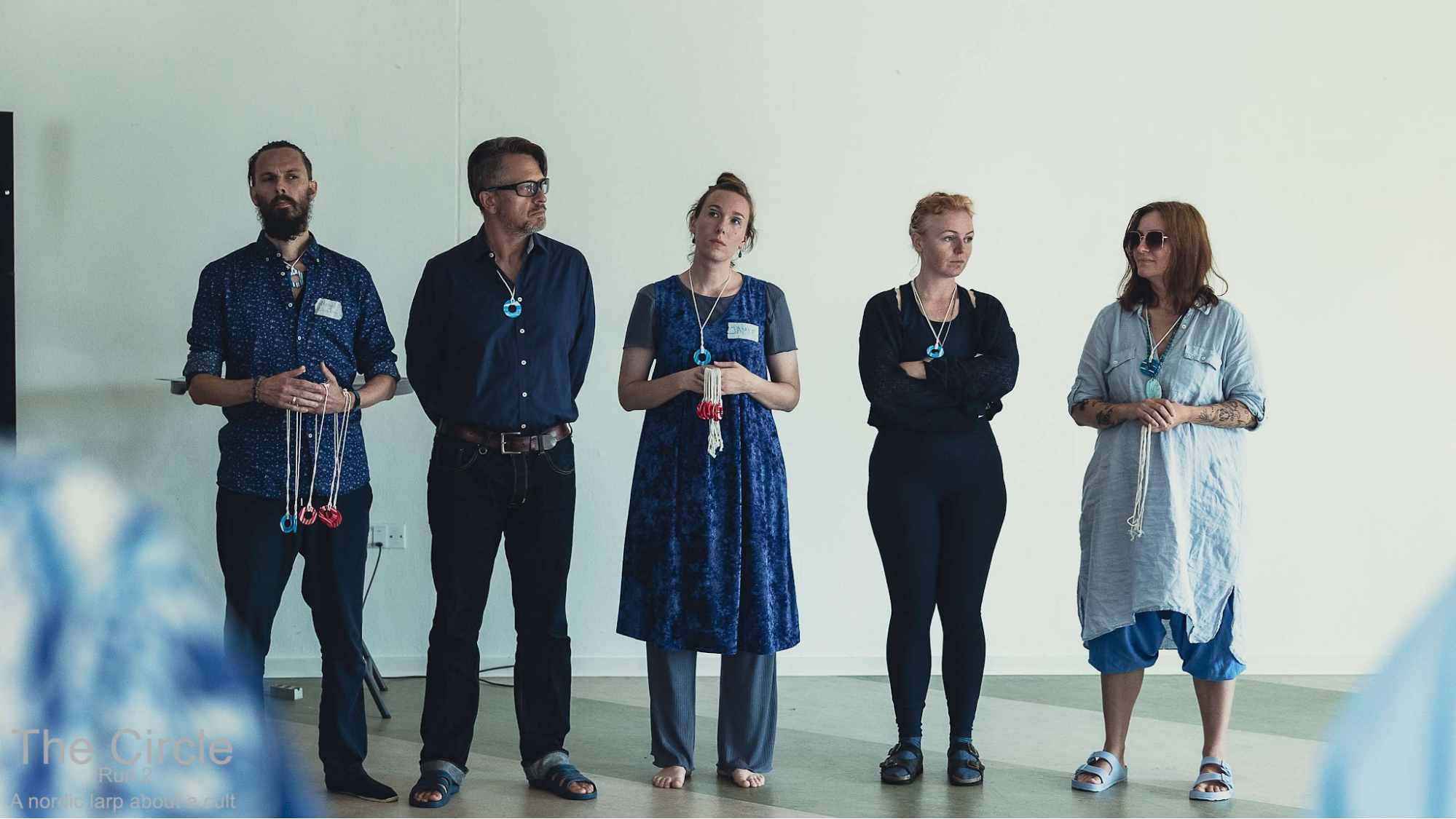
The Circle (Denmark, 2024) threw us right into the middle of a complicated knot of toxic relationships. We did not really know each other off-game beforehand as a group, and due to flight delays and life in general we had almost no time to flesh out relationships or calibrate playstyles before game start. Still, our characters instantly were this tight-knit and dead-locked group, and we managed to play intense emotional conflict easily throughout the whole larp – without ever feeling bored or done. This extended to providing play to other players through the group’s unpredictable conflicts and everchanging alliances.
“How the hell did this happen?” was our first question at the debrief afterwards. To not settle for the universal answer of “larp magic,” we got together to collect influences, design-features, and methods of play to see if we could provide the community with usable take-aways from this experience.
Of course, repetition is nothing new in larps, but to consciously work against resolving conflicts in a larp, has much too long been lacking a fancy name. Well, no more! We call it: Play to Loop.
The general rule in playing to loop is that any conflicts within a group – especially ones that have known each other over a longer period of time – will never be permanently resolved.
If that was possible, it would have happened long ago. Conflicts are never solved in-game, but instead transformed into new interesting conflicts with changing parties – and so used to drive play. In the larp where we first tried it: if the conflicting characters felt they had resolved or exhausted an issue, other group members always stepped in and erased any progress by fuelling the conflict from another angle or shifting it to different participants.
We are convinced play to loop can be used as a concept for game design – as well as a player technique – and be adapted by players and designers alike to further their particular game.
A matter of circumstances?
The premise of The Circle was a cult where close relations and negative emotions are frowned upon. The larp played out the final days before a few members of the cult would be chosen by their Messiah, The Maestro, to help heal the world.
The design document of The Circle framed it like this: “The Circle is a larp about relationships – about the longing for closeness and purpose, and when those things are at odds. We will be playing continually on that dilemma, and it might never be resolved for your character.” It was also explicitly communicated that the larp was not about toppling the power structure of the cult.
The authors of this article were all cast as the leaders of the five chapters of the cult – each with their own perception of how to reach the enlightenment the cult sought after. This meant that each of us were part of two groups: the Inner Circle (the group of leaders) and our respective Chapter. Since our leadership group had known each other for nearly two decades and had spent several years early on in their lives closely connected, it was obvious that the conflicts between them were not to be “solved” during a weekend.
If getting along or resolving conflicts was an option – surely that would have happened years ago. It was made clear that these self-absorbed characters would not be swayed by either reason, pity, or the greater good, if it could cost them but a fraction of their status. At the same time, the Inner Circle was the closest thing to a group of friends the members had; the people that knew them the very best, and the only ones whose situation resembled their own.
The different approaches to salvation made it easy to create a changing net of alignments and hostilities, depending on who in the group were considered the greatest threat to your own agenda or status at any given time. The characters were written as each having a set of warm, cold, and lukewarm relations in the group. In hindsight we ended up elaborating on this to keep the loop in flow, and regularly switching out which one of the other characters in the group we felt, warm, cold, or lukewarm towards. This was mostly done by playing everything to our character’s personal advantage, being petty and disregarding reason, or overreacting to minor comments or reactions that could be perceived as a threat or an opening. This kept the issue of who is on top and in the bottom of the conflict ever-changing and helped avoiding stalemate situations. It was a pact among players to never accept a permanent status quo in the power struggle, but always keeping it alive by mixing up the alliances. It was never about being on top – but about not being alone at the bottom.
Getting into the ring: how did we loop?
“I feel that you attack me now to avoid talking about you and your problems, to be completely honest. I see you deflecting.”
– (in-game quote)
The loops we created were not a conscious choice between us. They came into existence naturally, since we as a group weren’t allowed to fall apart for off-game reasons, some part of the design, some part of our mutual understanding as players that we wanted to play this together. The fundamental agreement between us was to help each other play our character back into the group, if the character had a fallout with some or all of the others. This basic agreement, created semi-consciously as an off-game rule, turned into becoming our safety net: everyone was free to storm out in a huff, claiming to be done – safely knowing they would be pulled back in, or would be allowed to play themselves back in. Thus making sure that no matter how ridiculously our characters behaved, we as players would never limit ourselves from play by going all-in.
Every time we as a group felt that we resolved a conflict, we celebrated, reconnected and patted ourselves on the back for being such excellent conflict solvers, until someone felt that “maybe it was a bit unfair that…” or “I am not sure we talked enough about…” or “actually it wasn’t this person’s fault, but that person caused it by their behaviour…” and then the loop took another turn.
Taking a step back and examining our process after the larp we identified four phases as part of each repetition:
- The Trigger Conflict: Any kind of disagreement, old grudge, moment of envy between two or more of the members of the group can be used to set the loop in motion. This could also be done by other group members not actively involved, i.e. under the guise of ‘clearing out the air’ or ‘to help you guys move on’.
- The Processing: Some or all members of the group work to ‘resolve’ the conflict – or that’s what the characters might believe (or pretend to believe). In truth they are fuelling their egos or following their own agendas – and the players know that there is no actual resolution.
- The Moment of Agreement: When everyone is tired out, guilt has been assigned and accepted, someone has stormed out and was brought back or a more urgent matter comes up, the group agrees that the conflict is ‘resolved’. By definition – not by actual solution.
- The Celebration of the Group: To cement the ‘Agreement’, to reinforce the bond of the group and let out steam.

In between the four phases of the loop, we had other kinds of play: scheming, one-on-one play with members of the group in always changing constellations – that always fed into the loop of how this group of leaders was functioning. “Functioning,” of course, meant being dysfunctional leaders more often than not; spilling the effects of our quarrels over onto the characters in our chapters, using chapter members as pawns, audience, and participants in the conflicts that played out in rituals and other forms of group activities.
Playing to loop made sure that we always had more fuel to put on the fire for our co-players.
Another relevant byproduct with looping is that we experienced the passing of time more actively. When going through the loop the second time on a given conflict, reaching phase 2, ‘the processing’, we could experience with our whole bodies that “we have done this before” – therefore confirming the feeling that we as a group have been doing this exact same thing many times in the past. If you go through the loop a third time, it’s tradition – and after that, it feels like you have done this forever. It gets easy to feel annoyed by “they are always doing this fucking thing!!?” when they have done “this fucking thing” once or twice already.
Buying a round for the crowd: how can you loop too?
For the Inner Circle we played at this specific run of The Circle, a lot of things fell into place to create the positive, functioning loop experience we described so far. Part of the circumstances in favour were root-ed in the design of the larp, part came from us as players. Reflecting on that and understanding the fundamental concept and core-technique led to the question: how do we think this could work also in other larps? We would like to suggest this as a technique for players to use in their game with each other and for designers to use as a concept in writing characters and relationships.
An important foundation for this is built from conscious, transparent agreements between the players, that can either be stated in the character descriptions by the designers or reached by the players in calibration – or both.
To take a step back from our own experience, imagine a similar setup of character relationships in a different setting. For example a village council of elders in which the oldest member of each family resides. This could easily set up the framework for playing to loop within the council and with interaction with the rest of the larp. Here are some exemplary assumptions for that and how they work as a foundation for playing to loop:
- Having this Council is tradition and is believed to have kept the village afloat during uncertain times for the good of everyone – this gives reasons to bind the group together and reasons to never leave for good.
- All council members believe that their own family should stand in higher regard than others in the city, because of their contribution and sacrifice – this gives reasons to hold on to one’s own agenda and not be swayed.
- Each character in the council is designed with strong traits and flaws connected to past, ongoing, and un-solved conflicts between them (i.e. mismatched relationships, unsolved crimes/accidents, and all kinds of other misunderstandings and abuses) – this gives reasons for triggering a conflict.
From a designer’s perspective as well as from the player’s side, we think it’s important that all of this needs to be transparent to everyone: the in-game information as well as the intention behind it to give the players the best tools to make it work in the larp. All council members can then work together during the larp to discuss and solve the problems of the village. Their allegiances in the group can shift depending on the subject or the tone of individual relationships. To make sure of that, the players need to be in the know of the reasons above and the intention of the set up. Then they can listen for their trigger points and shift their focus of kindness and cooperation – or rejection – accordingly.
The City Council, The Group of Elders, or The Squadron Commanders, can make sure to meet up regularly and keep the loop going while bringing back conflicts to players in other groups. Agreeing to make time for play in the group (and also with one or several members of the group) keeps the conflict alive and establishes a group dynamic. This states the importance of the group – co-leaders, friends, family members and so on – in the lives of the characters and provides the players with a place to play if they need a safe space to escalate (since a rule of playing to loop is to always bring people back in) or if they are feeling bored or alone, while providing them with opportunity to bring back play to other groups they are a part of.
Keeping the example in mind, the following paragraphs sum up some essential decisions, agreements, and actions that we consider useful exploring for your own version of playing to loop:
- Clearly state the idea that we are not playing the one point in time where these characters finally reconcile but to create a fragment in time of a relationship that loops – and perhaps always has looped – with waves of high and low conflict.
- Define one or more core conflicts that are not to be solved. A group of players can decide to hold on to a specific core conflict while other conflicts around them – or offspring conflicts of this core conflict – can be resolved. Keeping a core conflict boiling amongst everything else that happens can provide the opportunity to create more conflicts from this, and helps avoid conflict-free play or ‘they-lived-happily-ever-after’-endings while creating the feeling of age-old relations or emotions.
- Agree upon what ties the player characters together. Are they bound by blackmail, kinship, duty, money, solitude, demons? They need to be dependent on each other in a way that makes it ‘impossible’ for one character to fall irreparably. This is something designers could actively go for when writing characters and relationships.
- Find your tone within the group to mask the bad times as good ones or rephrase critique as praise. Decide an alibi for ‘reconciliation’, a ritual, a group-hug, something that none of the characters feel they can miss out on, if someone calls for it. Sometimes you need to remember why you are a group and why you’d like to stay in it.
Based on these decisions, agreements and actions, the following two paragraphs compile checklists of practical tips to prepare before starting and adjust your playstyle during the larp.
Getting the loop ready
Make time to calibrate the following in the group before play. Select, modify, and make it your own.
We want to play conflict together. Engaging in conflict is saying yes to the game.
- We will actively make time for playing together in this group. We play other stories as well, but being with the group should feel like entering the shared-apartment-scene in a sit-com.
- What are the reasons to hold on to one’s own beliefs and not be convinced to end the conflict, change course of action, or search for agreement? Petty works well.
- What are the characters’ triggers to escalate and de-escalate conflict? Not all necessarily need to be remembered by the group, but it can be good to have them actively addressed.
- What binds the group together and why can none of us ever truly leave – even after a fight? Having one common reason is stronger than having individual ones. We don’t just aim to be bound to the group – but to be bound together in the group.
- What happens if a character tries or threatens to leave the group? Define this never happens in secret and discuss the options and each character’s go-to reaction to hold the group together.
- Agree to welcome each other back into the group and the conflict as players. Do the players need help to be pulled back in, or will they play themselves back in?
- What are our warm, cold, and lukewarm relations within the group to start with – and what can change them? Agree to make sure that the relations change regularly to keep the loop going.
- We can ‘forgive’ and ‘move on’, without truly having done so. Everything can be brought up at a later time – especially if you have had time to gossip with your current warm relation about it.
- None of us plays to win – or to win at losing.
Keeping the loop alive
Use these as a checklist of reminders and practises for your group play. If you feel some points are specifically relevant to your own play, revisit them in short calibration sessions during the larp. You don’t need to play a full transparency larp for this, but at least short coordinated check-in with your fellow players are very useful to play to loop.
Never resolve. Act like you forgive and then never forget! Larp like a Real Housewife!
- Take turns to oppress and to be oppressed, support the victim, play to lift, and play for the players to choose losing and still be a part of the group. Bringing someone down with you might be more important than being on top.
- Gang up with positive reinforcement – “you are the only one that understands me, not X.” Shift these alliances to create dynamic play.
- Mix between group play and one-on-ones – having the whole group in mind at all times.
- Use other players as pawns and leverage to create play for each other and for players outside of the group.
- Mix up alliances: me against you, us against them, all of us against the world. We may talk shit about each other, but others can’t talk shit about the group.
- Use the whole toolbox of hidden hostile communication: Toxic positivity! Doublesided feedback! Backhanded compliments! Concern trolling!
- Make sure that the game within the group differs from the game outside of the group, to ensure a loop feed in both.
- Play both good and bad times – or mask bad times as good. You need to remember why you are a group and why you stay together.
- Pay attention to jokes, toasts, greetings etc. that pop up during the larp. Hold on to them and use them over and over to create the feeling of old relationships.
- If it’s going too well: drag up old shit and start over again!
- Enjoy watching the others in the group rise and fall, savour their stories!
Closing the circle: final words of wisdom
Larping conflict as a loop – and not as a straight line with a start and end – is a way to sustain drama and make it last during a larp – while still keeping it interesting.
We believe that all sizes of groups within a game – including pairs – can integrate playing to loop, and that you can benefit from it whether your group is in a place of leadership and decision making or merely to spice up your quarrel. The added safety net in this tool where the player group pull any member back in – or allow them to play themselves back in at all times (although not without in-game conflict) – also makes it useful for groups playing as families or otherwise close contacts where you want the high and low tides of the conflicts to occasionally peak without risk of either character relation or conflict play falling apart.
The loop of conflict is the antidote to the dreaded larp consensus. You could call it the equivalent of the annoying person in the back raising their hand with a “well, actually…”
It’s a carousel of drama that is designed to be game-driving, and of course evolving together with the game. By defining and naming the play to loop technique, we hope to give players and designers a framework to discuss and refer to, when in-game consensus is not preferred. Use it wisely. Make it your own. And enjoy!
Ludography
The Circle (2024) Regitzesdatter, J. , Barkholt-Spangsbo, T., Brederup Fyn, Denmark. https://web.archive.org/web/20250222121209/https://thecirclelarp.dk/
This article is republished from the Knutpunkt 2026 book. Please cite it as:
Linder, A.-K., Brunberg, M. F., Lindegren, F., Björklund Svela, K., and Quell, S. 2026. ‘Play to Loop ∞.’ In Seasons of Larp eds. Erlandsson, A., Svanevik, M., Holkar, M., and Brind, S. Gothenburg. Knutpunkt.

