Month: August 2019

  • High Resolution Larp Revisited

    Published on

    in

    High Resolution Larp Revisited

    By

    Johan Dahlberg

    Recently I rediscovered one of my absolute favorite texts about larp, “High Resolution Larping: Enabling Subtlety at Totem and Beyond” by Andie Nordgren. Now, eleven years after it was written, it is a topic well worth returning to.

    In the article, Nordgren introduces the concept of high resolution larps as a way of trying to understand the larps Mellan himmel och hav (English: Between Heaven and Sea) (Wieslander et al 2003) and Totem (Andreasen 2007). Mellan himmel och hav was a science fiction game exploring gender, sexuality, and relationships inspired by the writing of Ursula K. Le Guin (Stenros 2010). Totem explored the life of a post-apocalyptic tribe as they carried out their traditional coming-of-age rites (Munthe-Kaas 2010). Nordgren found both of these games to be were powerful, fulfilling experiences. The question she asked herself was, why? The larp community at the time did not have a terminology to describe what made these games special.

    The Foundation Stone of Nordic Larp (book cover image)
    The Foundation Stone of Nordic Larp (book cover image)

    High resolution here is an analogy to computer games, in which high resolution is a description of the level of detail in the computer graphics. Nordgren suggests that some larps have higher resolution than others; however, she does not see this as a function of the level of detail of props, character descriptions, etc. Instead, she argues that high resolution games are characterized by high fidelity in two dimensions of play. Firstly, they have a high level of depth (subtlety) in interactions between characters. Secondly, they are able to represent a wide spectrum of the human experience in play. This is defined as width (“High Resolution Larp – Nordic Larp Wiki” n.d.). She presents the game Totem as an example of a high-resolution larp, proposing that “maybe the interaction in the tightly knit tribe at Totem felt so real and powerful because we had managed to create a game world and vision about the game that enabled subtlety across a wide spectrum of possible diegetic interactions.” (p. 91) Her main thesis, as I see it, is that high resolution interactions are (or at least can be) a design feature of a game and not a matter of player skill.

    A term that is often used to describe these types of powerful experiences is immersion. However, the exact definition of this proves difficult to pin down, and varies in use and understanding between traditions (Bowman 2017). In this article I will instead define these powerful experiences as flow-like experiences, as discussed in a larp context by (Hopeametsä 2008):

    Flow gives a deep sense of enjoyment through the feeling that we are in control of our actions. According to Csikszentmihalyi, the best moments occur when a person’s body or mind is stretched to its limits in a voluntary effort to accomplish something difficult and worthwhile. Optimal experience is an end in itself: the act of doing is a reward in itself. This is an accurate description of larp experience at its best.

    p. 190

    This type of flow-like experience can be found in the heat of combat in a larp focusing on epic battle simulation, or in the glances between lovers in a modern day drama. Different players will seek out different experiences. The strength of the concept of high resolution is that it can be applied equally well in both situations.

    In this article, I attempt to summarize Nordgren’s thoughts on high resolution larp and high resolution interaction, and expand on them, mainly from a designers’ perspective. I argue that the terminology of high vs low resolution interactions is a term that is useful for designers in understanding the games they create. I also discuss the idea that rules in themselves act as affordances of interaction and tools for emergent storytelling, beyond simulation and safety mechanisms. While player skill is likely an important factor in enabling high resolution interaction, it will not be covered in this text.

    Tools for Lowering the Cognitive Load

    Nordgren presents two main tools for achieving high resolution larps: diegetic rules and ensemble play. Diegetic rules are rules that are part of the fictional world and take place within it, i.e. the character and the player both experience the same thing. Ensemble play describes the practice of running communal pre-game workshop where the players co-design the larp.

    I find that both diegetic rules and ensemble play focus on depth of interaction, rather than on the width of interaction. However, these tools implicitly broaden the spectrum of interactions that can be included in the game; they allow the designers of a game to explicitly state which interactions are a part of the game, instead of relying on common culture between the players to dictate it. Both of these tools are commonly used in Nordic larp today. However, the idea of differentiating between low and high resolution larps and interactions seems to have been lost to time.

    The framework presented for the interaction with the game is a three-fold model of person, player, character. The negotiation between these three and the game itself dictates which topics, and interactions are broached in the game. The person exists in the wider social context of real life and takes on the role of a player in the game. The role of player has a certain set of encouraged modes of behaviour as decided by explicit game rules and common culture. Finally, the player embodies a character, which interacts with the diegesis. Nordgren makes the point that the person constantly needs to recognize at which level any interaction during the game is taking place, and that high resolution play emerges when character-to-character interactions are as unambiguous as possible. That means that the player needs to spend less time thinking about at which level an interaction is going on, thus lowering the overall cognitive load. This in turn serves to make the experience feel more immediate.

    Interestingly, the contextualization of experiences during a game as in-character has been indicated to be an important factor in preventing negative bleed-out. The ability of a person to manage their experiences is decided both by their individual capabilities, as well as by the circumstances dictated by the game design (including unforeseen factors). In particular, the cognitive load placed on the player by the game is an important factor here (Leonard and Thurman 2018). However, the purpose of high resolution interactions is a different one. Instead of aiming at acting as a psychological safety mechanism, the purpose is to increase the probability of flow-like experiences. While the two are not mutually exclusive, the intent from a design perspective is different.

    An example of how players need to properly contextualize experiences in a game could be that a person in-front of them is screaming at them. The player needs to decide if the person standing in front of them screaming is doing so in-character or not. Preferably the cognitive load of making that decision should be low enough that the player is free to scream back with gusto (or react in whatever way it would make sense for their character).

    Diegetic Rules

    We use rules when we cannot trust players to represent a topic inside the game in a safe, coherent way that doesn’t spoil the game. Using diegetic rules is a way of moving these topics back inside the game world rather than excluding them or representing them with rules that are clearly off-game in the player’s head.

    Nordgren 2008

    As can be seen above, rules are presented as a tool for incorporating topics that would otherwise be risky to represent in games. An example of such a rule is ars amandi. Ars amandi represents sensual situations by touching only the hands, arms, and neck (Wieslander 2004). This interaction can be either diegetic or non-diegetic depending on how it is understood in the game. Hence the distinction of diegetic vs. non-diegetic rules.

    Portraying Love and Trying New Genders, Eliot Wieslander (Nordic Larp Talks)

    The difference between the two lies in whether the player and the characters are experiencing the same thing or not. If the characters experience kissing when the players touch each others’ hands, the hand-touching would constitute a non-diegetic (or simulating) rule. On the other hand, if the fiction of the game is such that touching of the hands would be concidered an erotic act in itself, the discrepancy between the character and player interaction is lessened. For example, in Mellan himmel och hav, touching the arms was erotically charged in the fiction. Thus when players touch each others arms, the player and the character were experiencing the same thing. Nordgren argues that the latter increases the opportunity for high resolution interactions. The reason for this is that it lowers the amount of the players’ mental capacity that has to be spent in interpreting at which level the interaction is occurring.

    The resolution of the interaction is a key here. The strength of a rule like ars amandi is that it allows for the expression of a wide spectrum of interaction, from the shy first kiss of a teenager to the wild orgy of a rock band. Compare this to another common diegetic rule: fighting with boffer weapons. Boffer weapons, at least for the most part, will represent lethal violence. This loses out on a large part of the spectrum of human violent experience. Before cold steel, there are many other forms of violence, often progressing from one to the other: first shoving, on to a fist fight, and finally weapons drawn and used. With this in mind, designers can inspect the interactions in their design, and decide on which parts they want to be of high vs. low resolution.

    Rules Beyond Safety and Simulation

    I am not in complete agreement with Nordgren on the function of rules. I believe that rules in themselves fulfill a wider role than acting as a safety mechanism for the game. The rules in themselves act as affordances of the game, thus encouraging particular modes of behaviour. Introducing boffers into a game increases the probability of there being a fight in the larp. Thus, the rules in themselves have a wider function than acting as a safety or simulation mechanisms.

    Both of the techniques described above tend towards simulation; however, the idea of increasing the fidelity of interaction can also be applied from a narrativistic perspective. An example of such a technique is the use of in-character, monologues as an expression of a character’s thoughts and emotions. While the other characters do not hear what is said, the other players will. Thus, they can steer (Montola, Stenros, and Saitta 2015; Pohjola 2015) their own characters interactions with that character to create the most appealing narrative. In this case, the resolution of the narrative itself, as well as that of individual interactions, increases, as more nuances of the characters’ inner lives come into the light. One game using monologues is A Nice Evening with the Family (Westerling et al. 2007). This game adopts nine theater plays into a larp set in a modern-day upper-class birthday celebration.

    Steering has been introduced mainly as player skill by Montola et al. (2015); however, they also note that it is something that can be more or less encouraged by the design of a game. The example of the monologue above demonstrates how steering can be facilitated through selection of appropriate rules and techniques.

    Rules can also be used in creating emergent narratives. One example of this is the use of acts to divide the time of a game. A Nice Evening with the Family utilizes this rule. In each act, the perfect facade of the happy birthday party, breaks down a bit more, until, in the final act, nothing is kept hidden, and not even murder is out of the question. This way of explicitly stating the narrative structure beforehand lowers the cognitive load of the players in steering for the appropriate interactions in each act. Thus, this structure increases the chance of flow-like experiences.

    I appreciate the aesthetics of diegetic rules over non-diegetic rules, that said, I am not convinced that non-diegetic rules cannot achieve the same effect in terms of facilitating flow-like experience. However, such rules add to the game at the player level, rather than the character level, by providing a context through which players can interpret and steer their characters’ actions. The use of acts, as described above, provides and example of how a non-diegetic rule can facilitate steering. However, my understanding is that Nordgren is trying to articulate what she felt has been special about Totem and Mellan himmel och hav, rather than pass judgement on what is a fulfilling larp experience in general.

    Ensemble Play

    The second tool for enabling high resolution interactions presented by Nordgen is ensemble play. The idea here is that the players, as a group, are taking an active part in designing the game itself, i.e. going through things like communal character creation workshops.

    Nordgren focuses on how ensemble play allow the players to negotiate and strengthen the boundaries of the game. This negotiation of a common understanding of game boundaries has the effect of making diegetic interactions less ambiguous. That is, a player needs to spend less energy deciding which interactions are diegetic and which are not. While this is not specifically addressed in the text, I think it can be argued that a significant part of this strengthening of the game boundaries comes from the establishment of trust between the players. Getting to know everyone out of character prior to the game, as well as the act of collaborative creation, establishes trust within the group. To aid in this, many workshops will contain silly elements. As Nordgren (2007) puts it, “When you have acted like screaming monkeys hunting for mango, everyone has already embarrassed themselves in front of each other, and can afford to take game relationships to a more serious level without any significant risk of further embarrassment.” (p. 96)

    High Resolution Larping, Andie Nordgren (Nordic Larp Talks)

    In a sense, this trust established prior to the game can be seen as a type of currency in the game. This is spent towards ensuring that actions are interpreted at the appropriate level of the game. Returning to the example of a person screaming at you, it is easier to interpret this as an in-character action if you have established a higher level of trust with that player.

    An additional component to ensemble play in the form of pre-game workshops is that they blur the line between designers and players. The extent to which this happens depends on the original design. In some cases the players are asked to create a large part of the fiction, from details about the world to their own characters. In other cases, they are only asked to create their own characters. Finally, sometimes there is little novel material generated in the workshops, but instead, players are asked to work on interpreting their characters, relationships, etc.

    The co-creational aspect of ensemble play does more than strengthen the game boundaries. It increases the players’ understanding of what interactions to expect in the game. In a game where the players are made co-designers, they will have a greater degree of understanding for the parts that they have designed themselves. It can be argued that this greater degree of understanding increases the resolution of those interactions, and decreases the cognitive load placed on players, hence facilitating flow-like experiences. This suggests that it may be an effective design decision to allow players to co-create the parts of the game which require higher resolution, leaving the low resolution parts entirely in the hands of the designers. Exactly how to design the co-creation process is an important decision for the designer. Too much freedom may move the game away from the designers intent, and/or leave the players facing decision paralysis. On the other hand, to little freedom may reduce the resolution of the interaction.

    Two examples of recent games using workshop to enable ensemble play is Here is my Power Button (Atwater 2018) and The Naked Truth (Hanska and Katko 2017). Here is my Power Button is an American freeform game about people forming relationships with an artificial intelligence. The game uses the workshop to familiarize the players with each other (thus building trust), as well as to develop the short characters that are assigned to each player. A large part of the game is played in pairs with one player portraying a human, and the other player an artificial intelligence. In the workshop, the pairs can also discuss what they want to experience in the game, as well as decide on topics to avoid, etc. These pre-game discussions facilitate steering, as discussed earlier.

    The Naked Truth is a slow-paced game about friendship in which four Finnish men gather for a sauna evening. In this game, the pre-game workshop takes on an almost ritualistic tone, where short pieces of text are read by the gamemaster as an introduction to each exercise. The exercise in the workshop develops the characters, but also bring the players into the slow contemplative mood of the game itself.

    Ensemble play is very common in Nordic larp today. In particular, it appears to be common in games where characters and relationships are the focus rather than world building.

    Constructing Shared Realities

    Both of the tools presented above have the added benefit of making all interactions more transparent to all players. This point of the high resolution idea is stressed by Nordgren in her presentation of the text in the Nordic Larp Talks series, where she says: “And another interesting question is how can you make interactions between two people visible to others?”

    Extending from the idea of high resolution interactions, when it is clear what a particular type of interaction represents, you need to spend less energy in parsing the interactions you see around you. This frees up mental space for players. It can also be used by players to better steer their characters through the fiction, thus, once again facilitating flow-like experiences.

    Just a Little Lovin' (photo, Frida Sofie Jansen)
    Just a Little Lovin’ (photo, Frida Sofie Jansen)

    An example of a technique which makes interaction visible to other players comes from the much celebrated larp Just a Little Lovin’ (Edland and Grasmo 2011). This larp is set in the 1980’s and deals with themes of friendship, desire, and fear of death in the wake of the HIV/AIDS epidemic in the New York LGBTQ+ community. Just a Little Lovin’ utilizes a technique called the phallus method to simulate sex. In this method, the players use a phallus to simulate sex while fully clothed. This method could be used to emphasize whether a condom was used during sex or not, which played into the setting, as the spread of HIV/AIDS is central to the story (“Phallus – Nordic Larp Wiki” n.d.).

    Indices to Icons

    Previously in this text, I have discussed how a property of high resolution interactions is that they put a relatively lower cognitive load on the person interpreting an interaction. One way of understanding why this might be is to take a semiotic view on the interaction. With this perspective, we understand everything that is part of a game as signs (of communication).

    These signs — everything from the locale and props to interactions — can be interpreted as indexes, iconics, or symbols. Or, indeed, they can be interpreted as any combination of these at the same time. Icons are linked to the concept they represent by being similar to the object, e.g. a boffer sword can be seen as an iconic representation of a real sword. Indices are linked to the concept they represent by having a relationship to what they represent. An example of this is using a cardboard card with a picture of a skull to represent poison. Symbols are understood to relate to a concept only by convention. An example of this is the use of words, which in general have no direct relation to the concept they represent (Loponen and Montola 2004).

    Loponen and Montola (2004) write about the interpretation of props in larps, stating, “The problems arise when players are confused as to whether to interpret a sign as an iconic, indexical or symbolic sign“ (p. 42). The same can be said for the interpretation of interactions. Iconic interactions are generally the easiest to interpret, as they are close to “what you see is what you get” (WYSIWYG), i.e. boffer fighting represents a real fight. Iconic interactions place a low cognitive load on the player. As interactions become more indexical, i.e. touching of the hands represents sex, the interpretation of exactly what is happening becomes more difficult. The cognitive load consequently becomes higher. According to Loponen and Montola’s model, meaningful role-play will occur when the players’ subjective diegesis — i.e. their understanding of the fiction in the head of each player — are equifinal. That is, their understandings of a situation are similar enough to have indistinguishable consequences. (Loponen and Montola 2004).

    Returning to the concept of high resolution, we see how diegetic rules work by making symbolic or indexical interactions iconic. Touching each other’s hands no longer represent having sex in the diegesis; it is having sex in the diegesis. Alternatively, ensemble play works with teaching the correct interpretation of symbolic and indexical concepts. By knowing the interpretations well, players need to spend less mental energy on parsing them once the game starts. Furthermore, it hopefully makes the players’ interpretations of the interactions equifinal, which according to Loponen and Montola, is critical for role-playing games to work.

    High Resolution and Bleed

    Nordgren closes with discussing the question of how much we want games to resemble reality with regards to relationships. She posits that the higher the resolution of the game, the more lifelike these relationships are bound to become. When the resolution of the interaction increases, the boundary between player and person becomes thinner, thus increasing the risk of the game impacting real life. This concept of things leaking through the semi-permeable boundaries between character, player, and person, are commonly referred to as bleed in today’s Nordic Larp discourse (Bowman 2015; Kemper 2017; Hugaas 2019). Strikingly, in Playground Worlds (2008) in which the text was first published, this term is not used to describe this phenomenon; however, in the foreword to the reprinting of the essay in The Foundation Stone of Nordic Larp (2014), Nordgren brings up the term and identifies that the text formed a foothold into that part of the Nordic Larp discourse.

    Closing remarks

    The term high resolution larp has not caught on to describe specific games. However, the idea of high resolution interactions is one well worth bringing back into the discussion.

    High resolution interactions can be understood as a way for larp designers to better understand the tools they have at their disposal. Nordgren identifies diegetic rules and ensemble play as two components of high resolution larp. I believe that these can be understood from a slightly different perspective.

    Diegetic rules should be seen as one of the tools in the designers’ toolbox – one that can be used to create high resolution interactions by transforming symbolic or indexical interactions into iconic ones. This is likely to prove successful in games that focus on simulation, either in the sense of having 360 degree aesthetics, or in the sense of simulating relationships and personal interactions. This may be why they worked so well in Mellan himmel och hav and Totem.

    Totem (photo, Rasmus Høgdall)
    Totem (photo, Rasmus Høgdall)

    If we change the perspective from simulation of character-to-character interactions to the narrative structure of the game, rules are still interesting. In this context rules can enable steering on the parts for the player, which in turn increases the resolution of the narrative. Thus, both ars amandi in Totem, and monologing in A Nice Evening with the Family, are examples of high resolution interactions. The first increases the resolution of the character-to-character interactions, while the second one increases the resolution of the player-to-game interaction.

    Ensemble play on the other hand is mainly a facilitator of high-resolution interactions. Its main purpose is the establishment of trust within a group. However, it also has a number of auxiliary functions, such as teaching the game, setting the mood, etc. As noted previously, ensemble play in the form of pre-game workshops is very common today in Nordic larp, probably owing to the fact that it has strong positive effects on the game, as well as having many practical benefits.

    To analyze the level of resolution (depth) in an interaction, consider a keyboard, with one or more keys available to the musician. It is possible to make music with a single key, for example pressing it to create a rhythm. If we add more keys it suddenly becomes possible to play a melody. However, just as the music is limited in which keys are used at a particular time by the musical key and time signature, the designer can select which interactions to make available to the players in order to create the desired experience. Incorporating the concept of resolution into a design framework, such as the FAtE (From Activity to Experience) model (Back 2016), could prove an interesting way forward. Briefly, the FAtE model suggests that the larp designer creates a construct (e.g. characters, workshops, etc) that encourages certain activities. These activities are what creates an experience in the player. Exactly how to create constructs that elicit high resolution interactions, beyond what has already been discussed in this text, requires further study.

    Cognitive load has been a key concept discussed throughout this article. While important, I think it provides only part of the explanation of why some interactions are more likely to produce flow-like experiences than others. As always, larps are very complex interaction systems, and understanding the whole from the parts will only provide part of the truth. Furthermore, I recognize that the concept of flow-like experiences is in itself inadequate in capturing what a good roleplaying experience is, however I think that it has served its purpose in this text.

    When Nordgren wrote her original text, she wished to express what was special about larps such as Totem. The language to describe it was lacking, so she came up with the high resolution analogy. Language lets us not only understand the world, but also shape it. I believe that by adding the resolution analogy to our vocabulary and refining it further, we can make more powerful, fulfilling games in the future.

    Acknowledgements

    I would like to extend my sincere gratitude to Sara Engström for reading this text and providing feedback. I would also like to thank Sarah Lynne Bowman for her excellent editing and feedback, pushing me to take this text much further than I could have done on my own.

    Ludography

    A Nice Evening With the Family (2007): Anna Westerling, Anders Hultman, Tobias Wrigstad, Elsa Helin, Anna-Karin Linder and Patrik Balint. Flen, Sweden.1

    Here is My Power Button (2017): Brodie Atwater. USA.

    Just a Little Lovin’ (2011): Tor Kjetil Edland, Hanne Grasmo. Lunde Leirsted, Oslo, Norway.

    Mellan himmel och hav (2003): Emma Wieslander, Katarina Björk & Ars Amandi. Stockholm, Sweden. Eng. “Between Heaven and Sea”.

    The Naked Truth (2017): Arttu Hanska and Joonas Katko. Finland.

    Totem (2007): Peter S. Andreasen, Rasmus Høgdall, Mathias Kromann Rode, Peter Munthe-Kaas and Kristoffer Thurøe. Copenhagen/Randers, Denmark.

    References

    Back, Jon. 2016. “Designing Public Play: Playful Engagement, Constructed Activity, and Player Experience.” Uppsala University. http://www.diva-portal.org/smash/record.jsf?pid=diva2%3A876519&dswid=4262.

    Bowman, Sarah Lynne. 2015. “Bleed: The Spillover Between Player and Character.” Nordiclarp.org. 2015. https://nordiclarp.org/2015/03/02/bleed-the-spillover-between-player-and-character/.

    ———. 2017. “Immersion into LARP: Theories of Embodied Narrative Experience.” First Person Scholar. 2017. http://www.firstpersonscholar.com/immersion-into-larp/.

    “High Resolution Larp – Nordic Larp Wiki.” n.d. Nordic Larp Wiki. Accessed July 13, 2019. https://nordiclarp.org/wiki/High_Resolution_Larp.

    Hopeametsä, Heidi. 2008. “24 Hours in a Bomb Shelter: Player, Character and Immersion in Ground Zero.” In Playground Worlds: Creating and Evaluating Experiences of Role-Playing Games, edited by Markus Montola and Jaakko Stenros, 187–98. Ropecon ry.

    Hugaas, Kjell Hedgard. 2019. “Investigating Types of Bleed in Larp: Emotional, Procedural, and Memetic – Nordic Larp.” Nordiclarp.org. 2019. https://nordiclarp.org/2019/01/25/investigating-types-of-bleed-in-larp-emotional-procedural-and-memetic/.

    Kemper, Jonaya. 2017. “The Battle of Primrose Park: Playing for Emancipatory Bleed in Fortune & Felicity.” Nordiclarp.org. 2017. https://nordiclarp.org/2017/06/21/the-battle-of-primrose-park-playing-for-emancipatory-bleed-in-fortune-felicity/.

    Leonard, Diana J., and Tessa Thurman. 2018. “Bleed-out on the Brain: The Neuroscience of Character-to-Player Spillover in Larp.” International Journal of Role-Playing, no. 9. http://ijrp.subcultures.nl/wp-content/uploads/2018/12/IJRP-9-Leonard-and-Thurman.pdf.

    Loponen, Mika, and Markus Montola. 2004. “A Semiotic View on Diegesis Construction.” In Beyond Role and Play: Tools, Toys and Theory for Harnessing the Imagination, edited by Markus Montola, Stenros, and Jaakko, 39–51. Ropecon ry.

    Montola, Markus, Jaakko Stenros, and Eleanor Saitta. 2015. “The Art of Steering: Bringing the Player and the Character Back Together.” In The Knudepunkt 2015 Companion Book, edited by Charles Bo Nielsen and Claus Raasted, 107–17. Rollespilsakademiet.

    Munthe-Kaas, Peter. 2010. “Totem – Body Language and Tribalism in High Definition.” In Nordic Larp, edited by Jaakko Stenros and Markus Montola, 255–61. Fëa Livia.

    Nordgren, Andie. 2008. “High Resolution Larping: Enabling Subtlety at Totem and Beyond.” In Playground Worlds: Creating and Evaluating Experiences of Role-Playing Games, edited by Jaakko Stenros and Markus Montola, 91–101. Ropecon ry.

    “Phallus – Nordic Larp Wiki.” n.d. Nordic Larp Wiki. Accessed August 17, 2019. https://nordiclarp.org/wiki/Phallus.

    Pohjola, Mike. 2015. “Steering For Immersion in Five Nordic Larps – A New Understanding of Eläytyminen.” In The Knudepunkt 2015 Companion Book, edited by Charles Bo Nielsen and Claus Raasted, 95–105. Rollespilsakademiet.

    Stenros, Jaakko. 2010. “Mellan Himmel Och Hav.” In Nordic Larp, edited by Jaakko Stenros and Markus Montola, 158–67. Fëa Livia.

    Wieslander, Emma. 2004. “Rules of Engagement.” In Beyond Role and Play: Tools, Toys and Theory for Harnessing the Imagination, edited by Markus Montala and Jaakko Stenros, 181–86. Ropecon ry.

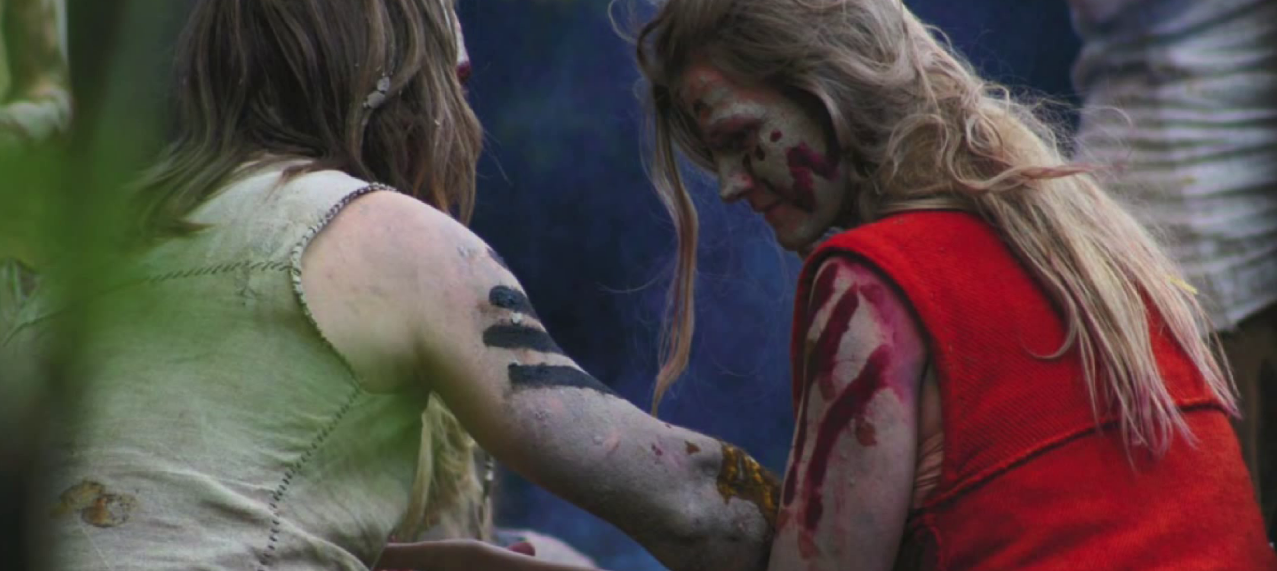
    Cover photo: Arm painting at Totem (photo, Mathias Kromann Rode).

    Content editing: Sarah Lynne Bowman.

    1. A Nice Evening with the Family was redesigned by Tor Kjetil Edland, Elli Garperian, Kajsa Greger, Susanne Gräslund, Anders Hultman, Caroline Holgersson, Frida Sofie Jansen, Maria Ljung, Gustav Nilsson, Martin Rother-Schirren, Daniel Sundström, Anna Westerling and Emma Öhrström in 2018, and subsequently re-run in 2018 and 2019. ↩︎
  • The Butterfly Effect Manifesto

    Published on

    in

    The Butterfly Effect Manifesto

    By

    Kjell Hedgard Hugaas

    This manifesto describes in detail our preference for playing, designing, and facilitating larp experiences with the explicit purpose of encouraging transformative impacts within participants. This work is a synthesis of countless conversations over the years and reflects the insights of many people within a number of regional and international larp communities from a variety of cultures. Ultimately, this manifesto reflects our personal perspectives built upon our exploration of dozens of different styles and genres of larps over the years.

    This work also integrates concepts and language from group dynamics, psychoanalysis, and personal development work in order to enrich our discourse about the potential of the larp experience. Thus, while this work represents our own commitments and beliefs, we are indebted to our wider communities for much of the content of this manifesto.

    While this work represents our current completed thoughts on this topic, we understand that as we progress further and deepen our knowledge in the field of transformative larping, the need for revisions and additions will present itself. When that happens, we will revise as necessary. This manifesto is intended to promote serious and respectful discussion rather than humor or antagonism. These words are offered in good faith with full knowledge that many may disagree. The authors welcome reflective and kind engagement for those who wish to discuss this approach.

    If you are interested in larping, designing, and facilitating for transformation, we invite you to join us in exploring the next steps together. We have created a Facebook group called Larping for Transformation where we will discuss themes, strategies, experiences, techniques, and pitfalls pertaining to larping in this fashion.

    Central Tenets

    1. We believe in the power of larp as a tool for transformation, self-awareness, empathy, and personal growth. We actively and intentionally use our larp experiences toward cultivating these capacities. Like the transformation of a caterpillar to a butterfly, changing oneself can be painful and difficult, but ultimately rewarding. While sometimes messy, the transformation process can yield life-changing results if participants grant themselves and others grace throughout it.

    2. As with the Butterfly Effect in chaos theory, we believe that even the smallest experience in a larp can have profound effects upon individual human and collective consciousness. A considerable number of people have shared the ways in which experiences in larps have helped them personally grow or become more engaged in their communities. We choose to honor and conscientiously amplify these impacts rather than think of them as secondary or serendipitous.

    3. The world is often a dark, dehumanizing, and demoralizing place. Because we believe that these small experiences can have profound effects, we feel that we have the obligation as players, designers, facilitators, theorists, researchers, and documenters to amplify these transformative impacts in order to help make the world and people’s lives a little bit brighter.

    4. We honor and respect all play experiences and motivations, while strongly expressing our preferences. While we do not discount or devalue the experiences of people who wish to larp for other reasons such as for instance entertainment, we choose to focus our intention toward these transformative impacts. We hold no ill will or criticism for people who play toward other purposes.

    5. Transformation involves stretching our edges in order to grow. Transformation involves taking risks and playing outside our comfort zones. Transformation involves exploring the boundaries of what we consider ourselves to be. Transformation is nurtured by the consensual creation and maintenance of a container that is secure enough to emotionally hold participants.

    6. We engage in transformative work with a deep reverence for our vulnerabilities, our sensitivities, and our hard limits. We acknowledge the bravery of anyone who chooses to push their edges, while equally honoring anyone who chooses to set healthy boundaries for themselves.

    7. Transformation involves moments of expansion and contraction. We may have peak experiences within a larp or within the larger community where we experience intense catharsis, ride unparalleled highs, give tirelessly of our energy to provide an experience for others, or have profound realizations about ourselves. These experiences may feel as purposeful as our daily lives outside of a larp context.

    8. Contraction is part of the expansion process. In order to explore the higher limits of our potential, we may also experience equally profound lows before, during, or after the event. Dips in energy, enthusiasm, sociability, feelings of profound loss, alienation, angst, or even post-larp depression are examples of contractions. These lows are part of the process and are invitations for us to reflect upon the change that is occurring within us.

    9. These moments of contraction can be valuably informative, showing us the places within ourselves that need healing or change. Embracing the contraction with open arms can help us learn how to deeply care for ourselves and steward our own experiences of life.

    10. When undergoing transformation, we give ourselves permission to ask for help from members of our community when we may feel at our most vulnerable. We may also be called to help others when they experience a profound low after a peak experience. Supporting one another as much as we are able is critical for creating a container where the needs of individuals having transformational experiences can be met in a secure environment. Co-creation has the power to catalyze powerful change. Mutual support provides nourishment throughout the process so that participants feel resourced.

    11. If we complete a larp experience without learning something about ourselves that we can use to improve our daily lives, we feel that we have missed an opportunity.

    12. We acknowledge that larp is not therapy unless facilitated by trained professionals.

    13. We also acknowledge that people already widely and consistently use larp for transformative purposes. Increased awareness around the principles of facilitation for transformative larping will therefore help create a safer environment for these transformative experiences to transpire. Thus, we believe that all parties engaged in the creation and enactment of transformative larping have a responsibility to try to create a secure environment for such experiences to unfold.

    mural of a rainbow butterfly on glass
    Butterfly mural outside of St Martins Lane Hotel in London, England. Photo taken by the authors after the August 2019 run of Just a Little Lovin‘, a larp by Tor Kjetil Edland and Hanne Grasmo that has inspired transformation in many of its players.

    Playing for Transformation

    14. As players, one of the tools of transformative larping that we employ is actively steering toward bringing aspects of our lives into our character experiences and stories and vice versa. We mindfully work with and intentionally insert aspects of our own lives into our characters and stories in order to examine, explore, and innovate our sense of self.

    15. As we believe that larp can be a transformative tool, we recommend treating the process of enactment with respect and reverence. Some players may bring into a larp content that is extremely personal and sensitive to them. We encourage this type of play when it is conscientiously used rather than disparage it, as it may lead to greater self-awareness and growth for the player and others within the community.

    16. We also believe that each player should have the right to opt in and out of challenging and intimate experiences. Therefore, we err on the side of consent and communication when inviting co-players into a particular theme or experience.

    17. Playing “close to home” — or close to one’s self-concept — may maximize the potential for transformative larping. Thus, we consider playing close to home a brave choice that we support whole-heartedly. The risks associated with playing close to home are lessened when the container surrounding the experience is held as supportively as possible.

    18. Playing a character unlike the self may also lead to transformation. Playing far from home may create an opportunity to explore characteristics one might like to attain, discover new facets of their identity, or reveal traits that a person might never want to embody again. Playing for transformation involves recognizing the humanity in both the heroic and the shadow sides of any given character. This recognition of the full range of human potential can encourage dramatic shifts in understanding and awareness about the world around us and ourselves if the opportunity for reflection is taken.

    Designing for Transformation

    19. While any larp content can be potentially transformative, how designers and players choose to implement that content before, during, and after the larp greatly influences the impact that a particular theme, moment, or story can have upon its participants. Conscious implementation of any and all design choices matters.

    20. As designers, we will choose themes, narratives, techniques, and facilitation principles that we believe have the potential to encourage transformative experiences. Of late, we have been interested in narratives that emphasize positive human potential, including traits such as compassion, empathy, humanization, personal growth, philosophical pondering, spiritual questing, conscious communication, and envisioning more optimal ways to build community.

    21. While exploring the darker sides of the human experience can be valuable, we are increasingly finding less interest in telling stories that only focus on oppression or harmful personality traits without offering some pathway to hope and redemption, even if such positive reframing only occurs during the post-larp process. Without sufficient post-larp processing and integration, we believe that exploration of narratives about oppression have limited transformational potential. We believe that play upon these themes can be recontextualized within the players’ lives in a way that motivates reflection, positive change, or prosocial behavior.

    22. We posit that all the stories we tell are connected to the world in which we live, even when exploring themes that seem fantastical. If we want to maximize the potential for transformation, then we need to contextualize these fictional narratives, anchoring them into the “real” world in a meaningful way.

    23. Because we believe that all stories are connected to the “real” world in some way and that larp can have a transformative impact, we emphasize the need for designers to write responsibly and inclusively. The goal of this process is to help the widest range of players relate to and feel engaged with the content. The positive impacts are limited and larp content can even become potentially harmful when care is not taken to consider the lived experiences that players bring into the fictional world.

    24. If a larp integrates themes of real world structural oppression, we believe that the design team must include and prioritize voices that represent people from those marginalized backgrounds as early and consistently as possible in the process. With greater nuance and care in representation, more people may experience a transformative impact from the larp.

    Facilitating for Transformation

    25. When facilitating a potentially transformative experience, organizers have a responsibility to create as secure and nurturing a container as possible so that the players feel held and respected through the experience. Building a strong container involves intentional and conscious co-creation and management of the social contracts between all participants; the safety structures that hold these contracts in place; and the content within the fictional world itself.

    26. The container of the larp experience does not only refer to the time spent onsite and in-game. The container starts with the genesis of the idea and continues with the beginnings of the organizing phases; the interactions with players before, during, and after the larp; de-roling and debriefing strategies; documentation; and the opportunities for integration that are made available after the experience. We recommend considering each of these stages at the forefront of design and facilitation throughout the process.

    27. When playing for transformation, everyone holds a piece of the responsibility for maintaining a strong container: the designers, the individual players, the play community, the organizers, and even the documenters, theorists, and researchers. Through shared responsibility and respect for the process, all parties can hold each other in a greater feeling of safety.

    28. We believe that the transformative impacts of larp can be amplified and negative impacts ameliorated through the use of proper frameworks. These frameworks can include consciously designed workshops, debriefs, meta-techniques, consent negotiations, check-ins, calibration conversations, and other methods that align the group toward both individual and collective transformative goals.

    a rainbow butterfly on a black and white leaf

    Integration

    29. We believe that the next step for maximizing the transformative potential of any given larp experience involves more extensive integration practices. Integration is the means by which a person or group can transition from a peak experience such as a larp back to their daily lives, evolving their own experience of themselves and the world in the process. Skills might transfer. Identities might shift. Social dynamics might change. Deeply buried pain may arise to be acknowledged. We encourage embracing the process of conscious and intentional integration from the fictional frame of reality to daily life, which involves facing and working with whatever arises.

    30. The post-larp integration process often involves a complex ebb and flow of emotions and thoughts. Relationships may shift, communities may expand, and consciousness may evolve. Contractions may occur that call forth intensely uncomfortable emotions. Creating solid structures to facilitate these transitions and integrate these experiences is paramount.

    31. Integration can also involve greater reflection upon the themes, the emotional dynamics, the social structures, and other aspects of the larp experience. Such reflection can occur through personal journaling, debriefing, documentation, discussion, theorizing, creating works of art, and many other processes. In larping for transformation, we understand that the larp does not end when the organizers call for the end of play.

    32. Our hope for the future is that we become increasingly mindful and intentional when designing toward transformative play. Engagement of this sort requires consideration of the integration of larp experiences into daily life as a vital part of the growth process for everyone involved.

    We appreciate your consideration of our manifesto. If you are interested in this style of play, come join us in the discussion at Larping for Transformation.


    Content editing: Elina Gouliou, Mo Holkar, and Johannes Axner.

    Valuable feedback on early drafts (alphabetical order): Arielle Brown, Clio Yun-su Davis, Dani Higgins, Jonaya Kemper, Joe Lasley, Lizzie Stark, and John Stavropoulos.