Month: April 2021

  • Playing with Eros: Consent, Calibration and Safety for Erotic & Sex Roleplay

    Published on

    in

    Playing with Eros: Consent, Calibration and Safety for Erotic & Sex Roleplay

    A version of this article was originally published by Pelgrane Press, in the Honey & Hot Wax anthology edited by Lucian Kahn and Sharang Biswas. (more…)

  • A Party Can Be Designed, Not Just Thrown

    Published on

    in

    A Party Can Be Designed, Not Just Thrown

    Coming out of pandemic mode after twelve months in isolation is no small thing. Surely, we aren’t the only ones who have been fantasizing about (while simultaneously being terrified of) grand fetes in historic mansions with commedia dell’arte performances and bubble machines.

    But if we’ve learned one thing from our decades of participation design, it’s that the human psyche doesn’t have a simple on/off switch for anything — we need transitional spaces to move out of extreme situations, like say, a worldwide pandemic. Easing the transition from isolation to small events and hopefully someday to bigger ones is something participation design can help you think through.

    In other words, good parties can be designed, not just thrown. As vaccines have become available, so have our hopes of once again meeting in small groups in person. And yet, all that time without social contact has changed many of us, leaving us with wonders about how it will feel to gather: Will small talk be awkward? What’s the best way to acknowledge loss? What if I freak out a little mid-gathering?

    While we aren’t qualified to answer safety questions like “how big is it safe for my party to be?” we can absolutely give some ideas on how to handle the social angle of things. Here is what we are thinking about as we start to ponder a return to social life.

    The Three Commandments of Post-Covid Parties

    Health First

    Don’t gather unless it’s safe to do so. Understand the risks of gathering in small groups by checking national and local guidelines before hosting a gathering. (As of the time of writing, the US’s CDC says that it’s safe for vaccinated folks to meet each other in small unmasked and indoor groups). But the infection landscape changes fast, so stay up to date. Ask your guests whether they are vaccinated and be transparent about the guest list. You may have friends who cannot have the vaccine, and accommodating them is also an issue for which you must refer to the experts.

    Health first also means that you, the host, should take care of your own mental health. You might find yourself tempted to go stressfully elaborate. Try to resist this impulse. Take it easy and find the option that is most fun for you.

    Finally, regardless of official guidelines, if you remain anxious or uncertain about gathering, give it some time.

    Photo, Jason Morningstar
    Photo, Jason Morningstar

    Start Small

    In general, the more intense the experience, the longer the return to normality takes. Many of us have been locked down for 12 months! So, go slow while returning to regular social life. Start with small, short gatherings. We suggest limiting to five or six participants tops, assuming that’s OK in your locality, and keeping it to two hours or less.

    Keeping it small reduces logistics (and thus headaches for you). It also prevents folks from getting overwhelmed with a sudden social marathon, and primes you for when it’s safe to scale up to bigger groups.

    Set Boundaries

    Boundaries can take many forms, from physical boundaries (we only hang outside), to social ones (masks on, please). It may seem obvious, but whatever you do, we recommend a start time and hard ending time at which the party closes. We suggest a starting point of two to three hours — long enough for meaningful conversation, but short enough that you won’t get too socially exhausted. Having a set duration for your event helps reduce social pressure on hosts and guests. You may wish to set other boundaries like “don’t come unless you’re vaccinated,” or even “we don’t talk about my cat.”

    Your Goals

    Knowing what you want to achieve helps you get half of the way to a great gathering.

    Design elements to consider:

    • Who is it most important for me to see in person? Who is it safe for me to see in person?
    • Am I emotionally ready for this?
    • What would my group most enjoy?

    Although progress has been made against the pandemic, things still feel tentative. It’s easy to believe that the restrictions could come back at any moment. So think about who it’s most important to see in person, everyone’s risk factors, and everyone’s vaccination status. In other words, health first, and make your gathering count.

    Take a beat to consider what your own boundaries might be. Are you ready to have people in your yard? Your house? Eating and drinking together? Do you end up socially exhausted an hour into a Zoom call? This will help you set up the terms of the event.

    Lastly, know your guests. Don’t bring a knife to a gun fight, and don’t whip out a complicated board game for a friend who just wants to talk extensively about their Warhammer 40K army (or, on second thought, maybe that’s not such a bad idea). As we always talk about while we’re designing games, what are the verbs of the situation — the things you will be doing. Will it be “sitting and talking,” “watching a movie,” “making friendship bracelets,” or something else?

    Photo, Jason Morningstar
    Photo, Jason Morningstar

    Designable Surfaces

    Our friend Johanna Koljonen refers to “designable surfaces” when talking about games, and that terminology feels particularly relevant here. A designable surface is any part of the experience that can be designed, and that list is much longer than we usually think it is. Here are some of the problems — meaning surfaces we can design on or around — that we anticipate with post-COVID parties:

    2020 Was a Hell of a Drug

    Last year brought a worldwide pandemic, police killings of people of color, protests, armed sedition, a tumultuous election, wildfires, widespread unemployment, and general chaos. Your friends may have experienced everything from the death of loved ones to job loss. They might want to talk about it. They also might not want to! There’s no real way to know how your friends will react.

    Design elements to consider:

    • Should I include a physical memorial?
    • Should I offer a memorial activity?
    • Should I build in a quiet space?

    Memorials

    Memorials and associated rituals exist to help us process confusing and difficult experiences, and we’ve all had a few of those recently. It’s worth considering including some ritual in your party to acknowledge, recognize, and memorialize. Sometimes silence is the worst possible response to death and trauma. Your guests may be craving the chance to articulate their feelings about 2020, and perhaps move past them in a meaningful way. Of course they may also want to forget it and get drunk instead, and only you know where to strike that balance. Tread carefully, because a less-than-thoughtful memorial is going to absolutely wreck your party as surely as a thoughtful and heartfelt memorial will elevate it.

    If you decide to include some memorial, you basically have two options. The first is some casual opt-in experience. This could be a “remembrance corner” with candles to light, a memorial book, a simple guided meditation or similar focused individual or small group activities. You could also arrange for guests to arrive with a memory and leave with a wish.

    One of our favorite rituals is artist Yoko Ono’s Wish Tree, which asks participants to write down a wish and attach it to a tree that already carries the many wishes of others. It is simple, powerful, and can be deeply meaningful to see your own desires subsumed in a flurry of others.

    The second is a more structured memorial for the entire group. This has the potential to get very intense, so approach it with caution and the full consent of your guests. Let them know well in advance that you plan on a formal memorial, and what it will entail. Once you have the enthusiastic consent of your guests, you can leverage the power of a group in solidarity. Share stories, sing, make noise to shake off the bad old times, or even set something on fire together. If you choose this approach, consider letting it start your party — end the ritual on a celebratory note that energizes your guests and sets the tone for the rest of the evening.

    What Is Small Talk, Even?

    A lot of folks avoided physical, in-person groups like the literal plague for the last 18 months. Getting used to being around other humans is going to take some time. Small talk isn’t going to be easy. In fact, a lot of people (hi fellow introverts) may find it more exhausting than usual.

    Photo, Jason Morningstar
    Photo, Jason Morningstar

    Design elements to consider:

    • What is the right theme and dress code for my party?
    • Should I include structured activities, and, if so, what?
    • What’s the optimal length for my party and how do I gracefully enforce it?

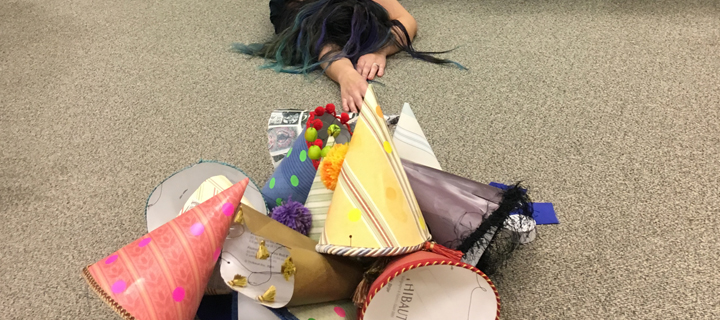
    Themes offer party-starved guests the opportunity to anticipate the event, by asking them to think about outfits or potluck food that fits with the hosts’ vision. Choosing an obscure holiday to celebrate — or inventing one — is a good bet. A theme that includes outfits can help get folks out of their heads and into party mode. Change the outsides to change the insides! Keep it simple and broad enough to accommodate the most theatrical diva and the guy who can just get it together enough to show up. The most reliable party theme of all time is “wear a hat.” But if your friends adore costuming, feel free to go hard with a pirate party, an eighties prom party, or something else ambitious and delightful and sure to generate lots of photos. Whatever the theme, make sure you keep a few extra bits around to offer a guest who doesn’t prepare.

    Structured activities are very effective at dissolving social awkwardness. A schedule, some advance warning, and an opt-in attitude can also lower the pressure for your anxious friends. You might want some passive-but-pervasive elements, like a movie or sporting event, as comforting background noise. An engaging and perhaps immersive activity that is easy to just observe or, if necessary, step away from, can be great. Party games, dancing, or karaoke all fit the bill. Host a tasting of something — traditionals are wine or cheese, but you could also do chocolate, water, or pizza. Finally, if you know your friends would welcome it, consider more formal activities. This could be a structured experience like a larp, a rave, making a craft or art object as a group, or doing some public service work.

    Things can only go so far off the rails in two hours. If you sharply limit the duration of the party, you are lowering the pressure for yourself and your guests. It may seem counterintuitive, but a clearly communicated and concise timeframe will improve… well, everything. When your guests know they need to be out by eleven, they will use the available time to everyone’s best advantage.

    We Don’t Know How To Act

    It’s been a long time since most of us have been physically close to other people. Is it OK to hug? To take our masks off? Boundaries are unclear and not knowing can make us insecure, anxious, or even at risk. Over and over again, we have heard that it’s not a good idea to hang out outside of your bubble or pod, if we are able to avoid it. Getting together in cross-pod groups will likely provoke some anxiety.

    Design elements to consider:

    • How do I keep my guests informed and set their expectations?
    • How do I help my guests behave the way I want them to?
    • Where can I bake in kindness and inclusivity?

    Tell your guests what will happen, what is expected of them, and what can be expected of you. Then tell them again, because they will forget. Stating “we will follow CDC guidelines, which you can read about here” is never a bad move — see commandment one. Ask them about their uncertainties and fears and share your own. Talk about your plan for reducing the spread of COVID with the group beforehand, so folks aren’t surprised with it when they get to your place.

    The single most effective way to engineer social behavior is through modeling. Your guests will naturally look to you for cues on what is appropriate and what is out of bounds, and you can leverage that. Design your event in a way that allows you to model good, safe, appropriate behavior. Have a plan for reinforcing it and gently correcting your friends who didn’t read the email — or who have forgotten how to behave. Offer hand sanitizer, discuss what the mask etiquette will be, particularly if you are in a group of mixed masked and unmasked folks, and default to the preferences of the most anxious person.

    You may have guests who find themselves anxious or uncertain, and it’s a good idea to plan for that. A shared activity that is individual, like, say, adult coloring books, may help to reduce anxiety. So will communicating in advance.

    Photo, Jason Morningstar
    Photo, Jason Morningstar

    Enthusiasm, and Why It Is Bad

    What we all want and what is safe and sane are not necessarily well-aligned. Resist temptation. Yes, you want to see all your friends. Yes, your heart races at the thought of a grand, elaborate event where dozens mingle and laugh in their best pirate costumes before descending into sweaty debauchery. No, this is not the first party you should have post-COVID.

    Design elements to consider:

    • What is just right for my party, and what is too much?
    • How can I design this to meet my own needs?
    • What can I learn to make my next gathering even better?

    The right size for your party is right there in the second commandment — small. That’s a relative term, of course, but a good rule of thumb is to make it more intimate than you want to.

    Putting your own needs first ensures that you will have fun and also allows you to obey the third commandment by setting boundaries. Be selfish. Make sure to design a party that will be a pleasure for you to attend. Delegate details to trusted friends. Don’t stress about cleaning. Be kind and patient with yourself.

    Considering this a test run for future festivities and collecting informal data on what works and what doesn’t may seem excessively dorky, but it’s another way to lower the pressure and embrace the unexpected. It will also make your next party better, and we all want that.


    Cover photo: by Jason Morningstar

    Content editing: Elina Gouliou

  • The Psychotherapeutic Magic of Larp

    Published on

    in

    The Psychotherapeutic Magic of Larp

    The fact that larp has psychotherapeutic and transformative potential is certainly not an arcane knowledge in the larp world. Many, if not all, larpers know experientially that even the kinds of larp that are designed to be strictly recreational contribute to one’s growth and personal development. Through larping we get to know ourselves better, we develop our creative and innovative thinking, we become better problem-solvers. We enhance our empathy, improve our social and communication skills, learn teamwork, and increase our sense of community. We explore different values, beliefs, ideologies, ways of behaviour and expression. We develop multidimensional artistic skills and gain better understanding and handling of the physical world. Through larp, we develop holistically: on a physical, mental, emotional, creative, and social level.((Elektra Diakolambrianou, “The Use of Live Action Role-Playing (LARP) in Personal Development, Therapy and Education” (presentation, Smart Psi National Conference, Bucharest, Romania, 24/11/2018).))

    Yet how does the psychotherapeutic magic of larp work? What are the mechanics behind this transformative experience? Are the processes and elements at play different when personal development happens informally in a recreational larp, as to when a larp is formally designed for psychotherapeutic purposes? What makes larp a valid and effective methodological tool in the hands of a mental health professional?

    The current article will make an attempt at answering these questions by:

    (a) exploring characters and stories in larp as psychotherapeutic material,

    (b) analyzing the role of empathy in the embodiment and function of larp characters, as well as

    (c) the connections between larp and some of its most adjacent psychotherapeutic methodologies (psychodrama-sociodrama, dramatherapy, narrative psychotherapy).

    Finally, it will conclude in:

    (d) discussing how techniques of the above-mentioned approaches can be used to design and use larps as tools in psychotherapy.

    The words "I want to evolve" on top of an abstract colorful painting
    Photos from a mixed-media art project on personal development through creativity. Photo by Elektra Diakolambrianou.

    Stories and Characters as Psychotherapeutic Material

    Humans create and share stories in order to make sense of their world. Every story told in the world – be it a folk tale, a bedtime story, or a personal narrative – is a participatory experience and a journey of inner and outer exploration for both the teller and the listener.((Alida Gersie and Nancy King, Storymaking in Education and Therapy, (London: Jessica Kingsley Publishers, 1990), 23-24.)) Psychotherapy as a process could not be any different; storytelling is a core element in the therapist’s room, as clients present themselves in various characters and roles, and share their stories in order to make sense of themselves, their problems and their lives.((Kevin Burns, “The Therapy Game: Nordic Larp, Psychotherapy, and Player Safety”, in Wyrd Con Companion 2014, edited by Sarah Lynne Bowman, (Los Angeles, CA: Wyrd Con, 2014), 28-29.)) In fact, what essentially differentiates the various approaches of psychotherapy from one another is the lens through which they interpret, understand and use these stories and the characters within them in order to understand the client and facilitate his transformation and change. So, from a psychological point of view, where do these stories and characters come from, and what do they mean?

    Larp literature has often used the Jungian perspective of archetypes to answer this question. Carl Jung defined archetypes as universal symbols and personality patterns, deriving from shared “archaic remnants” and “primordial images” within our collective unconscious.((Carl Gustav Jung, Man and His Symbols, (New York: Doubleday, 1964), 27-59)) Whitney “Strix” Beltrán has examined in great detail the relationship between larp, archetypes and depth psychology in her work “Yearning for the Hero Within: Live-Action Role-Playing as Engagement with Mythical Archetypes,” where she analyzes and discusses larp as an answer to the societal need for myth in the Western civilization.((Whitney “Strix” Beltrán, “Yearning for the Hero Within: Live Action Role-Playing as Engagement with Mythical Archetypes,” in Wyrd Con Companion 2012, edited by Aaron Vanek and Sarah Lynne Bowman (Los Angeles, CA: Wyrd Con, 2012), 91-98.)) Sarah Lynne Bowman similarly studies immersion in role-playing games through the perspective of the Jungian theory.((Sarah Lynne Bowman, “Jungian Theory and Immersion in Role-playing Games,” in Immersive Gameplay: Essays on Participatory Media and Role-playing, edited by Evan Torner and William J. White (Jefferson, NC: McFarland, 2012), 31-51.)) Kevin Burns discusses active imagination (a technique developed by Jung to explore the archetypes in the realm of the collective unconscious) as a process closely related to larp, and highlights how the exploration of archetypes through larp can facilitate personal growth and cultural richness.((Burns, “The Therapy Game”, 29-37)) And lastly, Beltrán has beautifully used the Jungian perspective as a lens for understanding the complexes and group processes in larp communities.((Whitney “Strix” Beltrán, “Shadow Work: A Jungian Perspective on the Underside of Live Action Role-Play in the United States.”, in The Wyrd Con Companion Book 2013, edited by Sarah Lynne Bowman and Aaron Vanek, (Los Angeles, CA: Wyrd Con, 2013), 94-101.))

    Given the extensive work already existing in the field of Jungian theory, I will not revisit ground already covered, but will instead attempt to discuss the issue at hand from a different perspective: that of the person-centred approach to psychotherapy. By doing so, I am not proposing an alternative to the archetypal paradigm, but rather suggesting a supplementary view, more focused on the self-concept and its phenomenological representation in the here-and-now of the individual experience.

    Configurations of Self: A Person-Centered Perspective

    The person-centred approach, developed by Carl Rogers in the early 1940s, views the person as an organism, a holistic entity where the biological, psychological and social aspects of existence are intertwined and inseparable. Each organism is believed to have an inherent actualizing tendency, an internal force that promotes the organism’s survival, differentiation and evolution.((Carl Rogers, ”Theory of Personality and Behaviour”, in Client-Centered Therapy – Its current  practice, implications and theory, (London: Constable, 1951), 481-533.)) The concept of self (our sense of who we are) within this framework is just a part of the organism; it consists of the elements of our internal and external experiences that we view as relating to us. This self-concept, however, is often distorted by our conditions of worth (our perception of what our environment and the important “others” in our lives expect from us to accept us and regard us positively); and this can lead to us only allowing parts of our real genuine self to enter our self-awareness and get integrated into our self-image, while other parts of us (the ones that are negatively regarded or not acceptable by our environment) are suppressed, distorted or denied.((Carl Rogers, “A Theory of Therapy, Personality, and Interpersonal Relationships, as Developed in the Client-Centred Framework”, The Carl Rogers Reader, ed. Howard Kirschenbaum and Valerie Henderson, (London: Constable, 1959), 236 – 257.))

    In addition to that, the concept of personality is not viewed by the person-centred approach as an entity that is stable, unidimensional and harmoniously integrated. On the contrary, according to later theorists like Mearns and Thorne,((Dave Mearns and Brian Thorne, “The nature of configuration within self”, in Person-Centred Therapy Today, (London: Sage, 2000), 101-119.)) the self is a mosaic of configurations: a range of differentiated self-concepts (alternative personalities, if you wish) that appear in different circumstances. Each of these configurations of self represents a coherent pattern of feelings, thoughts and behaviours, and each one has different needs, desires and views of the world. According to the situational circumstances, different configurations arise within us, even in the course of a common day, without us necessarily being aware of the process. The coexistence of these configurations within us can be harmonious and functional, or a cause of constant conflict and distress, depending on many factors relating to our life experiences, personality structure and levels of self-awareness.((Dave Mearns and Brian Thorne, “Person-centred therapy with configurations of self”, in Person-Centred Therapy Today, (London: Sage, 2000), 120-143.))

    Taking all the above into consideration, we can develop a view on characters in larp that is not far from the Jungian perspective, but slightly more focused on the here-and-now experience of the player than on their collective subconscious: When we create characters and stories that are consciously more on the close-to-home scale, we are essentially staying closer to our self-image and our symbolized experiences. Although we do not drift far from our comfort zone, this may still hold therapeutic value if it allows us to explore our self-concept and our internalized behavioural patterns (i.e. the behaviours that align with our conditions of worth). And most importantly to gain more insight and understanding as to how and why these have been formed within us, in what instances they arise, and how they influence our interactions with others. The further we drift away from our comfort zone and into a range of characters and stories that (at least seemingly) appear to be far from our self-image, the therapeutic value of the “material” is increasing, as we may be exploring the uncharted waters of parts of our real self that have been suppressed or denied, or we may be experimenting with alternative ways of being that can more easily arise in the safe environment that alibi provides us with during larp. Essentially, according to the person-centred perspective, what we will be portraying and exploring will always be some configuration(s) of our self, which can either be more close to our awareness and self-image or further away from it, depending on the level of challenge we chose to present ourselves with each time.

    The Role of Empathy in Larp

    Although there is a broad range of definitions of empathy as well as various empathy types recognized by theorists (cognitive empathy, emotional empathy, somatic empathy, situational empathy),((Hannah Read, “A Typology of Empathy and its many Moral Forms”, Philosophy Compass 14 (10), (2019) https://doi.org/10.1111/phc3.12623)) I will be here referring to empathy as our ability to understand another person’s feelings and/or experiences from within that person’s own frame of reference – in less scientific terms, our ability to put ourselves in another person’s shoes.((Carl Rogers, “Empathic: An Unappreciated Way of Being”, in A Way of Being, (Boston: Houghton Mifflin, 1980), 137-163.)) Studies in developmental psychology,((Martin Hoffman, Empathy and Moral Development: Implications for Caring and Justice, (Cambridge: Cambridge University Press, 2000).)) as well as neurobiology,((Mbemba Jabbi, Marte Swart and Christian Keysers, “Empathy for positive and negative emotions in the gustatory cortex”. NeuroImage, 34 (4): (2007), 44–53. https://doi.org/10.1016/j.neuroimage.2006.10.032)) show that all people are born with the inherent capacity for empathy (as it is linked with neuronic systems in our brains called “the mirror neuron system”), although the level of its development can be differentiated by parameters such as upbringing, life experiences, personality structure and psychophysiological factors. Thus, to some extent, every one of us can potentially perceive the world as another person sees it,((Jerold Bozarth, “Beyond Reflection: Emergent Modes of Empathy”, in Client-Centered Therapy & The Person Centered Approach, eds Ronald Levant and John Schlien, (NY: Praeger, 1984), 59-75.)) and that is why we can all larp.

    Indeed, the role of empathy in larp is to a certain degree self-evident, as it is our empathic ability that allows us to impersonate a character; the extent to which we can empathize with our character will determine the depth of our immersion and our ability to roleplay as that character. But at the same time, larp is also enhancing our empathic abilities; theatre and theatrical techniques have been used as an essential part of empathy training for at least two decades now in the fields of medical, clinical and activist communities, with relevant studies showing that theatre as a medium not only produces, induces and grows empathy for the actors, but also for the spectators.((Maia Kinney-Petrucha, “The Play’s the Thing: Theater as an ideal Empathy Playground”, (2017). https://www.researchgate.net/publication/317318081_The_Play’s_the_Thing_Theater_as_an_Ideal_Empathy_Playground)) In other words, the more we impersonate larp characters that are seemingly different from us, and the more we interact with other players impersonating such characters, the more our capacity for empathy increases. The importance of this needs to be emphasized, as it goes beyond the simple development of a social skill through larp but is indeed a factor of mental well-being on its own.

    To better understand its significance, let us revisit the person-centred psychotherapeutic approach. According to Carl Rogers, there are six conditions in the context of a therapeutic setting that are necessary and sufficient to bring about therapeutic change: psychological contact, incongruence (on behalf of the client), congruence/authenticity (on behalf of the therapist), empathy, unconditional positive regard, and sufficient communication of the latter two. Therefore, from a person-centred perspective, in a setting/relationship where all these conditions are present, the person can safely grow, examining his self-image and its conditions of worth, broadening his perceptual field, increasing his self-awareness and positive self-regard, and thus becoming more functional and open to experience.((Carl Rogers, “Conditions which Constitute a Growth Promoting Climate”, in The Carl Rogers Reader, ed. Howard Kirschenbaum and Valerie Henderson, (London: Constable, 1986), 135-147.))

    One could argue that in some larps all the above-mentioned therapeutic conditions can potentially be present (and we will revisit this in the section about ‘larp design for psychotherapeutic purposes’). For the time being, I will focus on empathy as one of the therapeutic conditions, even in the case of a larp where the remaining five conditions are not occurring. The development of empathy will, even in the absence of the other conditions, enhance the personal growth of the player in numerous psychotherapeutic ways:

    • Empathy dissolves alienation, by connecting us to others and to the human experience as a whole.
    • Empathy promotes inclusion and related values, as it is very difficult to enter the perceptual world of another without valuing it, or without ending up valuing it.
    • Empathy reduces judgmentalism (towards others and self), thus raising the person’s acceptance and self-acceptance.
    • An empathic internal environment will create more safety for self-exploration, thus fostering the ability to integrate more configurations into the self-concept.
    • Empathy allows the flow of experiencing (for self and others) to be unblocked, thus unblocking essentially our actualizing tendency.
    • Empathy is a vital element of effective communication in interpersonal and intergroup interactions.((Elisabeth Freire, “Empathy”, in M. Cooper, M. O’Hara, P. Schmid & G. Wyatt (eds), The Handbook of Person-Centred Psychotherapy and Counselling, ed. Mick Cooper, Maureen O’Hara, Peter Schmid and Gill Wyatt, (New York: Palgrave Mc Millan, 2007).))

    Connections Between Larp and the Psychotherapeutic Process

    Although every psychotherapeutic approach could potentially be linked to larp,((Eirik Fatland, “A History of Larp – Larpwriter Summer School 2014,” Fantasiforbundet, published on August 3, 2014, Youtube video, 48:10, https://www.youtube.com/watch?v=Rf_gej5Pxkg)) I will here refer to the ones whose techniques are, from my viewpoint, more closely linked to larp as a process. Given the theatrical nature of larp, the most obvious connections would be to the approaches of psychodrama-sociodrama and drama therapy. Added to that, I will also discuss its affiliations with narrative psychotherapy.

    Psychodrama – Sociodrama

    According to Eirik Fatland’s lecture on the history of larp, the lineage of modern larp can be linked to the invention of psychodrama by Jacob Levy Moreno in the early 1920s. Psychodrama probably does not need long introductions; it is a widely used and known psychotherapeutic approach, and more precisely a method of exploring internal conflicts by dramatically reconstructing them in a group setting, usually under the direction of a trained psychodramatist. In his own words, Moreno describes it as “an action method” and “a scientific exploration of truth through dramatic art”.((Jacob Levy Moreno, Psychodrama Volume 1, (New York: Beacon House, 1946), 37-44.))  His improvisational and political approach to theatre (rooted in his earlier groundbreaking work in his Theatre of Spontaneity) is evident not only in his theory of psychodrama but also in his later work on sociodrama, a method used for groups to reenact and explore social situations of conflict and oppression (which would in the 1970s become the cradle for Augusto Boal’s Theatre of the Oppressed).((Beliza Castillo, “Psicodrama, Sociodrama y Teatro del Oprimido de Augusto Boal: Analogías y Diferencias,” Revista de Estudios Culturales 26 (26), (2013), 117-139.))

    Theory-wise, the strongest connection link between larp and psychodrama is Moreno’s approach of the dramatic role as an acting and interacting entity, something that humans actively embody and not passively wear, contrary to the paradigm of his time that viewed dramatic roles cognitively, as a part of the self that has been absorbed by the mind.((Robert Landy, Persona and Performance: The Meaning of Role in Drama, Therapy and Everyday Life, (London: Jessica Kingsley Publishers, 1993), 52-54.)) On the other hand, a major difference between larp and psychodrama can be located in the methodological directivity of the latter; although spontaneity is necessary and desired in the content that participants bring and the way they engage with it in the psychodramatic session, the director (psychodramatist) is leading the process by instructing and guiding them through selected exercises and techniques.((Sue Jennings and Ase Minde, Art Therapy and Dramatherapy: Masks of the Soul, (London: Jessica Kingsley Publishers, 1993), 28-31.))

    I would, however, argue that many of the techniques used in psychodrama and sociodrama occur in larp as conscious or unconscious player choices, despite the usual lack of directivity of larp as a medium. Let us take a close look to a few of the most commonly used psychodramatic techniques((Ana Cruz, Celia Sales, Paula Alves and Gabriela Moita, “The Core Techniques of Morenian Psychodrama: A Systematic Review of Literature”, Frontiers in Psychology 9 (1263), (2018) https://doi.org/10.3389/fpsyg.2018.01263)) and give some input to when and how they can be observed in a larp framework:

    • Role reversal: The participant steps out of their own role/self and takes on the role of a significant person in their life.
    • Mirroring: The participant becomes an observer while auxiliary egos (other participants) reenact an event they have previously described or acted out, so the participant can watch.
    • Doubling: Another group member adopts the participant’s behaviour, expressing any emotions or thoughts that they believe the participant has.
    • Soliloquy: The participant shares inner thoughts and feelings with the audience.

    Role reversal can often be observed in larp when players end up creating or receiving a character that shares personality or backstory characteristics with a real person in their lives. As in psychodrama, this can build empathy and shed light on obscure relationship dynamics, as the player moves a step closer to perceiving the world through the eyes of that person.

    Mirroring and doubling are “services” that, knowingly or not, other characters can provide to the player during a larp. Without necessarily intending to or even realizing it, other players may as characters embody personality traits that the player portrays out-of-game, may create scenes that are close-to-home for the player’s real-life experiences, or may express emotions that the player can relate to. When this happens, it can provide the player with an opportunity for self-awareness, self-compassion, as well as constructive self-analysis through a safe distance (see also next section: drama therapeutic empathy and distancing).

    Lastly, soliloquy often occurs during the game when characters decide to open up to others in-game, but most importantly is a crucial element of the debriefing. As in psychodrama, this sharing, and generally the time allocated for group discussions about the in-game events, gives the opportunity for the meaning of the feelings and emotions that have come to light to be processed, thus essentially allowing transformation to occur.

    Woman leading her companion through the Wieliczka salt mine in Poland.
    Woman leading her companion through the Wieliczka salt mine in Poland. Photo by Nikola Sekulic.

    Drama Therapy

    Drama Therapy is a broad term, referring to the application of the art of drama in various frameworks and settings with the aim of creating a therapeutic, remedial and useful experience for the participants.((Sue Jennings, Introduction to Dramatherapy: Theatre and Healing – Ariadne’s Ball of Thread, (London: Jessica Kingsley Publishers, 1998), 39-40. )) There are countless exercises and techniques used in dramatherapy, as it serves more like a methodological framework than as a concrete therapeutic paradigm; however, there are certain concepts that apply generally in its various implementations, and here we will focus specifically on those. In his book “Drama as Therapy – Theatre as Living,”((Phil Jones, Drama as Therapy – Theatre as Living, (London: Routledge, 1996), 166-196.)) dramatherapist Phil Jones identifies and describes nine core processes that occur in dramatherapy, thus explaining its psychotherapeutic effectiveness. I will shortly discuss each of them, arguing how all of them can be found in a larp, therefore rendering it a therapeutic medium:

    Dramatic Projection

    Dramatic projection is the process through which people project aspects of themselves and their experiences onto theatrical and dramatic material, thus externalizing internal conflicts. This way, a relationship is built between their deeper internal states and the external dramatic formation, rendering self-exploration and therapeutic change possible through the dramatization of the projected material. Dramatic expression creates a new representation of this material, mediating a dramatic dialogue between the material and its external expression, providing the person with the opportunity to create a new relationship with it and reintegrate it within that context.

    In larp, dramatic projection of inner material can happen consciously when we intently choose to play close to home, or subconsciously when we end up in one way or another portraying some configuration of ourselves. Following the argumentation of the person-centred approach, some level of dramatic projection is inevitable, and what varies is the degree to which we are aware of our process of projection.

    Therapeutic Performance Process

    The therapeutic performance includes the process of identifying the needs for expression of specific aspects that a person would like to explore. Turning that material into a performance is in itself therapeutic, as the person may take on different roles in the process, changing their viewpoint on the situation and allowing themselves to experience their creativity and relate to their issues through it. Thus change can occur through engaging with the problematic material from a different perspective, experimenting, and breaking the feeling of being trapped in the problem.

    The identification of our needs for expression starts at the moment we choose to participate in a larp, or choose to play a specific character in it. Again, the extent to which this process is a conscious or subconscious one may vary, at least in larps that would be categorized as recreational.

    Drama Therapeutic Empathy and Distancing

    Empathy and distancing in drama therapy are two distinct but correlating processes, that refer both to active participants and to “witnesses” of the dramatic material. In accordance with the previous analysis of empathy, dramatherapeutic empathy encourages the resonance of feelings and the intense emotional involvement, making the development of empathic responses therapeutic for people in and out of the drama therapy room. Parallelly, distancing encourages a way of involvement that is orientated more towards thinking, reflection and opinion forming. It allows the person to engage with the material using critical thinking, and therefore to form a meta-perspective on it. The two processes can occur interchangeably or simultaneously, creating a dynamic of therapeutic change through their interaction, and giving the person the opportunity to develop holistically.

    Essentially, when we are talking about drama therapeutic empathy and distancing, we are talking about immersion and aesthetic distance / meta-reflection. Their degree may vary depending on the larp and its design, but the balance and shifting between them is in the end what allows the player to develop and achieve self-growth through larp.((Hilda Levin, “Metareflection”, in What Do We Do When We Play? The Player Experience in Nordic Larp, edited by Eleanor Saitta (Finland: Solmukohta 2020), 62-74.))

    Personification and Impersonation

    Personification (representing personality characteristics or aspects using objects in a dramatic way) and impersonation (creating a persona by adopting and portraying characters and roles) are two techniques through which people can express their inner material while exploring the meaning these processes have for them during and/or after their development. They provide a concrete focus point for expression and exploration: the participants have the possibility to experience how it is to be someone else or themselves while playing someone else. Opportunities for the transformation of the inner material are created, as the fictional world that is being built can allow the freedom for explorations that would be judged or denied in real life.

    Both processes are necessary for any kind of larp to take place, with the importance of each to vary according to the type of the larp and its design. They are the psychological processes that explain how characters, costumes and props function in larp, and provide the safe frame (alibi) in which larp (and transformation through it) can happen.

    Interactive Audience and Witnessing

    Participants in drama therapy can become an audience to others but also themselves through a framework of deep self-awareness and development. Thus they start to witness their experiences, empowering their ability to work on issues in a different way and from a different angle. To be witnessed can be therapeutic in itself, as it can be experienced as acceptance and reinforcement. Moreover, projecting part of themselves or the experience on others in the audience can assist the drama therapeutic process by providing more opportunities for material expression. The witnessing process is interactive, without formal boundaries between actors and audience, leading to a powerful dynamic in the group experience and support.

    Although interactive witnessing in dramatherapy may seemingly look very different from a larp on the surface, it is essentially the same core process that lies within the interactivity of larp as a medium. Playing together with others makes us constantly shift from witnessing to being witnessed. Other players’ larp performances can be equally valuable for our personal growth; and their interacting with our performances functions as an accepting environment in which we can explore ourselves.

    Embodiment

    Embodiment refers to the (actual or envisioned) physical expression of personal material, and generally to the connection that the participants form with that material in the here-and-now. The relationship between the body and the identity of the person makes the body use in drama therapy of vital importance for the nature and the intensity of the participant’s engagement. The participants can engage themselves in the development of their bodies’ capacities; they can unleash powerful therapeutic dynamics by adopting a different body identity; and they can explore the personal, social and political forces that influence their bodies.

    The significance of the role of the body in larp is increasing in the last years, rendering the process of embodiment more important, recognized and discussed. The power of embodiment can especially be witnessed in larps where players can, through their characters, explore playing with age, gender and disabilities. However, it can be also witnessed in the most common Anglo-Saxon larp, where the players need to physically and accurately embody their characters’ abilities or inabilities.

    Playing

    Through the element of play, a playful atmosphere and a playful relationship with reality are created, in which the attitude towards facts, consequences and dominant ideas can be flexible and creative. This offers participants the ability to adopt an equally playful and experimental attitude towards themselves and their life experiences. Play, as part of the drama and the expressive continuum, becomes a symbolic, improvisational and creative language. Its therapeutic value also has a developmental aspect, as play can, on one hand, promote the cognitive, emotional and interpersonal development, while on the other hand, it can also be a means of returning to former developmental stages, in order to revisit an obstacle or trauma through different eyes.

    The element of play needs no introductions when discussed in the context of larp. Play, as a context and process, allows us to be someone else during a larp, as well as to explore what being this someone else means for us. The larp setting and alibi create a framework where this play can be more or less free, and certainly free from real-life consequences, thus allowing us not only to transform but also to reconnect with our inner child.

    Life-Drama Connection

    The connection between drama and life can be evidently direct or seemingly indirect, and it can be a conscious process for the participant, or a more spontaneous and unaware one. Often the life-drama connection only becomes evident after the dramatization is over. For some participants, it is the experience of the drama itself (and not a cognitive realization) that becomes the link between dramatization and life, and this can also happen (consciously or unconsciously) during the dramatization itself. It is of utmost importance that the drama therapy framework can be connected to real-life without being a part of it; this is what brings freedom for real action in the drama therapy space.

    The life-drama connection process can sometimes happen within playtime, with meta-reflection allowing for revelations and aha moments to occur while we are playing. However, it is mostly facilitated and supported during the debriefing, thus rendering the debriefing a vital part of any larp.

    Transformation

    Transformation is the end result, as well as a multidimensional process itself. Life events are transformed into dramatized representations. People are transformed into roles and characters. Real-life experiences and patterns of experiencing are transformed through the language of drama into an alternate experimental reality. The participation in the drama itself, and the emerging artists in the participants, lead to a transformation of identities, perceptions and emotions. And real-life relations are experienced as transformative in the here-and-now of the drama therapeutic group and framework.

    This transformation, closely linked with bleed processes, is what essentially renders the player a changed person after taking part in a larp. It is the result of all the above-mentioned processes, actualized through the immersive experience, and rendered possible through the alibi of the fictional world. The potential of self-growth may vary on many factors already mentioned, as well as on the quality of the debriefing. However, even a slight or subconscious transformation is still something the player leaves the larp with, knowingly or not.

    Narrative Psychotherapy

    Taking a few steps outside the realm of expressive art therapies, let us visit another psychotherapeutic approach that can be connected to larp as a process: Narrative therapy is a form of psychotherapy, developed in the 1970s and 1980s by Michael White and David Epston, that focuses on the stories (narratives) we develop and carry with us through our lives. Through these stories, we give meaning to our experiences, life events and interactions, while at the same time they influence our self-perception and world views.((Catrina Brown and Tod Augusta-Scott, Narrative Therapy: Making Meaning, Making Lives. (Newbury Park, CA: Sage Publications, 2007), 18-22.)) According to the narrative therapy perspective, reality is not objective but socially constructed, and thus having narratives is our way of maintaining and organizing our personal reality and making sense of our experiences. Although our narratives are usually multiple and multidimensional, we often carry one that is more dominant over the rest. When our dominant story is problematic, in the sense that it is becoming an obstacle to our personal growth and change, this can be the cause of emotional pain, distress and dysfunctionality. Such a dominant story may derive from judgemental and/or negative external evaluation that has been internalized, as well as from societal and systemic sources of influence and pressure. This internalization may make us perceive our problems/issues as personal defining attributes and lead us to think we “are” the problem, while at the same time unwillingly following behavioural patterns that reproduce the dominant story in the form of a self-fulfilling prophecy.((Jill Freedman and Gene Combs, Narrative Therapy: The Social Construction of Preferred Realities, (New York: Norton, 1996), 22-41.))

    To help achieve emotional and mental well-being, narrative therapy focuses on people’s stories, with the aim of exploring them, understanding them, and eventually challenging them with alternative healthier narratives. This is achieved with a range of techniques (often referred to as conversation maps) that aim to separate the person from their problem, to deconstruct unhelpful meanings, and to give the person the agency to construct their own narratives and ways of being and experiencing:((Michael White, Maps of narrative practice, (New York: Norton, 2007), 9-144.))

    • Putting together the narrative: A primary task in narrative therapy, that helps the person become aware of their stories, explore their origin and identify the values and meaning they carry.
    • Externalizing conversations: To separate people’s identities from their problems, narrative therapy employs the process of externalization, which allows people to distance themselves from their relationships with problematic narratives and become observers of themselves.
    • Deconstruction: It is used to help people gain clarity about their narratives, especially in cases where a dominant story has been carried for so long that it overwhelms the person and creates overgeneralizations.
    • Unique outcomes: When a narrative is experienced as stable and concrete, it can overshadow many aspects of our lives and render us stuck in it and unable to consider alternative narratives. A narrative therapist can assist by challenging the story, offering alternative views, and exploring information that is within us but is not allowed to gain value if it does not fit into the dominant story.
    • Re-authoring identity: People are assisted by the therapist to create new narratives for themselves, more genuinely meaningful and accurate to their own existential experience.((Michael White and David Epston, Narrative Means to Therapeutic Ends, (New York: Norton, 1990), 58-82.))

    All these processes are relevant to the character and story creation that takes place within a larp. Players are constructing a narrative when they create content in larp, with dominant stories often being reproduced through bleed and its many aspects.((Ane Marie Anderson and Karete Jacobsen Meland, “Bleed as a Skill”, in What Do We Do When We Play? The Player Experience in Nordic Larp, edited by Eleanor Saitta, (Finland: Solmukohta 2020), 53-58.)) The game play itself can function as a kind of narrative psychotherapist at this point; the embodiment of character can function as an externalizing conversation, often also providing unique outcomes, as we are not playing alone but with other people who may at any point challenge our dominant narrative, knowingly or not. Moreover, a transformative larp experience can on its own provide us with revelations that allow us to become aware of our narratives and deconstruct them, leading to one or more re-authored identities (essentially any character embodiment is to some extent a re-authored identity). However, the role of the debriefing in facilitating the actualization of all these processes and their therapeutic potential is crucial, also often supported by pre-larp workshops for character creation (see next section for more details).

    Images of books, tea kettles, and Eiffel Tower statues next to the words "I want to expand my horizons"
    Photos from a mixed-media art project on personal development through creativity. Photo by Elektra Diakolambrianou.

    Larp Design for Psychotherapeutic Process

    I would like to start this section by pointing out something that is often not obvious: When designing a larp for psychotherapeutic purposes, it is vital to have at least one mental health professional in the designers’ and/or organizers’ team. As Maury Elizabeth Brown very thoroughly analyzes in her article “Pulling the trigger on player agency: How psychological intrusions in larps affect game play,”((Maury Elizabeth Brown, “Pulling the Trigger on Player Agency: How Psychological Intrusions in Larps Affect Game Play”, in Wyrd Con Companion 2014, edited by Sarah Lynne Bowman (Los Angeles, CA: Myrd Con, 2014), 96-111)) larps can contain triggering content even if they do not intend to do so, and this is something that needs to be carefully handled by organizers. Particularly in the case of psychotherapeutic larps, where the triggering is intended, the contribution of a professional will be essential both in designing / curating the larp within a theoretical and practitioner-oriented framework focused on mental well-being and relevant processes, as well as in providing emotional safety and emergency care if needed during its implementation (briefing, gameplay and debriefing). Moreover, especially in case the psychotherapeutic larp in question is aimed to address specific mental health issues / themes (e.g. grief, abuse, trauma etc), or is targeted at specific participant groups (e.g. people with personality, anxiety, mood disorders), a deep scientific understanding of these issues and/or participants is a  necessary element of the larp design.

    Having said that, this section aims at providing some ideas and potential guidelines either for mental health professionals that would like to use larp as a psychotherapeutic medium, or for larp designers that wish to collaborate with a mental health professional to direct their larps towards the field of psychotherapy. Keeping in mind all the psychological and psychotherapeutic processes previously analyzed in the article, I will attempt to indicate the points of the larp design process that can transform the larp into a formal psychotherapeutic tool.((Elektra Diakolambrianou, “Larp as a Tool for Personal Development and Psychotherapy” (presentation, PoRtaL 8 Interntational LARP Convention, Zagreb, Croatia, 8/3/2020).))

    Designing the World

    • When the intention is to immerse participants in a specific psychological theme, the setting is there to serve the purpose of the alibi. To ensure the optimal balance of drama therapeutic empathy and distancing (see section about dramatherapy), the created world should effectively mask into a fictional setting a situation that may, for many of the participants, be close to home. The distance between the real-life situation and the fictional situation should be carefully evaluated, and playtests are essential for receiving feedback on whether a functional and meaningful balance has been achieved, or whether the setting should be “moved” closer to reality or further away from it. Essentially what has to be decided at this point is the appropriate level of immersion that the designers intend the players to experience, with emotional safety in mind.
    • Within the designed setting, the scenario / plot of the game has to be designed carefully to portray the desired processes that the larp intends to bring to the surface. This can be achieved either by a more railroaded design that provides direct mirroring of a real-life situation, or by a more abstract and/or sandbox design in which the intended situations / themes can be enabled or facilitated. At this point, it is essential for the larp designers to decide how much they would like the players’ experience to be guided or freely created (this may also vary according to the psychotherapeutic approach they want to adopt, with some approaches being fundamentally more directive or non-directive than others), and make design choices accordingly.
    • Props and scenography should be there to support the above-mentioned design choices, as well as the level of immersion that is considered as desired and healthy for the specific larp purposes. A 360` illusion approach with rich costumes and props will increase the immersion and drama therapeutic empathy. A more abstract, blackbox or chamber larp approach will probably provide more drama therapeutic distancing. Another thing to be taken into consideration is the potential need for stimuli management in the case of a player target group with relevant difficulties.
    • While an indoor larp venue can provide more possibilities for managing the space and its use and function (also for purposes of safety), the therapeutic potential of the outdoors needs to be taken into account and possibly considered. Experiential data from adventure therapy,((Michael Gass, Adventure in Therapy: Therapeutic Applications of Adventure Programming in Mental Health Settings, (Boulder, CO: Association for Experiential Education, 1993), 153-160.)) wilderness therapy,((Keith Russell, John Hendee, Dianne Phillips-Miller,. 2000. “How wilderness therapy works: an examination of the wilderness therapy process to treat adolescents with behavioral problems and addictions”, in Wilderness Science in a Time of Change Conference Proceedings – Volume 3: Wilderness as a Place for Scientific Inquiry edited by Stephen McCool (UT: U.S. Department of Agriculture, 2000), 207-217.)) and outdoor experiential therapy((Alan Ewert, Bryan McCormick & Alison Voight, “Outdoor experiential therapies: Implications for TR practice”, Therapeutic Recreation Journal 35(2), (2001), 107–122.)) underline the added therapeutic value that nature and the outdoors can offer.

    Mechanics and Rules

    • If game mechanics and rules exist generally in larps to provide safety, this needs to be furthermore emphasized in the case of psychotherapeutic larps. Careful design choices need to be made about whether specific actions will acquire a deeper psychological meaning if embodied more physically, or if the emotional safety requires them to be portrayed through more gamified mechanics. Playtests can once more be valuable in fine-tuning these elements.
    • Special attention should be generally given to elements of physical touch, intimacy, acts of violence (of any form). In the case of specific player groups, these elements may expand to other areas, like stimuli management or specific actions / situations that are potential triggers.
    • The rules should therefore be very well-curated, specific and player-friendly when it comes to consent (in and out of game), emotional and physical safety words, emergency handling, and trigger warnings.

    Characters and NPCs

    • The designers have a choice to make about whether the larp will better serve its purpose with the characters being pre-written, or created by the players. This may depend on logistical and organizational factors, but also on the intended player target group. In both cases, there are ways to foster emotional safety as well as the psychotherapeutic effectiveness of the larp, as described below.
    • In case the characters are pre-written, it would be useful for their backstories and backgrounds to be created and/or curated using real-life relevant material (e.g. real-life stories and/or case studies, diagnostic criteria and experiential research data).
    • Proper assignment of pre-written characters to players can be assisted by the use of short personality questionnaires or similar tools that the players need to fill in before the larp. The use of such tools can provide the organizers with information regarding the players’ profiles, as well as how much they are willing to step out of their comfort zone, or what kinds of situations and/or emotions they are comfortable with experiencing in-game. If the larp design allows it, it would also be useful to give each player the opportunity to choose from 2-3 characters that match his profile and/or survey choices.
    • In case the characters are to be written by the players themselves, it would be good for this to happen during a pre-larp workshop, facilitated ideally by a mental health professional who will assist the players to make emotionally safe but meaningful choices in the character creation. In this process, it is essential to keep in mind the already mentioned balance between drama therapeutic empathy and distancing, as well as the narrative psychotherapy processes of narrative construction and deconstruction, externalization and unique outcomes.
    • When it comes to NPCs, in psychotherapeutic larp they are expected not only to serve as plot-pushing mechanisms, but to also act as facilitators in a setting of expressive arts therapy. Given that it may be difficult to recruit mental health professionals for all the NPC roles, a functional solution would be to have at least one GM in the game who is a mental health professional, and have the NPCs carefully trained and/or briefed by this person before the game runs. It is also useful to have another mental health professional as an emotional safety arbiter (in-game as an NPC, or in the off-game area), so that the GM can monitor the whole process and game dynamic, while the arbiter can tend to individual needs if they occur, or intervene to ensure emotional safety.

    Briefing – Playtime / Downtime – Deroling / Debriefing

    • Depending on the larp theme and the players’ profiles, the briefing should be extensive, carefully facilitated, and possibly involve relevant pre-larp workshops. It is essential for the rules to be well-understood to ensure emotional safety, with special attention given to elements mentioned before.
    • Generally, one-off events are more functional than campaigns in psychotherapeutic larp, as it is essential for the experience to be framed in a safe environment that downtime between events cannot securely provide.
    • Depending on the game duration and intensity, it may be useful to have off-game breaks, either by having intermissions in the playtime, or by providing the players with the opportunity to spend some time in a quiet room / off-game area when they feel they need it.
    • Careful attention should be given to deroling, as it is important for the players to disrobe themselves from their characters, especially in the context of a psychotherapeutic larp. It would be good to include here some deroling exercises, possibly in the form of rituals. Particularly in the case of specific player groups, one has to take into consideration that they may need more time and further facilitation to successfully transition from their characters and the game back to reality.
    • The debriefing is namely the most important part of the whole larp experience from a therapeutic point of view. It is where the players are supported to gain a psychological and critical distance between the extra-ordinary and the ordinary self, and make the desired life-drama connections. At this point, a mental health professional with experience in group therapy and/or facilitation would be well-equipped to lead a debriefing session that provides the participants with therapeutic value. Through stimulation for self-reflection and facilitation for verbalizing thoughts and feelings, the potential intense emotions and/or cognitive dissonances can be mitigated, the revelations and self-exploration outcomes symbolicized and outlined, and their meaning clarified. This way, the participants can become aware of their configurations of self, reauthor their identities and narratives, and consider new possibilities of being by allowing the transformative experience of the larp to be actualized.
    • It is at this point significant to revisit the necessary and sufficient conditions for therapeutic change, previously described at the section about empathy. These conditions very likely will not all occur during the larp, but they have to exist during the debriefing in order to form the therapeutic climate and safe environment where all the above-mentioned meaningful outcomes can take place. The debriefing facilitator needs to not only embody and model these conditions, but also carefully guide the participants into being themselves empathetic, congruent and non-judgemental during the discussion and feedback that the debriefing may include.
    Phoro of a clock with the words Timne and the phrase "I want to become a better person."
    Photos from a mixed-media art project on personal development through creativity. Photo by Elektra Diakolambrianou.

    Epilogue

    This article intended to contribute in deciphering the psychotherapeutic magic of larp, and I hope it has offered the readers some theoretical and practitioner-based frameworks through which to better understand the therapeutic processes and elements in larp and larp design. However, I hope it did not kill the magic; science often does that, and we are often witnesses of the ever ongoing battle between science and magic in larp as well. We all need magic, and that’s essentially why we larp. Therefore, I hope that the readers will be able to compartmentalize all the knowledge gained from this article in the meta-reflection corner of their brains, while allowing the immersion to fill the rest of their minds with transformative magic.

    References

    Anderson, Ane Marie, and Karete Jacobsen Meland. “Bleed as a Skill.” In What Do We Do When We Play? The Player Experience in Nordic Larp, edited by Eleanor Saitta, 53-58. Finland: Solmukohta, 2020.

    Beltrán, Whitney “Strix.” “Yearning for the Hero Within: Live-Action Role-Playing as Engagement with Mythical Archetypes.” In Wyrd Con Companion 2012, edited by Aaron Vanek and Sarah Lynne Bowman, 91-98. Los Angeles, CA: Wyrd Con, 2012.

    Beltrán, Whitney “Strix.” “Shadow Work: A Jungian Perspective on the Underside of Live Action Role-Play in the United States.” In The Wyrd Con Companion Book 2013, edited by Sarah Lynne Bowman and Aaron Vanek, 94-101. Los Angeles, CA: Wyrd Con, 2013.

    Bowman, Sarah Lynne. “Jungian Theory and Immersion in Role-playing Games.” In Immersive Gameplay: Essays on Participatory Media and Role-playing, edited by Evan Torner and William J. White, 31-51. Jefferson, NC: McFarland, 2012.

    Bozarth, Jerold. “Beyond Reflection: Emergent Modes of Empathy.” In Client-Centered Therapy & The Person-Centered Approach, eds Ronald Levant and John Schlien, 59-75. NY: Praeger, 1984.

    Brown, Catrina, and Tod Augusta-Scott. Narrative Therapy: Making Meaning, Making Lives. Newbury Park, CA: Sage Publications, 2007.

    Brown, Maury Elizabeth. “Pulling the Trigger on Player Agency: How Psychological Intrusions in Larps Affect Game Play.” In Wyrd Con Companion 2014, edited by Sarah Lynne Bowman, 96-111. Los Angeles, CA: Myrd Con, 2014.

    Burns, Kevin. “The Therapy Game: Nordic Larp, Psychotherapy, and Player Safety.” In Wyrd Con Companion 2014, edited by Sarah Lynne Bowman, 28-29. Los Angeles, CA: Wyrd Con, 2014.

    Castillo, Beliza. “Psicodrama, Sociodrama y Teatro del Oprimido de Augusto Boal: Analogías y Diferencias.” Revista de Estudios Culturales 26 (26), (2013), 117-139.

    Cruz, Ana, Celia Sales, Paula Alves and Gabriela Moita. “The Core Techniques of Morenian Psychodrama: A Systematic Review of Literature.” Frontiers in Psychology 9 (1263), (2018) https://doi.org/10.3389/fpsyg.2018.01263

    Diakolambrianou, Elektra. “The Use of Live Action Role-Playing (LARP) in Personal Development, Therapy and Education.” Presentation at Smart Psi National Conference, Bucharest, Romania, 24/11/2018.

    Diakolambrianou, Elektra. “Larp as a Tool for Personal Development and Psychotherapy.” Presentation at PoRtaL 8 Interntational LARP Convention, Zagreb, Croatia, 8/3/2020).

    Ewert, Alan, Bryan McCormick and Alison Voight. “Outdoor Experiential Therapies: Implications for TR Practice.” Therapeutic Recreation Journal 35(2), (2001), 107–122.

    Fatland, Eirik. “A History of Larp – Larpwriter Summer School 2014.” Fantasiforbundet, published on August 3, 2014, Youtube video, 48:10, https://www.youtube.com/watch?v=Rf_gej5Pxkg

    Freedman, Jill, and Gene Combs. Narrative Therapy: The Social Construction of Preferred Realities. New York: Norton, 1996.

    Freire, Elisabeth. “Empathy.” In M. Cooper, M. O’Hara, P. Schmid & G. Wyatt (eds), The Handbook of Person-Centred Psychotherapy and Counselling, ed. Mick Cooper, Maureen O’Hara, Peter Schmid and Gill Wyatt. New York: Palgrave Mc Millan, 2007.

    Gass, Michael. Adventure in Therapy: Therapeutic Applications of Adventure Programming in Mental Health Settings. Boulder, CO: Association for Experiential Education, 1993.

    Gersie, Alida, and Nancy King. Storymaking in Education and Therapy. London: Jessica Kingsley Publishers, 1990.

    Hoffman, Martin. Empathy and Moral Development: Implications for Caring and Justice. Cambridge: Cambridge University Press, 2000.

    Jabbi, Mbemba, Marte Swart and Christian Keysers. “Empathy for Positive and Negative Emotions in the Gustatory Cortex.” NeuroImage, 34 (4): (2007), 44–53. https://doi.org/10.1016/j.neuroimage.2006.10.032

    Jennings, Sue, and Ase Minde. Art Therapy and Dramatherapy: Masks of the Soul. London: Jessica Kingsley Publishers, 1993.

    Jennings, Sue. Introduction to Dramatherapy: Theatre and Healing – Ariadne’s Ball of Thread. London: Jessica Kingsley Publishers, 1998. 

    Jones, Phil. Drama as Therapy – Theatre as Living. London: Routledge, 1996.

    Jung, Carl Gustav. Man and His Symbols. New York: Doubleday, 1964.

    Kinney-Petrucha, Maia. “The Play’s the Thing: Theater as an Ideal Empathy Playground”, (2017).

    https://www.researchgate.net/publication/317318081_The_Play’s_the_Thing_Theater_as_an_Ideal_Empathy_Playground

    Landy, Robert. Persona and Performance: The Meaning of Role in Drama, Therapy and Everyday Life. London: Jessica Kingsley Publishers, 1993.

    Levin, Hilda. “Metareflection.” In What Do We Do When We Play? The Player Experience in Nordic Larp, edited by Eleanor Saitta, 62-74. Finland: Solmukohta, 2020.

    Mearns, Dave, and Brian Thorne. “The Nature of Configuration within Self.” in Person-Centred Therapy Today, 101-119. London: Sage, 2000.

    Mearns, Dave, and Brian Thorne, “Person-centred Therapy with Configurations of Self.” in Person-Centred Therapy Today, 120-143. London: Sage, 2000.

    Moreno, Jacob Levy. Psychodrama Volume 1. New York: Beacon House, 1946.

    Read, Hannah. “A Typology of Empathy and its many Moral Forms.” Philosophy Compass 14 (10), (2019) https://doi.org/10.1111/phc3.12623

    Rogers, Carl. ”Theory of Personality and Behaviour.” In Client-Centered Therapy – Its current practice, implications and theory, 481-533. London: Constable, 1951.

    Rogers, Carl. “A Theory of Therapy, Personality, and Interpersonal Relationships, as Developed in the Client-Centred Framework.” In The Carl Rogers Reader, ed. Howard Kirschenbaum and Valerie Henderson, 236 – 257. London: Constable, 1959.

    Rogers, Carl. “Empathic: An Unappreciated Way of Being.” In A Way of Being, 137-163. Boston: Houghton Mifflin, 1980.

    Rogers, Carl. “Conditions which Constitute a Growth-Promoting Climate.” In The Carl Rogers Reader, ed. Howard Kirschenbaum and Valerie Henderson, 135-147. London: Constable, 1986.

    Russell, Keith, John Hendee, Dianne Phillips-Miller. “How Wilderness Therapy Works: An Examination of the Wilderness Therapy Process to Treat Adolescents with Behavioral Problems and Addictions.” In Wilderness Science in a Time of Change Conference Proceedings – Volume 3: Wilderness as a Place for Scientific Inquiry, edited by Stephen McCool, 207-217. UT: U.S. Department of Agriculture, 2000.

    White, Michael, and David Epston. Narrative Means to Therapeutic Ends. New York: Norton, 1990.

    White, Michael. Maps of narrative practice. New York: Norton, 2007.


    Cover photo: Girl with a leaf on her hair overlooking a river in South Poland. Photo by Elektra Diakolambrianou.

    This article will be published in the upcoming companion book Book of Magic and is published here with permission. Please cite this text as:

    Diakolambrianou, Elektra. “The Psychotherapeutic Magic of Larp.” In Book of Magic, edited by Kari Kvittingen Djukastein, Marcus Irgens, Nadja Lipsyc, and Lars Kristian Løveng Sunde. Oslo, Norway: Knutepunkt, 2021. (In press).

  • It Wasn’t Me

    Published on

    in

    It Wasn’t Me

    This article, by Thomas Munier, was initially published in French on ElectroGN on January 18th, 2021. It was translated into English for publication here by JC, with the approval of the author and with the permission of ElectroGN.


    “It’s not me, it’s my character.”

    In larp and tabletop roleplaying, this justification of our actions is called alibi, and it allows us to dare to try new experiences. Alibi is a key factor in benefitting from what larp has to offer.

    However, alibi is not always accepted: either because the participant does not see any difference between themself and their character, or because the other participants refuse to forget about the participant when considering the character.

    This article will categorize several definitions of alibi, consider the ways in which it is emancipating, and finally the situations when alibi is not enough. Another article will follow, focused on ways to strengthen alibi.

    Summary

    The common contract of “it’s not me, it’s my character”, also called alibi, allows the participant to experience both themself and otherness, which is both enriching and liberating.

    However, the simple fact of knowing about this process keeps us from really abandoning ourselves to the role. We are aware of the concept’s limits: the larp remains part of reality and so there are some things we do not allow ourselves to dare.

    Furthermore, even when we fully wish to abandon ourselves to the character, this remains very difficult if other participants do not consider us fitted to play them. We see this when the group does not manage to distinguish the character’s social category from the participant’s; or when it refuses to recognize a character’s ability that the participant does not have. This stems from a larping perspective where “the character is what the participant does and says”, which keeps participants from being seen as able to play characters too different from themselves. The cognitive load, which can be significant in certain larps, also sometimes keeps participants from giving the actions of others the consideration they deserve.

    These cases where alibi is not enough motivate us to search for tools to reinforce it. These will be studied in a follow-up article, Building the aura.

    Definitions of Alibi

    Dico GN (written by Leïla Teteau-Surel and Baptiste Cazes) states “Alibi is making your in-character actions legitimate through your larp character and the larp context”.

    Axiel Cazeneuve states: “The basis of the social contract in a roleplaying game is alibi. Alibi is what allows us to say: it’s not me, it’s my character. It’s a contract because, by taking part in the roleplaying game, we in a way commit to not holding other participants to account for their in-character actions. This is an essential aspect of roleplaying, because without this alibi, it’s impossible to really play someone else, including when this someone else commits morally reprehensible acts. Playing a war-criminal or a narcissistic manipulator is only possible because we trust others to differentiate between my actions as a character from those as a person. This is even more true in larp, where we are directly involved in our character’s actions and cannot simply represent or describe them.

    • To go further (in French):
      [Video] Axiel Cazeneuve, LOIDOROS – Alibi, on the Larp in Progress channel

    The basic principle is that alibi is a form of social contract that stipulates that participants are not held responsible for what their characters do and say (and, in return, that they accept to not hold other participants accountable for their characters’ words and actions). In other words, “What happens in Alibi-land stays in Alibi-land”: once the larp is over, no participant has to answer for what their character did.

    The larp constitutes a “magic circle”, an imaginary space where we cease to be ourselves to become the characters, or, at least, where we change social masks. In that space, participants agree to dissociate the actions and words of other participants from what those participants do and say outside of the larp space.

    In reality, things are of course often quite different. In practice, alibi implies a tolerance margin (how far can I go before I go “too far”) rather than actual freedom from responsibility.

    Firstly, freedom from responsibility only covers a limited number of situations (participants are, for example, still legally liable). These limits are often informal and implicit (participants are responsible for each other’s physical and psychological wellbeing). They are also often unclear and arbitrary: while some have no issue with being spat on, others will consider the contract broken as soon as someone raises their voice.

    The tolerance margin is also often (implicitly) linked to how different the other participant’s character is from that participant: oppressive insults by a cyber-pirate on amphetamines will go down better than if they come from a modern-day character that is similar to their participant.

    Finally, the freedom from responsibility is only formal, because despite the alibi contract, the human psyche creates subconscious transfers between “participant–participant” relations and “character–character” relations. Participants who play friends tend to be more mutually friendly after the larp. Our thoughts end up conforming to our actions.

    Alibi and its practical manifestations lead participants to exploit it. Abuses of the tolerance margin are easy to find: abusively extending the margin (for example, harassing other characters despite your character not fitting that profile) or abusively reducing the margin (for example, being vindictive towards a participant because their character disobeyed).

    There are also abuses of alibi’s porosity. These can be “bleed in”, from outside towards the larp (for example, becoming close in character with real-life friends), or “bleed out”, from the larp towards outside (for example, becoming close in character to someone you would like to meet in real life).

    Used well, alibi is emancipating, in a way that the larp community almost unanimously defends, letting participants act without fear of being personally judged (for example, allowing them to speak or sing in public).

    Of course, alibi does not grant total immunity. Even inside the magic circle, participants must obey the law (some laws may be broken in character, for example with insults). They must also respect a number of usually implicit rules regarding the physical, material and psychological well-being of other participants (we will see later that the psychological aspect is the most ambivalent, since that is where the participant/character distinction is least obvious).

    Alibi is one of the almost systematically assumed social contracts when participating in larp. But it is one of its tacit components. Alibi is considered as self-evident and is rarely explicitly expressed in design documents or larp briefings. In most larps, “you are playing a character” is supposed to be enough, and participants are expected to infer “what the character does cannot be attributed to the participant” by themselves.

    Those were, hopefully, the more rigorous definitions of alibi.

    Now here are some of the fallacious ways alibi is defined in practice, and which are the cause of the problems we will detail later on:

    • Alibi is an excuse to justify certain behaviours, in good or bad faith.
    • Alibi is an authorization to be “rude”, as defined in improv theatre (to refuse the character or situation the other person proposes, or to impose a character on them).
    • Alibi is a state of deep immersion (we believe in the situation and in our character).

    As we can see, alibi is, in its most rigorous definition, most often an implicit concept. Therefore, it is not always known or understood. Other, fallacious definitions of alibi are also implicit and can generate misunderstandings, which we will see later can be quite damaging. But let us first take a deeper look at the benefits of alibi, when the concept is well understood and mastered by participants.

    Emancipating Alibi

    The concept of character, which was initially a gaming construct, allows us to inhabit another person’s identity for the duration of a larp or RPG.

    This allows for escapism but also for the experience of oneself. After all, in reality, when we do or say things in an RPG or (even more so) in a larp, we have really done and said them, simulation techniques aside. The role was a pretext to do it, both making us disinhibited and helping us get legitimacy from the group.

    Axiel Cazeneuve confides that they are afraid to sing in public. But when, in the larp OSIRIS/Wish You Were Here, they are supposed to play a renowned artist, they can finally go for it. Axiel explains how the audience (the other larpers) fully supports them. Alibi has attained its goal: it has given Axiel the ideal excuse to try a new experience.

    Playing a role is an opportunity to experience oneself. We are still ourselves, but we try different things.

    And this makes our real life richer. By experiencing polyamorous relationships and making art in the larp “The Ivy and the Vines”, some participants revisited what they allowed themselves to do in art and love.

    Because playing a role is doing, says Marie Olivier in her anthropology memoir of that title on roleplaying (unpublished). Thanks to the alibi it procures, the character is a wonderful tool to construct our identity, by giving us a safe space to experiment before drawing conclusions to use in real life.

    Photo by Manda, cc-by-nc, on Flickr
    Photo by Manda, cc-by-nc, on Flickr

    When Alibi is in Danger

    But all is not simple in Alibi-land. Alibi mostly works, for participants used to the concept: but it is more fragile in novices – as well as, paradoxically, in some participants who are very experienced or focused on others’ well-being, because alibi’s limits are hard to pinpoint accurately. Alibi can also be exploited for abuse by people who are clumsy or have bad intentions.

    When participants self-sabotage

    Participants themselves are not always convinced by alibi. Many fail to suspend disbelief when the character sheet lacks coherence, or when they don’t think they have the necessary ability or self-confidence to play their character. If a participant does not believe in their character or feel credible when playing their character, they cannot immerse in their role and reach the experience of self and of otherness promised by alibi.

    Misunderstood alibi

    It may also happen that alibi, being an unspoken social contract, is not well understood by beginners. These participants then will not “dare” to act in character in a reprehensible or socially charged way.

    Alibi demystified

    This concept of alibi, progressively popularized in articles and discussions, has become demystified. Let there be no misunderstanding: it is important that concepts like alibi be discussed far and wide. Most participants can finally “go all out” once they really understand the implications of alibi. But for some, learning the tricks kills the magic. We end up understanding that alibi is just a pretext, and that if roleplaying is doing, then we are just playing ourselves. Alibi made us not responsible for our actions, making it possible and acceptable to experiment. But now that the concept has been explained, we are once again responsible for our in-character actions.

    Larps reveal themselves to be political spaces. These larps are more than games and they aim to transform the participants through their characters. It therefore becomes difficult to really dare to go beyond one’s comfort zone and social markers, because alibi, considered a scam, no longer operates. Some larps aim to denounce alibi. In Love Is All by Yannis, for example, participants kiss each other. Can anyone really consider that that kiss only happens between characters? This is perhaps only an issue for larp veterans that tend to over-analyse, but it was worth mentioning.

    Hacking alibi

    “It’s not me, it’s my character” actually becomes a suspicious sentence as we ponder a new question: emotional safety. Because if alibi can be a pretext for experimentation with oneself, it can also be one for abusing others, if there is no consensus on the limit between participant and character responsibility. Anecdotes abound of people using their character and gameplay to simulate aggressions, that are felt by the victims as real ones. This is a case of rudeness or alibi hacking, since the participant knowingly or unknowingly uses their character as cover to exert actual physical or psychological pressure.

    We are our characters

    Because we know that the border between participant and character is porous. Because if alibi allows us to get invested in our fictional life, it also implies an emotional back and forth between participant and character.

    There are cases where the simulation is too far removed from reality to impact us emotionally (even so, some feedback from mass-larp battles relate incredible emotions), but in other cases, the difference between doing and pretending is very small.

    When you say “I love you” or “I hate you” in character, you really say it. It has an impact on us and on others. For example, a larper who had to play out a love story with someone they did not really like testified they were still a little bit in love with that person at the end of the larp. It is not so easy to erase the impact a role has on us. I personally avoid larping love stories (less so in tabletop, which seems more abstract) because it makes me feel like I’m cheating on my wife, which goes against my wish to be faithful to her. And I also do not want to run the risk of falling in love.

    Alibi’s unclear limits

    We have seen previously that the unspoken social contract that creates alibi is limited to ensure that the physical, material and emotional wellbeing of other participants is protected. But how does one discern those limits when it is hard to distinguish the participant from the character? The previous example about romantic relationships is relevant, but here is another one: is it OK for me to shout at another participant? They might find loud noises painful, or they might find getting shouted at difficult to deal with on an emotional level. So yes, alibi should allow me to shout since it’s my character, not me, but by shouting I might be jeopardising the other person’s physical or emotional wellbeing.

    As a consequence, out of precaution and in a bid to be inclusive, larpers have no choice but to pull their punches. I would also like to remind everyone that videos of larpers shouting at each other in a historical larp were used to criticise larp in the French Zone Interdite TV show (by people who did not give alibi any consideration). So how can we truly play a character with intensity when it can hurt another participant or impact our hobby’s image negatively?

    To go further (in French):
    [Video] Zone Interdite, Roleplaying games (1994)

    No alibi, no transgression

    In short, even if we were at one time fooled by alibi, we no longer are once we calmly think about it. By recognising the artificial nature or the unwelcome effects of alibi, we remove the opportunities for transgression that it offered us.

    Photo by aripborip, cc-by, on Flickr
    Photo by aripborip, cc-by, on Flickr

    When Others Ignore Our Alibi

    If it can be difficult to believe in one’s own alibi and so to really let oneself go, it can also be difficult for others, because of:

    • cultural and social barriers;
    • an unwillingness to see the participant as legitimate;
    • a larping culture that reduces the character to the participant;
    • a cognitive difficulty in giving importance to the actions of all characters.

    Cultural and social barriers

    It does not seem to me that respecting the alibi of other participants is part of the social contract of all tabletop RPGs and larps. It depends on the culture, the people and the organisations. Here are some examples where a participant’s alibi is not recognised, preventing them from legitimately playing the role of someone different, and sometimes even of someone similar to their real identity!

    In the Harry Potter at the School of Masculinity podcast, Axiel Cazeneuve talks about their experience on a Harry Potter larp where character creation was quite free, including choice of gender. Gendered as female at birth, Axiel decides to present their character as male. They then change their mind, explaining their character is in fact genderfluid.

    During the larp, Axiel plays their character as masculine, in a way they deem convincing. Despite this, most participants gender Axiel’s character as female. Axiel explains that, even though most of these larpers were from a progressive environment, accustomed to issues of gender, they still ignored Axiel’s alibi, gendering their character not as neutral or male, but as female, their socially assigned gender. This can be explained by determinism that remains strong within the group, as well as by Axiel changing their mind during character presentation, which might have confused people.

    My point is not to blame anyone for what happened in that particular example. I am simply trying to show that alibi is not always a given and that certain factors can lead a group to ignore your role to see you as your usual self instead.

    To go further (in French):
    [Podcast] Axiel Cazeneuve, Harry Potter at the School of Masculinity

    Issues related to abilities and disabilities

    This is also something we see during boffer fights in larp. If combat is touch-based, without a system that codifies damage or magic that could give you an advantage, you can only play a dangerous adversary if you are indeed good at boffer fighting. Even with a character background and roleplaying that say you are the finest swashbuckler in the land, if you are a beginner in boffer fighting, you will probably lose your fights, because the mechanisms of boffer fighting keep your opponents from taking your character background into account.

    We see here that the problem comes less from people than from design. Systemless boffer fighting is a legitimate part of larping, but it is not a tool designed to support alibi. If you do not assign yourself a role that aligns with your actual boffer fighting skills, we observe ludonarrative dissonance. We will not here delve either into the fact that boffer fighting is a form of sports combat and is thus different from real fighting (where touch-based victory makes no sense), or into larps using metal weapons instead of boffers (which support alibi even less).

    The concepts of authority and hierarchy between characters are also often problematic in terms of support for alibi. In a rules-light larp, if you are lacking in natural leadership, there is a risk that characters that are supposed to be under your orders will not show you respect. Even if their character backgrounds indicate that they fear and obey you, the participants will quickly forget this if they don’t find you charismatic enough.

    The problem with the search for convergence

    In these cases, longstanding sexism and ableism can of course be involved, but the problem comes essentially from an approach to roleplaying based on “roleplaying is doing”, or convergence.

    Convergence is a technique that guarantees simplicity, immersion and bleed. It is sought after for its many advantages, but does not support alibi.

    Convergence is making what the character and the participant feel and do as similar as possible. In larp, this is close to a “what you see is what you get” approach. In other words, the main source for the virtual experience is the actual experience. Simulations such as “let’s pretend I’m very athletic even if I’m not in real life” or “let’s pretend that stick in front of you is actually a dragon” or “let’s ignore these electric wires” are put aside.

    In other words, when you interact with a participant, you mostly take into account how you see them and their real-life background. Anything in their character sheet that contradicts this is hard to take into account, and the mechanics of convergence tend to erase as much as possible any dissonance (this is a caricature, because a larp can be convergent on some aspects and divergent on others). This means you will gender a character based on the participant’s roleplay and real-life background, you will only lose a boffer fight if they are more skilled than you are, and you will respect them only if their roleplay and real-life background confirm their status.

    Convergence completely blurs the distinction between participants and characters. Here, roleplaying is more than ever doing, and there is no room for make-believe, abstraction, or taking into account character background information that is not corroborated by roleplay, the participants real-life background or reputation.

    The difficulty of forgiving

    When we see participant and character as one and the same, we can sometimes bear a grudge towards the participant for something the character did or said, for example because the character hurt us, humiliated us, turned us down, foiled our plans, etc. It seems difficult for anyone to just forgive, even if some participants thank others “for having been a great antagonist”. But within populations who are new to alibi, grudges can appear that outlast the larp.

    When we also see some participants using their character to assault others, it seems all the more reasonable to say: “Wait a second, what your character did to me was not OK.”

    In other words, whether for reasons legitimate (assaulting the participant via the character) or not (lack of familiarity with alibi), alibi does not magically grant immunity or forgiveness for everything we said and did as a character. Other participants will not automatically forgive everything, and this can hold us back.

    The issues of cognitive load

    I wanted to finish on one last instance of ignoring alibi, which does not necessarily have to do with participant–character confusion, but rather with the issues of cognitive load.

    • To go further (in English):
      [Article] Anonymous, Cognitive load, on Wikipedia

    You may know these climactic scenes that frequently occur in larps, where many issues are resolved at the same time. While you are declaring your love to the duchess, two sisters are challenging each other to a duel nearby… and that is when the zombies attack.

    In general, it is difficult to roleplay a strong emotional reaction to several things happening at once. So we concentrate on our personal roleplaying objectives, which for example lead us to continue a trivial conversation even as the baron just dropped dead from poisoning.

    This creates dissonance in our own experience, but also ignores other participants’ alibi. When you challenge your sister to duel to the death, you expect everyone to react – this is your moment – but unfortunately no one does. Alibi is definitely impacted!

    Conclusion

    Alibi is an implicit part of the social contract, that removes responsibility from the participants for the things their character does and says.

    When the participant is familiar with alibi, they can abandon themselves fully to their role and so access experiences that would otherwise be inaccessible. Alibi is a real tool for emancipation through an experience of self and of the other that is deep and without judgement.

    But the physicality of larp and our flawed humanity catch up with us in the end. Some participants do not believe in alibi any more, either because they do not feel able to play their character, or because they lack knowledge of the concept of alibi, or have analysed it too far to still believe. Still others use this concept to commit abuse, knowingly or not.

    The community can also be a hindrance. Alibi’s “non-judgement clause” is not always respected and others can sometimes confine us to our social constraints, refusing to let us legitimately roleplay the character we have chosen.

    For us to roleplay someone different from ourselves and for the group to acknowledge it, we would need to be surrounded by some kind of aura that gives us legitimacy.

    So, how can we build this aura? That’s what we will see in the next article!

  • Six Magickal Techniques

    Published on

    in

    Six Magickal Techniques

    Six magickal larp techniques were designed for “Walpurgis” (2018) and refined for its second run (2019). They were created to reinforce psychedelia, confusion and messing with dark undercurrents in a Psychedelic 70’s, Eurotrash surreal setting. Magickal techniques are specific and alternate ways to engage with oneself, with each other character, and with the environment in larp.

    The techniques were created by Juan Ignacio Ros and José Castillo Meseguer, working together as Somnia. They were intended to be a complete set: inclusive (for all magick went through them) and prescriptive (for they had to be followed if the character was performing magick and no magick was performed outside them). They were intended as approaches to follow and not definite “spells”, and similar outcomes could be achieved by many of them. They were all about how to do magick, how to be immersed while performing, and results were secondary.

    The techniques were also designed to enhance Somnia’s preferred style of seamless immersion and to avoid any blatant stepping out of the illusion to negotiate outcomes – play to flow. For that same reason, the techniques are autonomous and don’t require supervision, decisions or judgement from the larp organization. It was not an aim of the design to enable power fantasies, and we focused on psychological horror.

    The esoteric and occult make-up of the magic enacted by the characters through the techniques was seen a secondary concern, or a non-issue, but they enhanced the mood. These techniques benefit vastly if three principles are also followed:

    There are no masters” – Even if characters think they are masters of the Occult, they are not, according to these techniques. There is no certain outcome for their performance and rituals.

    You cannot be wrong” – While the actual performance could be compromised, characters are confident in their works – the same as in any movie with obvious silly rituals that are taken seriously nonetheless. As long as the participant put an effort delivering their “magick”, it was accepted and slight deviations are welcomed.

    Outcomes flow along with the larp running course” – If a character wants to set up a specific situation or opportunity in advance, that is fine, but if the “magick” involve other participants’ characters, they are the ones who decide the intensity and persistence of the effects as they find them interesting. Attempts to perform them in a casual manner, to automatize or to exploit them can be seen as bad form and ignored, for these techniques are played to flow, to see what happens next, and not to abuse other participants’ goodwill.

    Lastly, a desired outcome could be irrelevant or going against the larp desired experience or the larp specific phase, flow or limits, so it is expected that participants restrain themselves if such is the case.

    Second Sight

    The Second Sight is seen as the foundation technique, for it is a requirement before performing the rest of them. It is an active technique to enhance the larp experience by engaging through the inner turmoil and phantoms of the portrayed character.

    The key issue is the conscious distortion of perception, and should always be done through the character’s mindset.

    A recipe for workshops follows:

    Stop for a moment, look inside and try to see what is unseen, the hidden meaning behind what is happening, a subtle level beyond the evident reality of what you see. Let any image, impression or idea manifest in your imagination and hold unto it. Take your insight as the truth or vision your character is perceiving, within the worldview of the larp, however irrational or outrageous it could be, and go with it, act upon it.

    The Second Sight is intended to be used as often as possible for inspiration, or to decide if what another character is saying or doing is true, or to look for hints or motivations for anything, but also as a preamble to any act of magick, to “measure“ and ”perceive” hidden forces.

    It is a way to generate content for the larp experience in an unilateral way.

    Comment: We designed the Second Sight as a “symbolic mode” to engage the larp in a different approach than regular perception allows. We often felt that the standard portrayal of magic in larp relies too often on props, special effects and external actions. The inner action and symbolic significance of performing magick is too often overlooked or not considered, so we used this technique as a prerequisite and threshold for all participants to help them find subjective meaning in sometimes absurd and illogical actions that have sense within themselves.

    We stressed the importance of the Second Sight for the second run of Walpurgis, as we found it under-used during the first run.

    This technique encouraged participants to tap into their visions and ideas for the larp, situations and characters “in media res” and forge new paths of action.

    Divination

    This technique is performed to deliver indirect suggestions for a character ‘s next actions or path, by looking into the blurry past and the hidden present. It could be performed by a character on another, or by the character alone over themselves, as a form for diegetic steering. It requires a divination tool, but anything could be used if it makes sense for the larp itself.

    When a seer performs the reading on another, they require a framework for the interpretation of the signs, and it can be as vague or specific as the consultant wants.

    The answers from the divination should include situations the character who asks for the divination will most surely come across (or have the delusion of encountering), as proofs or triggers behind the divination messages.

    Comment: Divination is best for “soft” influences and suggestions. Anything goes with it, and any vague statements and inaccuracies make it very fitting for the “consultant”character to fill up the blanks. It is taken for granted that the “seer” character will start any reading after they enter the Second Sight.

    Sorcery

    There is no subtlety in sorcery, a blunt and direct technique to exert power and obtain results and alterations in the outer world and in others. It is defined as engaging through forceful commands and overt manipulation.

    The effects on other characters depend a lot on the dramatic abilities of the performer, for they are delivered mostly through personal influence.

    Examples of sorcery execution could be the ritual delivery of a charm, talisman or potion with the intent of a direct change on another; the use of gestures, looks and words to convey psychic manipulations or cursing; the composition of some sort of semblance or doll, etc. All of them are tied to let the target character know about the intent.

    There are many ways of performing sorcery, but with each one the sorcerer is sending a clear message: the character wants a specific result or course of action, is not afraid to force it, and the consequences be damned.

    Comment: Successful use of sorcery goes through the principle of “play to flow” for all involved participants: go along if it is well delivered and makes sense, display resistance even if the character is going to lose, let the circumstances and the specifics of your character decide.

    By design, subtle and indirect influences, charms and enchantment were not considered for “Walpurgis”, as we aimed for overt and dramatic interventions.

    Journey

    The technique for Journey was designed to enable travelling through other worlds, alone or in company. It is also seen as engaging through delusions and mindscapes.

    It comes in two modes: a mind trip and a physical walk, and both can be performed alone or with company, and take for granted the Second Sight is being used. As a mind trip, the character sits and navigates through a predefined inner landscape of the larp, using the guidance of another character who takes the lead and suggests (but not describes) what is happening or following their own path.

    As a physical walk, the character moves through a path after night falls, but projects the inner landscape they should be navigating in the outer world. It can also be performed with another character leading the path and suggesting the zones they are travelling through.

    This technique has worked better when performed with some aim or purpose of what the character wanted to find, and dressed up with rituals, music, candles or special lights.

    Comment: “Walpurgis” had a predefined inner landscape – the Underworld – for the characters to travel. It was broad and based on Mediterranean otherworlds (specially the Greek Hades) and the larp location, a group of cave houses in Southern Spain, was well suited to it.

    Implementing this technique in a larp would require to define an inner landscape or otherworld with the principles that operate inside and the kind of experiences that the Journey might provide. Otherwise, it could end in aimless wandering and complete disconnection.

    Evocation

    Evocation is intended as the conjuring of otherworldly beings to interact with them for information, exchanges, dealings and pacts. The technique was conceived as engaging through the perspective of a third person with an inhuman mindset: The Other, a character that is played through another character. Different kinds of Others could be conceived: long dead people, personifications of a specific emotion or complex entities who could be conscious but utterly alien.

    Evocation requires two characters, the one who calls forth, and a companion who helps and will serve as the basis for the Other.

    The evocation ritual is performed in a dramatic way by the one who calls, and conveys to the companion all the information they require: titles, powers, attitude, quirks and demeanor. At the climax of the ritual, the companion embodies the Other. Outwardly, there are no changes, but the magician can see them through the Second Sight.

    Then follows a power play between the Other and the magician, who are constantly testing each other’s power and will through their interaction and exchange, trying to gain the upper hand. The entity could ask for prices, obedience, tasks or information. At the end of the interaction, the entity departs by its own volition or when it is banished, and the companion has some distant memories of the interaction.

    A particularly dangerous – yet intense – variation is the summoning of a being of desire for the magician, a “demon lover”. The demon lover embodies the qualities and possess the gender the character finds most attractive. The companion embodies the demon lover and interacts – there could be words, touch, a playful exchange, violence, slight gratification or any kind of interaction, but there should be no fulfillment. Whatever interaction develops, it should be unsatisfying and frustrating at the end, but it might be insightful.

    Comment: Consent and safety are paramount when playing with Evocation, and particularly if any kind of intimacy is going to be enacted. It is understood the participants would have negotiated before the larp their interaction limits and are able revoke them at any point. To implement this technique, it should be also stressed that whoever plays the companion character could return to their normal character even if they don’t feel threatened, but don’t like how the interaction is developing, stating that the entity has gone.

    That all interactions were unsatisfying was a design feature for “Walpurgis”, but it could be different for another larp. However, we thought it was better to avoid power fantasies and any kind of wish fulfillment.

    Metamorphosis

    The technique for Metamorphosis is the process of becoming the alien Other, engaging inwards through a self-inflicted change of the character.

    It allows to change the character by direct ritual action during the larp, to discover new or vestigial aspects unknown before or to fumble and mess with oneself in a horrible and permanent way, whatever seems more interesting. Altering character traits, mindset or basic social functions, like substituting words for humming or rhythmic clapping, or losing the capacity to express some thought or emotion could be some examples.

    Tools for Metamorphosis are meditation, concentration, devotion, the invocation and absorption of god forms and specific actions undertaken as a means of transformation.

    Comment: As “Walpurgis” themes were horror, confusion and lack of identity, Metamorphosis was the way to go for radical transformations and experimentation, never to “improve” the character or give them an advantage over others, but to make them different from normal human beings by becoming the Other. Metamorphosis was intended as a permanent change, for a passing influence was the purview of other techniques such as Sorcery.

    An important point of note was that Metamorphosis was sought after by the character, and it was always personal. This could change for another larp in which a character could alter others’ core identities by sorcerous means.

    Additional comments

    The techniques were intended as a whole, but they allow for ample experimentation using only a couple of them. For instance, a short chamber larp – “δαίμων” (Daimon, 2019 and 2020), written by Juan Ignacio Ros for Somnia – has used only a streamlined version of Evocation. Other magickal techniques could be designed for specific larps, considering the needs, the design and how they would enhance the way the characters could interact.

    We made slight adjustments on the techniques for the second run to explain them better, but they stayed mostly the same.

    The biggest changes were connected to Evocation, to offer a more practical approach about it and establish better that the technique should be used with a companion who would perform the entity evoked.

    We altered Sorcery so it was understood only as “brute psychic force” and not as a general guidance and manipulation, for we felt it was needed to avoid vagueness and convey the coercive nature of such magicks.

    The definition of Metamorphosis was confusing for the first run, according to several participants, so we stressed that the Otherness that took over the character was inhuman, alien, unknown: connected to the chthonic and titanic nature of the Dark Gods that the characters followed.

    For the second run of “Walpurgis,” an online session was set up before the larp to give examples, describe and comment on how a participant could produce their larp content through these tools. Extended workshops would be also highly advisable to practice the techniques if participants are not familiar with them.

    These tools required engagement and a bit of preparation, but were designed to flesh out and guide interactions in a “magical” mindset, and to enrich the larp experience when Occult and ritual magic are considered.


    Cover photo: From the second international run of Walpurgis. Photo by Stefano Kewan Lee.

    This article will be published in the upcoming companion book Book of Magic and is published here with permission. Please cite this text as:

    Ros, Juan Ignacio. “Six Magickal Techniques.” In Book of Magic, edited by Kari Kvittingen Djukastein, Marcus Irgens, Nadja Lipsyc, and Lars Kristian Løveng Sunde. Oslo, Norway: Knutepunkt, 2021. (In press).